


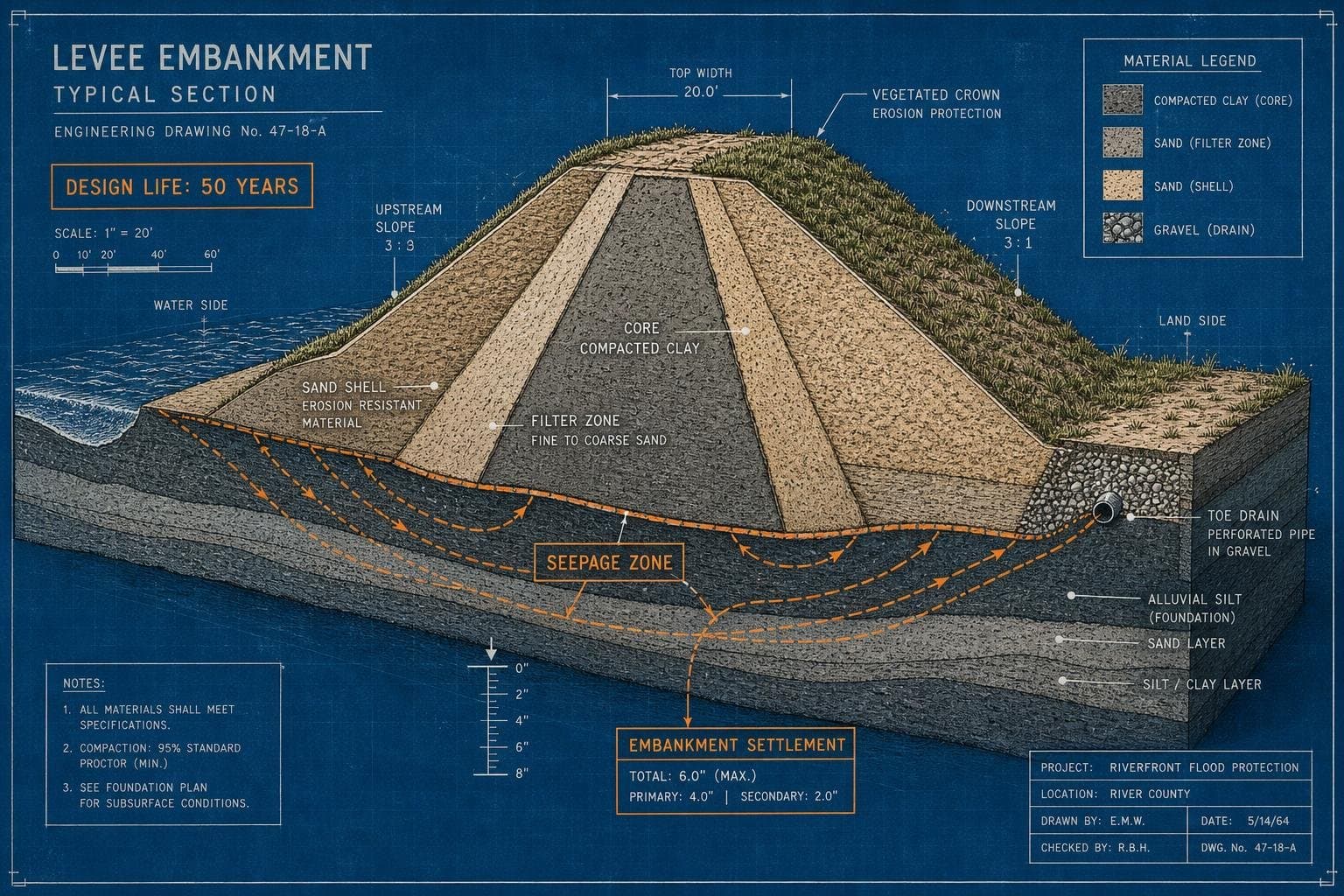

Three out of five levees in Pennsylvania lack a FEMA accreditation stamp. That sounds like a crisis until you understand what accreditation actually measures — and what it doesn't.
According to Penn State research cited by Hoodline, roughly 65% of Pennsylvania's more than 180 levees aren't FEMA-accredited, not because engineers have flagged them as unsafe, but because the communities that own them can't afford the engineering evaluations certification requires. That's a funding gap, not a structural verdict. Conflating the two is exactly the kind of error this newsletter exists to flag.
Accreditation Is a Paperwork Gate, Not a Condition Rating
FEMA accreditation determines whether a levee can be mapped as providing flood protection on official flood insurance rate maps. Losing or lacking that status pushes the properties behind the levee back into high-risk flood zones for mapping and insurance purposes — a designation that FludZone notes applies "even when a levee is otherwise functioning."
That's a different question from the one the U.S. Army Corps of Engineers asks through its own Levee Safety Program. Created in 2006 and now encompassing more than 14,000 miles of levees nationwide, the program runs structural assessments through the Inspection of Completed Works process and the Public Law 84-99 rehabilitation program, feeding results into the National Levee Database, according to USACE's St. Paul District. That's the inspection apparatus that actually evaluates embankment condition, seepage risk, and erosion — the engineering equivalent of a bridge inspection rating. FEMA accreditation, by contrast, is a separate certification process gating insurance maps, and its absence tells you about a community's engineering budget more than it tells you about the levee's margin against failure.
Pennsylvania's own numbers illustrate the gap. The state's levees protect an estimated $26.2 billion in property and about 158,000 residents, according to Army Corps data cited by geotechnical engineer Kaleigh Yost writing in The Conversation. Most were built between 1950 and 1970 under the Flood Control Act of 1936, designed to standards from six to eight decades ago. The levees were engineered to hold back a flood with roughly a 1% chance of occurring in any given year — the standard design threshold Yost describes — and most have now outlived the 50-year design life that standard assumes.
Age and Design Life Are a Warning, Not a Countdown Clock
Here's where I'd push back on the instinct to read "exceeded design life" as "about to fail." A 50-year design life is an engineering planning assumption, not an expiration date — the same way a D-rating on a bridge inspection means a structure needs attention and monitoring, not that it's about to collapse. What exceeding that design window actually signals is rising maintenance burden: more vegetation control, more seepage monitoring, more erosion repair, all on embankments that were never engineered with today's storm intensity in mind.
The problem is who's paying for that monitoring. Over 90% of Pennsylvania's levees are locally operated and maintained, per Yost's analysis, and she notes that rural communities with aging populations and shrinking tax bases are the ones struggling hardest to fund the vegetation management, seepage control, and embankment upkeep that keep an aging levee's safety margin from eroding alongside its soil. That's a maintenance funding problem layered on top of a certification funding problem — two distinct gaps that both trace back to the same scarce local budgets.
What Determines Whether This Gap Closes
The exposure here isn't abstract. The National Flood Insurance Program — the backstop that prices risk for the properties sitting behind these levees — required congressional reauthorization by September 30, 2026, according to FEMA. Properties mapped into high-risk zones because their levee lost accreditation depend on that program functioning. Watch whether Congress uses reauthorization as an opportunity to fund the engineering certification backlog directly, rather than leaving it to local sponsors who've already shown they can't close the gap alone.
The honest read is this: Pennsylvania's levees aren't a disaster story yet. They're an unfunded-inspection story and an unfunded-maintenance story running in parallel, on infrastructure whose original engineers assumed someone would keep paying attention past year fifty. Whether anyone does is a budget decision, not an engineering one.