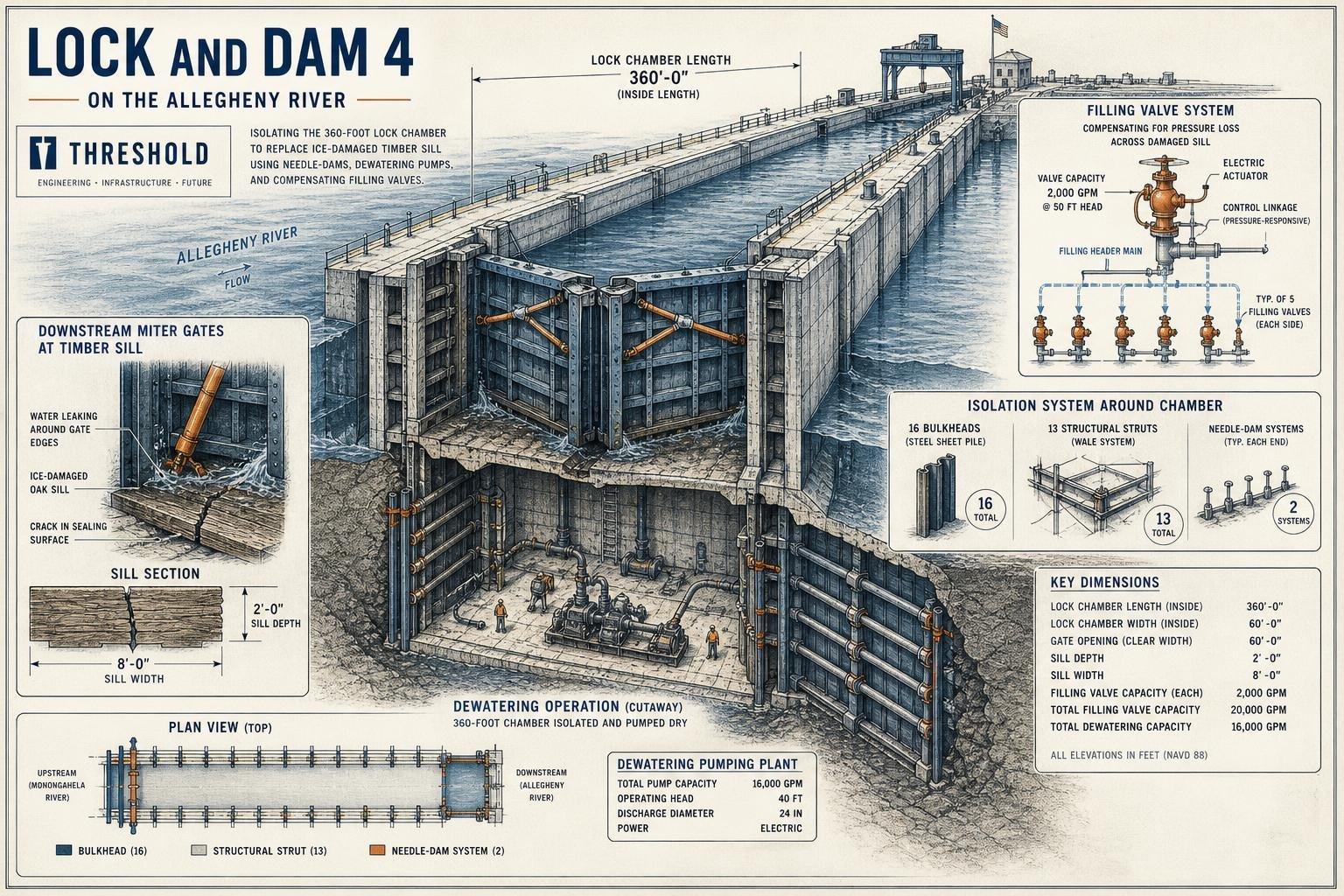

A single piece of wood closed an entire stretch of the Allegheny River to barge traffic. Not a cracked gate, not a failed hydraulic system — a timber miter sill, the sealing surface where the downstream lock gates meet the chamber floor, damaged by ice during a severe winter freeze earlier this year, according to DredgeWire. That's the kind of failure mode that doesn't show up in headlines about crumbling infrastructure, but it's exactly the kind of thing that determines whether a river stays open for commerce.
The Design Is a Century Old, and So Is the Vulnerability
American locks have used oak timber sills since the nineteenth century because the wood seals tightly against the gate and holds up under constant submersion, per the Corps' account of the Allegheny River Lock and Dam 4 repair, carried via EIN Presswire. That design worked for close to a hundred years until ice moving down the river this winter cracked the seal and let water escape around the gates. The lock kept operating, but the aging filling valves had to compensate for the leak — and if those valves had failed too, the chamber might not have been able to reach the correct water level at all, effectively shutting down navigation, the same account notes.
That's the risk calculus worth sitting with: not a single dramatic failure, but a damaged primary seal forcing worn secondary components to carry load they weren't sized for. And because Lock and Dam 4 has only one chamber, there was no alternate route for barges to use while it was fixed — a structural single point of failure built into the system a century ago, when redundancy wasn't the design philosophy it is today, as DredgeWire reported.
Fixing It Meant Pulling the River Out of the River
The repair itself is a good illustration of what "critical maintenance" actually costs in labor and logistics, even before materials enter the picture. The Corps' Medium Capacity Fleet — a Huntington District unit of divers, crane operators, and equipment specialists that travels between navigation facilities for major repairs — installed 16 bulkheads, 13 structural struts, and two needle-dam systems to isolate the 360-foot lock chamber before pumping out millions of gallons of water, per EIN Presswire's coverage of the operation. Divers worked near the dam's crest, where turbulent water made the valve bulkhead installation especially dangerous, Pittsburgh District project engineer Chris Smidl said. Water managers coordinated releases from eight upstream flood-control reservoirs just to reduce flows enough to make that diving work survivable.
None of that effort touches the actual sill repair yet — it's the setup cost just to get crews dry access to the problem. That's the part of lock maintenance that rarely makes it into a budget line item labeled simply "repairs": the dewatering, structural isolation, and reservoir coordination can dwarf the cost of the component actually being replaced.
The Pattern Isn't Limited to Navigation Locks
The Allegheny repair isn't an isolated case of a century-old Corps structure reaching a stress point. In North Carolina, Lock and Dam No. 1 on the Cape Fear River — also 111 years old and also an Army Corps structure — has a channel the current has carved into the riverbed underneath it, with the Corps warning that continued erosion could undermine the structure it supports, according to reporting by Autonoción. That structure isn't a navigation chokepoint the way Lock and Dam 4 is — it backs up water for drinking-water intakes serving Wilmington — but the underlying pattern is the same: a Corps-operated lock and dam built in the early twentieth century, now facing a condition serious enough that the agency has assigned one of its specialized in-house repair units, rather than routine maintenance scheduling, the same Autonoción report notes.
The Corps' deadline problems extend beyond physical repairs, too — the agency has also missed congressionally mandated reporting deadlines on how its dams in Oregon's Willamette Basin affect endangered fish, a slippage tribal representatives and environmental groups say is deepening the risk to already-threatened steelhead populations, according to the Albany Democrat-Herald. It's a different kind of backlog than a damaged timber sill, but it points to the same underlying strain: an agency managing thousands of aging water-control structures with workloads that consistently outrun its reporting and repair timelines, a tension that shows up across the Corps' infrastructure portfolio and in other large-scale water projects covered by outlets like Engineering News-Record.
What both lock cases share is this: the Corps doesn't appear to be waiting for catastrophic failure before acting. It's moving crews, dewatering chambers, and coordinating reservoir releases in response to specific, documented damage — ice-cracked seals, erosion channels — rather than general age. That's the useful distinction for anyone trying to read these stories correctly: a century-old structure isn't automatically a ticking clock, but when inspectors find an active failure mode, the response scales to match it, in money, personnel, and river closures.
The open question for barge operators and river communities isn't whether the Corps can respond to damage once it's found — both of these cases show it can, with real resources. It's how many single-chamber locks like Number 4 are still out there with no redundancy built in, waiting on inspectors to catch the next damaged sill before ice does the same thing somewhere else.


