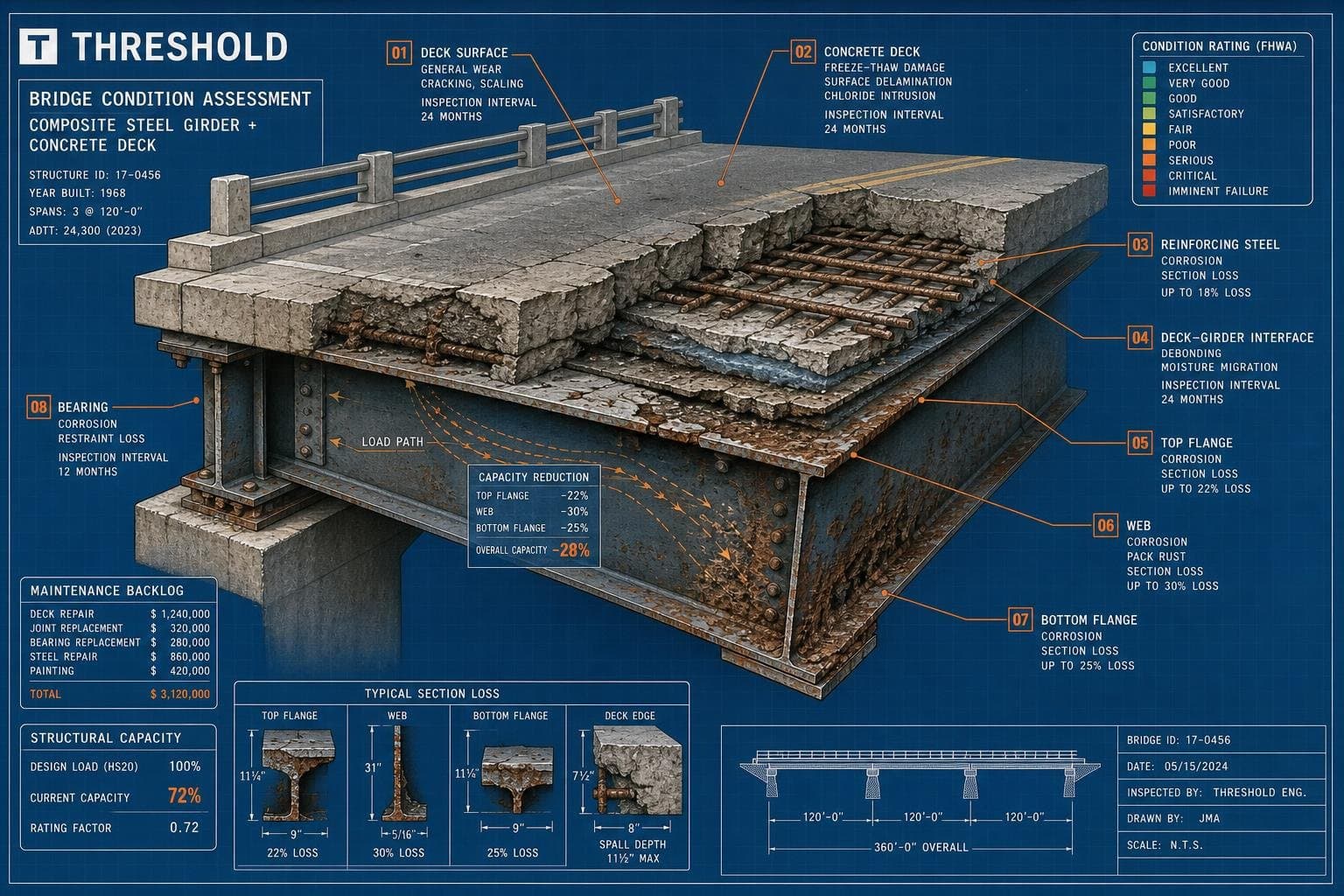

One out of every nine bridge crossings in Massachusetts happens on a bridge rated in poor condition. Not structurally failed. Not closed. But poor — the kind of rating that means the clock is running, maintenance is overdue, and the margin between acceptable and urgent is narrowing with every winter freeze cycle.
That number comes from the 2026 Report Card for Massachusetts' Infrastructure, released last month by the Boston Society of Civil Engineers Section. The report assigned Massachusetts bridges a D+ — two full letter grades below the national C — and identified the state as holding the oldest bridge inventory in the country, with a median age of 65 years. More than 500 bridges statewide either carry weight restrictions or are closed entirely.
The D+ grade doesn't mean those bridges are about to fall. As I've written before, inspection grades and failure risk are different variables. A D-rated structure can remain serviceable for years under active monitoring. The problem is what happens when the monitoring itself falls behind.
The Backlog Is the Risk Variable
The assigned topic this week is inspection backlogs — and the Massachusetts data gives that problem a concrete address. The ASCE report finds that bridges are deteriorating faster than they can be repaired, which is a maintenance problem. But embedded in that finding is an inspection problem: when the workforce isn't large enough to execute all necessary projects, assessment cycles stretch, and the gap between a bridge's actual condition and its last documented condition widens.
That gap is where risk accumulates. An inspection rating is a snapshot. The older the snapshot, the less it tells you about current load capacity, current corrosion extent, or current bearing condition. A bridge rated fair in 2022 and re-inspected in 2026 has four years of thermal cycling, freeze-thaw damage, and traffic loading that the rating doesn't capture. The inspection interval is the risk variable — a point I covered in the June 9 issue in the context of dam safety, but the logic applies identically to bridges.
The ASCE report is direct about the workforce constraint: sustained, predictable investment is needed to expand an engineering workforce that is currently not large enough to carry out all necessary projects. That's not a funding problem alone — it's a capacity problem. You can appropriate money for inspections and still not have enough qualified inspectors to run them on schedule.
What the Morandi Verdict Adds to This Conversation
The legal dimension of deferred inspection is no longer theoretical. An Italian court recently convicted 32 individuals in connection with the 2018 Morandi Bridge collapse in Genoa, with former Autostrade per l'Italia CEO Giovanni Castellucci receiving a 12-year sentence. According to Engineering News-Record's coverage, the court assigned responsibility across inspection, design, and management functions — meaning the legal exposure wasn't limited to engineers who missed a crack, but extended to executives who oversaw the systems that were supposed to catch it.
That's a significant shift in how accountability gets distributed. The Morandi collapse killed 43 people and has become the reference case for what happens when inspection regimes fail on aging cable-stayed infrastructure. The convictions signal that "we had an inspection program" is not a sufficient defense if that program was inadequately resourced or systematically ignored.
Massachusetts isn't Genoa. But the structural conditions — aging inventory, funding shortfalls, workforce constraints — rhyme closely enough to make the Italian verdict worth reading carefully.
The $1 Billion Number Needs a Definition
MassDOT estimates approximately $1 billion annually over the next decade is needed to address the growing inventory of aging bridges and clear the maintenance backlog. The Boston Globe's coverage of the report confirms this figure, framing it against a broader picture of climate stress — the February blizzard, summer flash floods — that is actively accelerating deterioration on infrastructure not designed for current weather patterns.
That $1 billion figure, per the ASCE report, represents the annual funding gap — the difference between what's being spent and what's needed. It does not appear to represent total project cost inclusive of contingency and design fees; the report characterizes it as an annual investment requirement. That distinction matters when comparing it against actual appropriations, which the report does not break out in the available excerpts.
What the number does tell you: the gap is large enough that incremental budget increases won't close it. Closing a $1 billion annual shortfall requires a structural change in how Massachusetts funds bridge maintenance — not a one-time infusion, but a predictable, multi-year commitment.
The inspection backlog and the funding backlog are the same problem expressed in different units. One is measured in overdue assessments; the other in dollars. Both are growing. And in Massachusetts, they're growing on the oldest bridge stock in the country.
Watch for MassDOT's next capital investment plan update, which will be the clearest signal of whether the state intends to treat the ASCE grade as a call to action or a data point to acknowledge and file.


