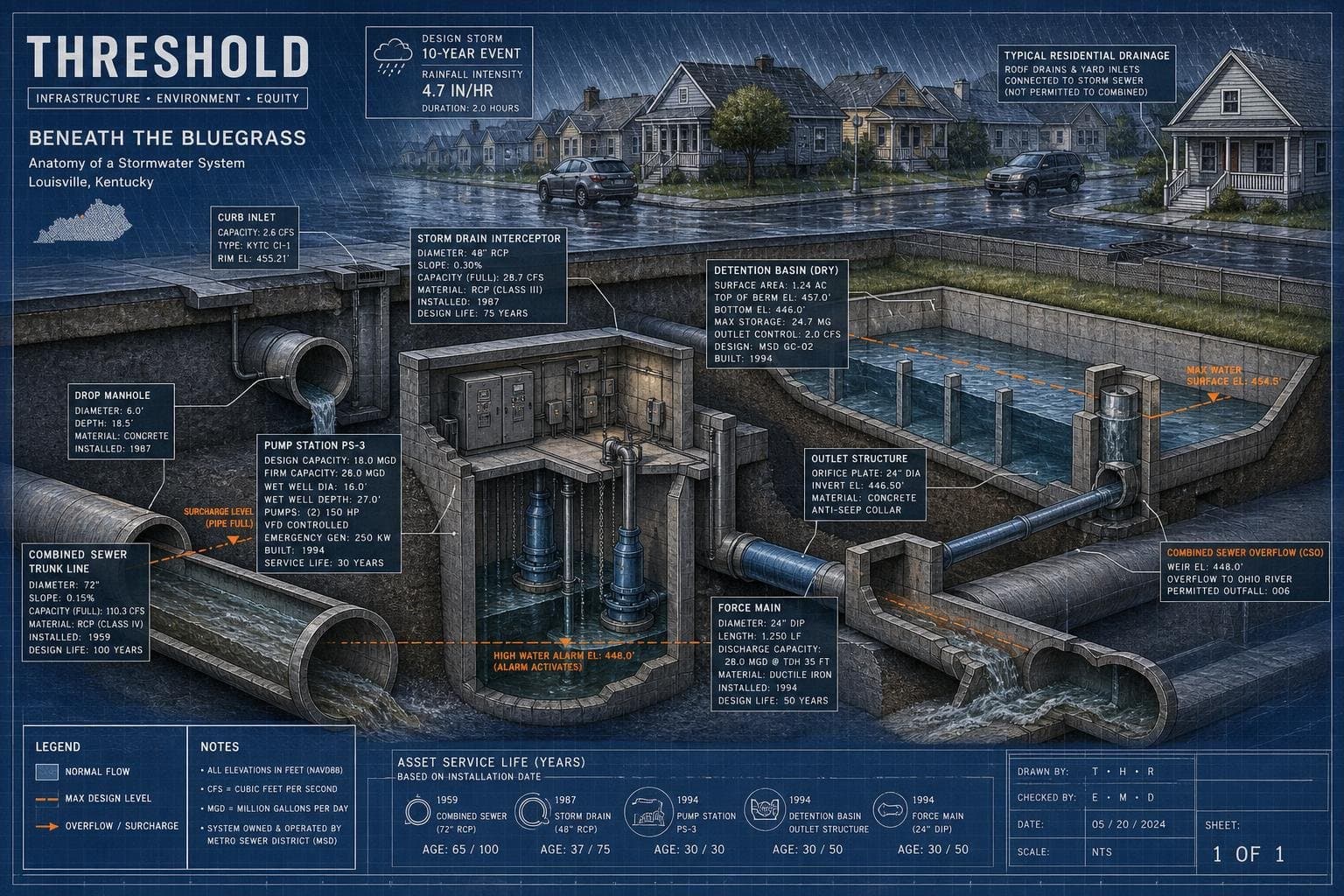

Most infrastructure report cards bury their worst news in the middle of the alphabet. Kentucky's latest didn't. Stormwater systems came in at a D-minus — the lowest mark in the state's entire infrastructure portfolio, below even the D-plus grades handed to levees and dams, according to the American Society of Civil Engineers' first Kentucky assessment since 2019 (Louisville Courier Journal, via Yahoo). The report draws on government data and input from state and local agencies, and it frames the grade around a specific mechanism: stormwater infrastructure is what stands between a heavy rain event and a flooded neighborhood, and Kentucky's version of that infrastructure hasn't kept pace with either the storms or the growth sitting on top of it.
That's the engineering story worth sitting with. Stormwater capacity isn't a single pipe or a single pump — it's a distributed network of culverts, detention basins, storm drains, and pump stations, each sized decades ago against rainfall assumptions that extreme weather has since outrun. A D-minus doesn't mean the system is actively failing today. It means the margin between what the system was built to handle and what it's now asked to handle has shrunk to a level the engineers assessing it consider inadequate, with no near-term funding path identified to close that gap.
The Flooding Doesn't Wait for the Grade to Improve
The Kentucky report frames this as cumulative: repeated disasters "have impacted water and wastewater systems, damaged roads and bridges, strained energy infrastructure" in a pattern the ASCE calls unsustainable if recovery stays purely reactive (Courier Journal, via Yahoo). That's not rhetoric — it's a capacity argument. Every storm that exceeds a system's design threshold either overwhelms the pipes directly or forces a cascade into whatever system sits downstream of it, which in a lot of American cities is a combined sewer.
Carter Lake, Iowa offers a smaller-scale version of the same vulnerability, and it's instructive because it isn't about pipe diameter at all. The town's stormwater and sewage system relies on gravity until water levels get too high, at which point it needs electric pump stations to keep sewage from backing into homes. A June 2024 windstorm knocked out power townwide, and the city just secured roughly $491,675 in FEMA hazard mitigation funding to replace 11 backup generators that are already at the end of their 20-to-30-year service life (KETV). The lesson generalizes: a stormwater system's actual failure point is often not the concrete infrastructure but the single point of electrical dependency that keeps it running when it matters most.
What Proactive Capacity Investment Actually Looks Like
Contrast that with New York City's $35.7 million North End Recirculation System, which broke ground in Central Park and represents the kind of stormwater investment most underfunded systems never get to make (Engineering News-Record). The project links three park water bodies through new pumping, filtration, and conveyance infrastructure, and the city's projected performance figures are specific: it's designed to keep an estimated 132 million gallons of water annually out of local combined sewers, conserve 175 million gallons of drinking water, and cut stormwater flows from a managed 204-acre portion of the park into the sewer system by 90% — figures the city and Central Park Conservancy describe as projected once the system is operating, not yet measured results. The project works by creating storage capacity ahead of storms, essentially buying the downstream combined sewer system time and volume headroom it wouldn't otherwise have.
That's the tradeoff stormwater funding debates usually skip past. $35.7 million buys one park's worth of runoff capacity in one of the best-funded cities in the country. Pennsylvania's parallel approach — $190.3 million in PENNVEST funding spread across 24 drinking water, wastewater, and non-point source projects statewide, financed through a mix of state bond funds and federal IIJA and EPA dollars — spreads thinner money across far more infrastructure (American Infrastructure). Neither figure tells you what a state the size of Kentucky would need to move its stormwater grade off a D-minus, but the EPA's own framing of the national water infrastructure funding programs — the Clean Water State Revolving Fund among them — makes clear that this financing model was designed as a supplement to local capital budgets, not a replacement for them (EPA).
The Grade Is a Snapshot. The Rainfall Isn't.
A D-minus doesn't predict the next flood. It describes a system whose design margin has narrowed faster than its funding has grown — a gap that shows up first in the places with the least capacity to absorb a bad storm, whether that's a generator at the end of its service life in a small Iowa town or a stormwater main sized for rainfall patterns that no longer apply. Watch whether FEMA's FY2026 Pre-Disaster Mitigation funding — $189.7 million allocated across 125 congressionally directed projects, most of them flood-focused — actually reaches the stormwater systems carrying the worst grades, or whether it keeps flowing, as it often has, toward the disasters that already happened (FEMA).


