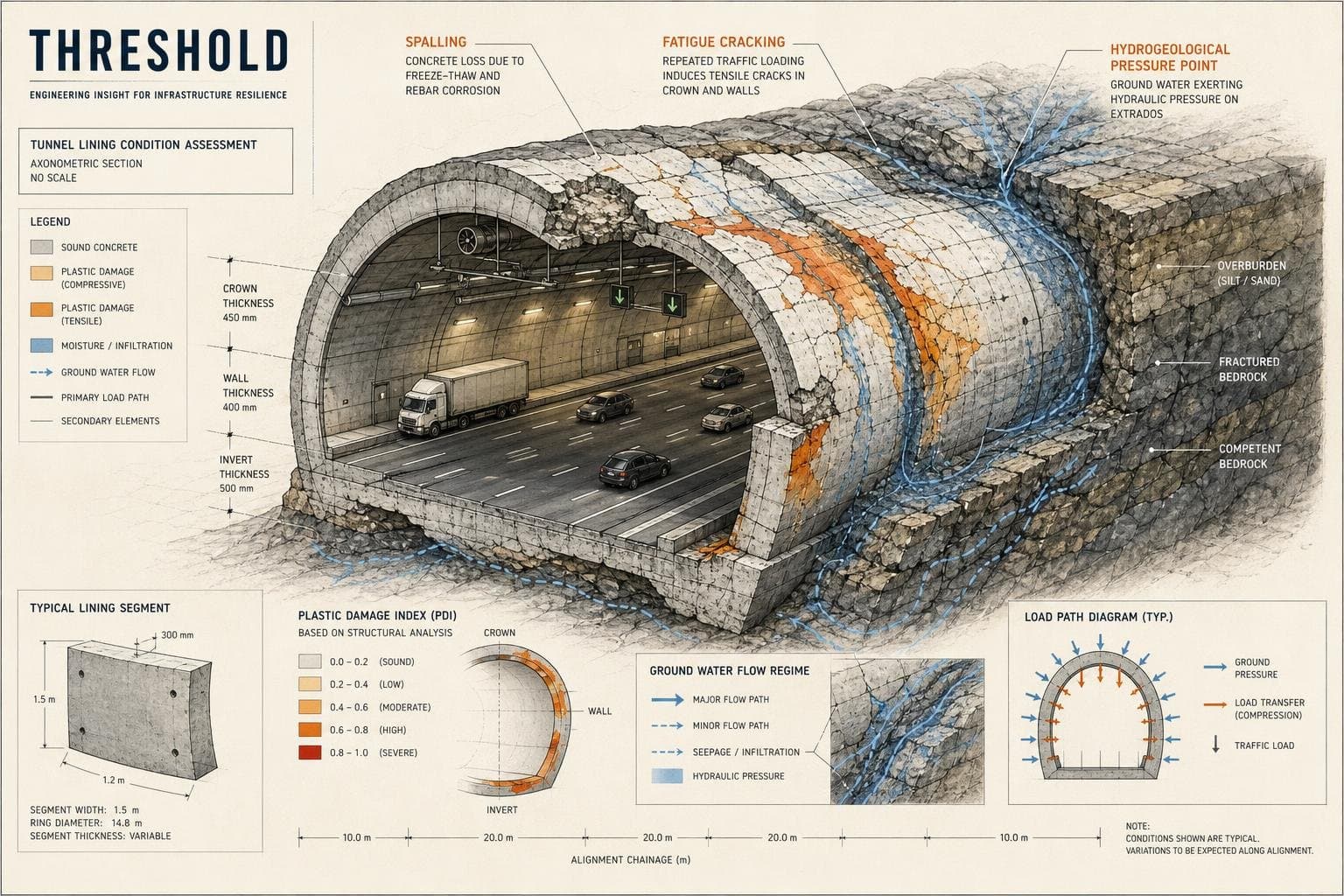

Bridges get a letter grade every four years. Roads get a letter grade. Tunnels, the structures where a structural failure traps people underground instead of just closing a lane, don't show up as their own category in the 2025 Report Card for America's Infrastructure. They're inspected under a separate federal framework — the National Tunnel Inspection Standards, which sit alongside the better-known National Bridge Inspection Standards in Title 23 of the Code of Federal Regulations, as Illinois DOT's bridge and tunnel inspection program lays out. Illinois trains and certifies separate rosters of bridge inspectors and tunnel inspectors, which tells you something: tunnel condition assessment is its own discipline, with its own failure modes, and it doesn't map cleanly onto the "D" and "C" ratings that dominate the national conversation about roads and bridges.
What fatigue actually looks like in a tunnel lining
A bridge deck cracks and spalls in ways engineers can inspect with a hammer and a flashlight. A tunnel lining deteriorates under something harder to see directly: repeated cycles of ground and traffic-induced stress acting on concrete or rock that's already lost strength to age and moisture. A 2026 study in Applied Sciences modeling deteriorated tunnel linings under prescribed cyclic stress changes found that as surrounding-rock deterioration moved from 20% to 30% in their simulations, the lining's plastic-zone fraction — essentially, the share of material that has passed from elastic deformation into permanent damage — increased more sharply than it did at lower deterioration levels. That's a threshold effect, not a straight line, and it matters for inspection scheduling: a lining that looks stable at one interval can cross into a faster-deteriorating regime before the next scheduled check if the interval is wrong. The researchers frame this as a relative-comparison tool for reconstruction planning, not a universal failure clock, and that caveat matters — this is a laboratory and numerical study, not a field-validated timeline for any specific operating tunnel.
The monitoring side of the problem is just as granular. A separate 2026 paper on intelligent safety-control systems for tunnel construction near heritage structures describes a risk-assessment framework built on four primary risk dimensions and sixteen secondary indicators, which classified one monitored tunnel section as "orange" — major risk — based on hydrogeological conditions. That's a construction-phase monitoring system, not an inspection standard for operating highway tunnels, but it illustrates the same underlying point: tunnel risk isn't a single number. It's a composite of ground conditions, lining condition, and load history, and the industry is still building the instrumentation to track all three continuously rather than through periodic spot checks.
The funding fight tunnels are competing in
Here's where the ventilation-upgrade question actually connects to money, even without a tunnel-specific cost figure to cite. ASCE's 2025 report card found the nation's bridges holding at a C grade and roads improving only to a D+, with an estimated funding gap of $684 billion for roads and $373 billion for bridges over the next decade. Tunnels draw from the same state DOT capital programs that roads and bridges compete for, and in states where the underlying inventory is aging the fastest, that competition gets sharper. South Carolina's 2026 state report card is instructive here even though it doesn't isolate tunnels: bridges there actually slid from a C to a C- as the inventory ages, even as roads improved from D to D+ on the back of new investment. When a state's bridge grade moves backward while its road grade moves forward, that's a signal about where political attention and capital are flowing — and tunnel ventilation, fire-life-safety, and lining rehabilitation work, which is expensive, invisible to drivers, and doesn't generate ribbon-cuttings, is exactly the kind of maintenance category that loses that competition by default.
What to watch
The honest version of this story is that nobody has published a national tunnel-specific report card with the kind of D/C granularity ASCE applies to roads and bridges — which means the public conversation about tunnel fatigue and ventilation adequacy is running well behind the research on how these structures actually deteriorate. Watch for whether ASCE's next infrastructure report card cycle breaks tunnels out as their own category, the way it already separates dams, drinking water, and wastewater. Until it does, tunnel condition will keep getting assessed state by state, inspector by inspector, with no single number for taxpayers to hold anyone accountable to.


