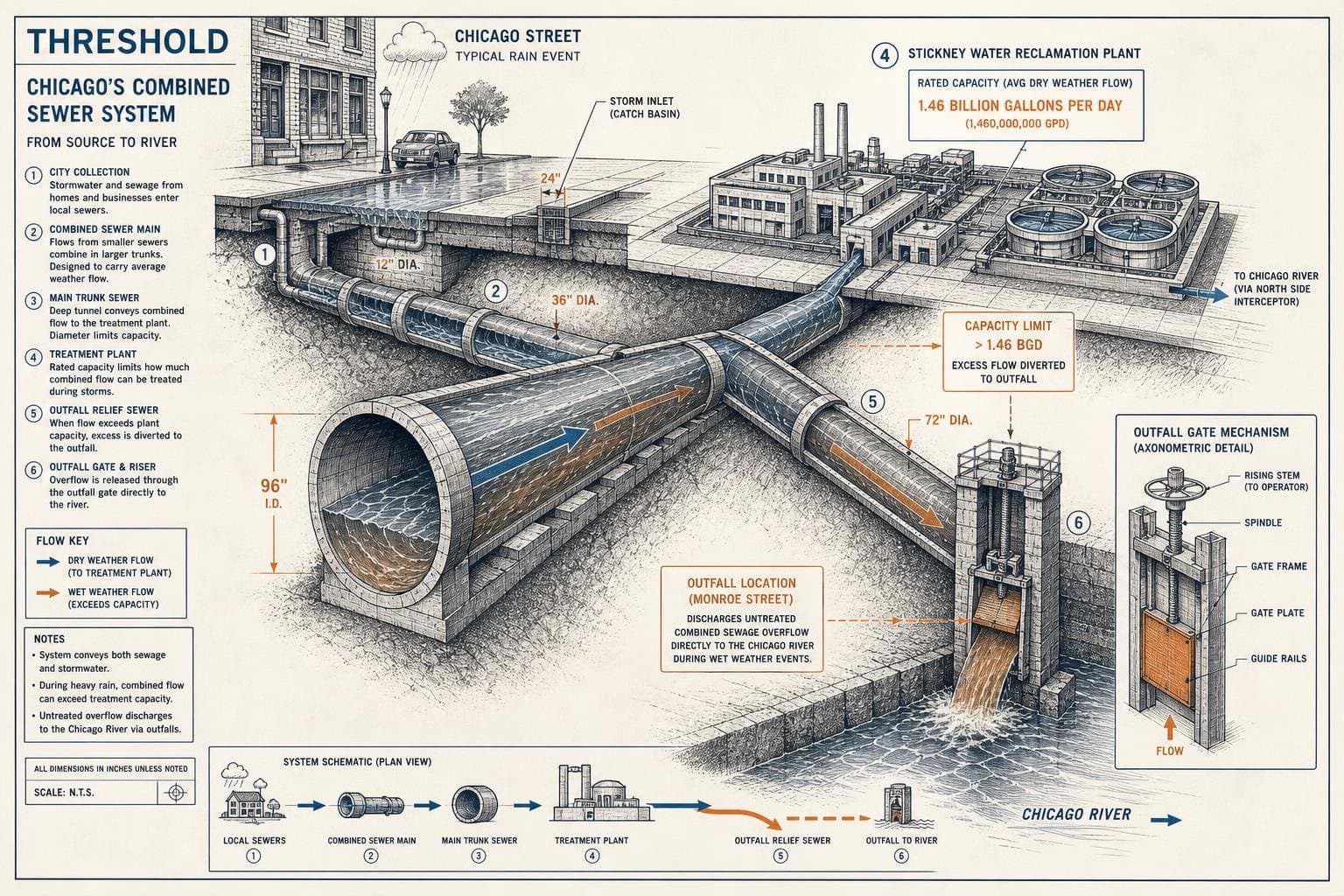

Chicago's Bubbly Creek had eight combined sewer overflow events this summer — the most since Urban Rivers began tracking the area in 2022, according to research director Phil Nicodemus (via Block Club Chicago). Between July 2 and July 5 alone, the Metropolitan Water Reclamation District of Greater Chicago logged 42 combined sewer overflow events across the county (Block Club Chicago). That's not a maintenance backlog. That's a system doing exactly what it was designed to do — which is the problem.
The Design Isn't Broken. The Design Is the Overflow.
Combined sewer systems carry stormwater and sewage in the same pipe. When rain volume exceeds what the treatment plant can process, the system is built with relief points — outfalls that dump the excess, untreated, directly into the nearest river. That's not a failure mode engineers are scrambling to patch. It's the original spec, dating to an era when "dilution is the solution" counted as sound sanitary engineering. New York's Department of Environmental Conservation notes that nearly 65% of sewers over 60 years old experience overflow events, and that roughly 40% of the state's 35,000+ miles of sewer are already past that age threshold (NYSDEC). The infrastructure isn't degrading into overflow behavior. It's aging within a design envelope that assumed overflow as the release valve.
The consequence in Chicago is visible and specific. Combined sewer overflows there carry oil, road salt, pesticides, and bacteria into the river, and Nicodemus describes watching fish surface or leap out of the water chasing oxygen after a discharge event — a direct sign of the dissolved-oxygen crash that follows an overflow and subsequent algae bloom (Block Club Chicago). The city's annual Chicago River Swim was canceled at the last minute this year partly over water quality concerns tied to the same pattern (Block Club Chicago).
What Fixing It Actually Costs — and What You Get for It
The honest counter-example is Alexandria, Virginia. The RiverRenew tunnel project replaced sewers dating to the 1800s with a 2.2-mile, 130-foot-deep storage and conveyance tunnel plus a dewatering pump station rated at 180 million gallons per day of wet-weather treatment capacity (Engineering News-Record). The project's own reported numbers: annual overflow volume into local waterways dropped from roughly 140 million gallons to under 16 million, and the frequency of overflow events fell from about 70 per year to fewer than four (Engineering News-Record). ENR reports the project came in on budget and on schedule despite pandemic-era cost increases, though the trade publication doesn't break the total figure down into labor, materials, and design shares — so treat that "on budget" claim as a schedule-and-cost-discipline outcome, not a line-item breakdown you can compare dollar-for-dollar against other cities.
That's the real tradeoff curve for combined sewer systems: a tunnel-and-storage approach can cut overflow frequency by an order of magnitude, but it requires deep tunnel boring, drop shafts, and a pump station sized in the hundreds of millions of gallons per day — civil works on the scale of a subway project, not a pipe replacement. Chicago's system, by contrast, is still absorbing storm volume the old way, and this summer's rain pattern pushed it past what Urban Rivers has observed in four years of monitoring.
Real-Time Control Is the Cheaper Lever, With Limits
Not every city can fund a RiverRenew-scale tunnel. A September 2026 peer-reviewed review in Water Science & Technology looked at real-time control (RTC) systems — software and sensors that actively manage flow and storage within existing pipe networks rather than building new capacity. The researchers distinguish volume-based RTC, the dominant approach in practice today, from pollution-based RTC, which research has shown can achieve greater reductions in pollutant load reaching rivers — though the review's authors note adoption of the pollution-based method remains limited because there's no standardized methodology yet for evaluating its benefits at full scale (IWA Publishing/Water Science & Technology). In plain terms: cities can often get meaningful overflow reduction by operating the pipes they already have more intelligently, but the tools to measure and deploy the pollution-reducing version of that approach aren't mature yet.
South Carolina's 2026 infrastructure report card, for context, graded the state's wastewater systems a D — a reminder that combined sewer overflow is one symptom within a broader category of underfunded wastewater infrastructure, not an isolated defect (ASCE).
The number to watch isn't a grade. It's event frequency per storm season, tracked the way Urban Rivers is tracking Bubbly Creek — because that's the only metric that tells you whether a city's combined sewer system is losing ground to the rain it's actually getting, not the rain its spillways were sized for decades ago.


