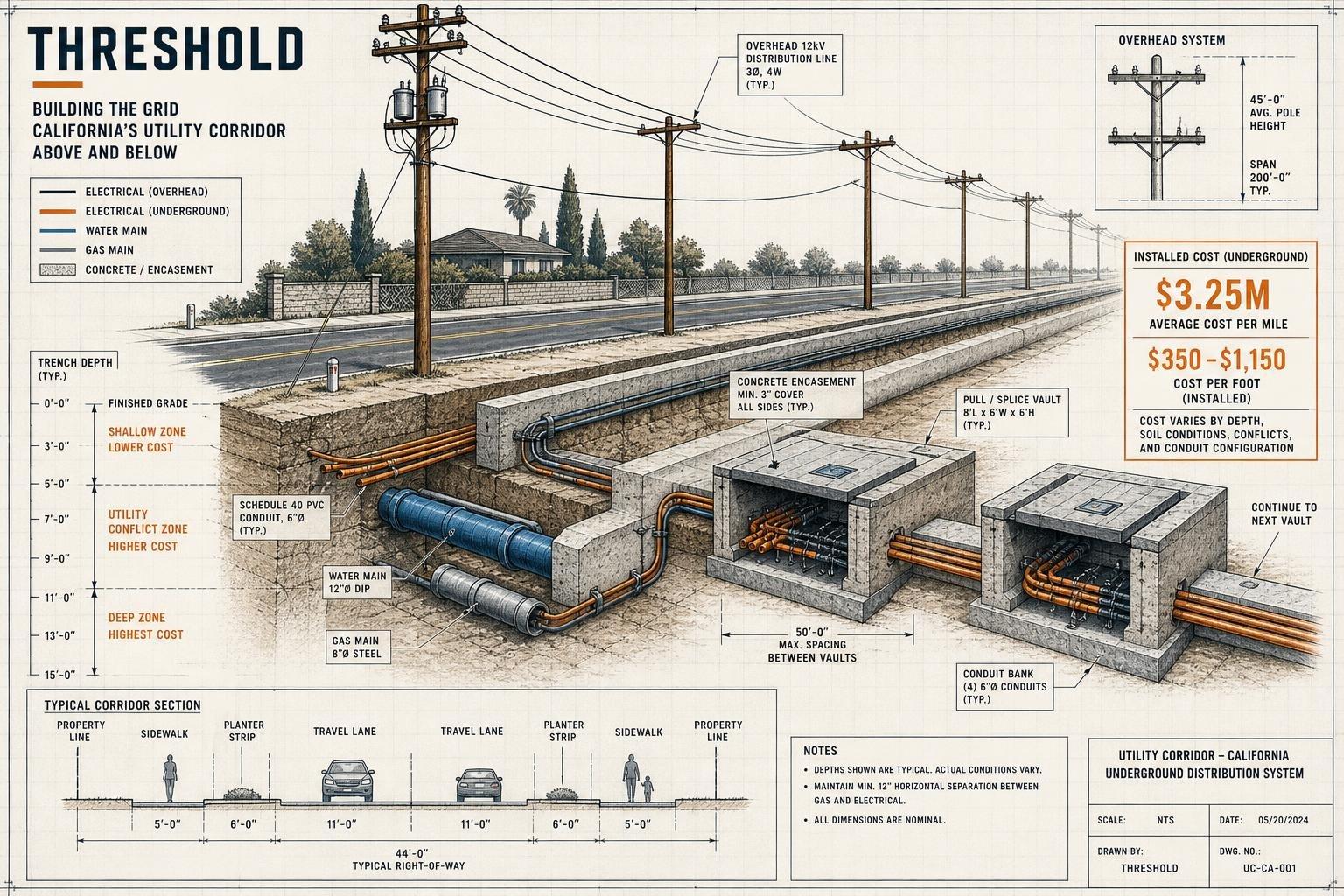

PG&E wanted to bury 5,000 miles of power line over the next decade. California regulators just told the utility it can count on roughly 1,100 of those miles for cost recovery — a fifth of the ask (PG&E). That gap is the whole story of wildfire mitigation economics right now: undergrounding works, but it's expensive enough that regulators are forcing utilities to prove it's worth more than the alternative, mile by mile.
The Decision That Actually Changes the Calculus
The California Public Utilities Commission adopted new rules on Nov. 19, 2026, implementing SB 884, the law that set up a voluntary, expedited 10-year undergrounding program for PG&E, Southern California Edison, and San Diego Gas & Electric (EnerKnol). The rules don't ban undergrounding. They require utilities to run every proposed project through a standardized benefit-cost methodology and show it beats the most effective alternative — covered conductors, advanced protection settings, or straight vegetation management — for that specific stretch of line (CPUC). Projects also get independent audits and must be checked against updated cost forecasts once they're fully engineered, not just the rough estimates filed at proposal stage.
That's a real procedural shift. Before this, a utility could propose a 10-year plan and argue the wildfire case qualitatively. Now the burden is quantitative: prove the benefit-cost ratio clears the bar against whatever cheaper option exists for that circuit. PG&E's own numbers show why that bar matters. The utility says undergrounding permanently cuts wildfire ignition risk on buried circuits by about 98% and cuts outages on those same lines by about 90% (PG&E). Those are strong numbers. They're also expensive numbers, and the new framework is built to ask whether a cheaper intervention gets you 70% of the risk reduction for 20% of the cost.
What a Mile Actually Costs, and Where the Money Goes
California regulators put the per-foot cost of undergrounding distribution lines at roughly $350 to $1,150, which works out to something between $1.85 million and $6.07 million a mile (Genius Energy). PG&E's own trajectory inside that range tells you the program is maturing: it reported averaging about $4 million a mile when the undergrounding effort started in 2021, closer to $3 million by 2023, and roughly $3.25 million a mile over the last three years, with a target near $2.8 million going forward (Genius Energy).
The reason it costs that much has almost nothing to do with cable. Civil work — trenching, boring under driveways and roads, conduit, vaults, pavement and landscape restoration — runs 75% to 90% of the total project cost. The electrical equipment itself is the cheap part. That's also why the number swings so hard between a new subdivision with clear ground and an old street where gas, water, and fiber are already down there competing for the same trench (Genius Energy). It's worth being precise about what these figures include and don't: this is project cost per mile for burying the line, not a comparison against vegetation management's annual recurring spend, which is a different kind of expense entirely — ongoing labor and tree removal rather than one-time capital construction.
There's a reliability trade embedded in the undergrounding bet that doesn't show up in the ignition-risk headline. Buried cable is not exposed to wind, falling limbs, or ice loading, so outages happen less often. But when a buried fault does occur, locating and repairing it takes substantially longer than swapping out a snapped crossarm on an overhead line (Genius Energy). Fewer outages, longer ones. That's not a flaw in the engineering — it's the physics of digging up a trench versus climbing a pole.
Scale Explains Why the Debate Isn't Going Away
The underground share of U.S. distribution lines has crept from about 18% in 2009 to roughly 20% by 2023, out of an estimated 5.5 million miles of distribution line and more than 180 million poles nationwide (Genius Energy). Florida Power and Light runs about 45% of its distribution system underground and puts roughly 90% of new construction below ground — but that's new-build economics in flat terrain, not retrofit economics in California's fire-threat tiers (Genius Energy). PG&E has completed 1,500 miles since 2021 and says it has avoided hundreds of millions of dollars in tree-trimming and maintenance on those circuits (PG&E) — the clearest evidence yet that undergrounding and vegetation management aren't simply competing line items, they're substitutes whose relative value depends entirely on terrain, tree density, and how long the utility expects to hold the circuit.
Watch the next nine months closely. Under the adopted framework, the CPUC must review each utility's 10-year plan and set cost-recovery conditions within that window, and PG&E's reduced 1,100-mile allocation is the number to track against its original 5,000-mile filing as implementation moves forward (CPUC). The benefit-cost ratio methodology adopted this month will decide, circuit by circuit, whether burying the line or just cutting back the trees wins the argument.