



Two weeks ago I wrote about what ASCE's grading scale actually measures. This week, let's get more specific — because the most misread number in American infrastructure isn't a cost estimate or a failure probability. It's the bridge condition rating sitting in the National Bridge Inventory for a structure you probably drove over this morning.
The Rating System Isn't Grading Danger — It's Grading Condition
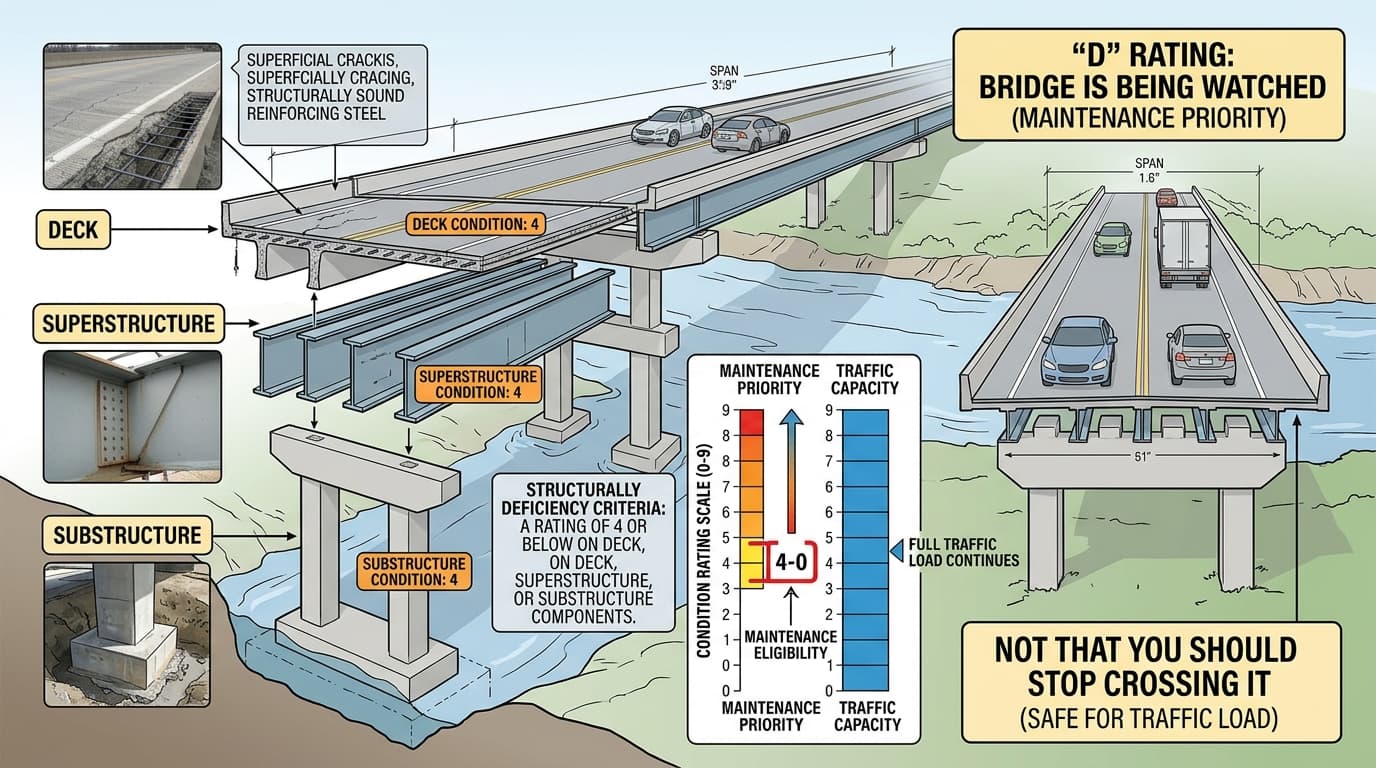
The federal government requires inspection of every bridge on public roads at least once every two years. Inspectors assign numerical ratings from 0 to 9 across three primary components: the deck (the surface you drive on), the superstructure (the beams and trusses carrying the load), and the substructure (the piers and abutments holding everything up). A bridge earns the label "structurally deficient" when any one of those components scores a 4 or below.
That label does a lot of damage in headlines. "Structurally deficient" sounds like "about to fall." It isn't. Per the National Bridge Inventory framework cited by the Reason Foundation, a structurally deficient designation makes a bridge eligible for federal repair funding — it's a maintenance priority flag, not a condemnation notice. A bridge rated 4 on its deck has deterioration that needs attention. It may carry full traffic loads for years while that work is planned and funded.
The ASCE 2025 Report Card upgraded America's overall infrastructure grade to a C — a signal that the inspection and investment system is functioning well enough to catch problems before they cascade, not that the problems are gone.
What the rating system is actually telling you: where the deterioration is, how severe it is, and how much time the maintenance window has left. A 4 is a warning. A 2 is a crisis. The difference matters enormously, and most coverage collapses them into the same alarm.
The Gap Between "Deficient" and "Closed" Is Where the Real Work Happens
Oregon's DOT publishes one of the more transparent bridge condition reports in the country. The 2025 ODOT Bridge Condition Report tracks changes in NBI ratings across the state's inventory and documents the agency's key performance measures — including load rating programs that determine whether a bridge's posted weight limits are still appropriate for current traffic.
That load rating piece is where the engineering gets interesting. A bridge can carry a lower condition rating while still meeting its load requirements — because the rating reflects surface and structural deterioration, not necessarily remaining load capacity. Engineers recalculate load ratings as conditions change. When a bridge can no longer safely carry its posted limits, that's when weight restrictions go up or the structure closes. The condition rating is an input to that calculation, not the output.
The practical implication: a D-rated bridge with current load ratings and active monitoring is a managed asset. A B-rated bridge with outdated load calculations and deferred inspections may be the more dangerous structure. Grade alone doesn't tell you which one you're on.
Newport's Dams Are the Cleaner Illustration of This Principle
The bridge rating system's logic — condition flag, investigation, managed timeline — applies across infrastructure categories, and the contrast is sharpest when you look at a case where the managed timeline is running out.
Newport, Oregon's Big Creek Reservoir dams offer exactly that. The lower dam was built in 1951, the upper in 1969; both are earthen structures holding approximately 56 million and 270 million gallons respectively. In 2023 they were rated the highest-hazard dams in Oregon. The critical issue isn't age — it's seepage discovered in 2019 in the upper dam's spillway, seepage that could cause failure without any seismic event at all. The foundational soils underneath both structures have seismic vulnerabilities that weren't understood when the dams were built to the standards of their era.
The city has been conducting community tours, posting warning signs, and working toward a long-term fix. But as of this week, that fix remains undetermined.
That's the difference a rating system is supposed to prevent: a condition flag in 2019, seven years of managed uncertainty, and still no resolved engineering path. The flag worked. The response timeline is the problem.
Bridge condition ratings are a maintenance scheduling tool that got drafted into service as a public safety communication system — and they're not well-suited for the second job. A 4 on a deck component means "fund the repair." It doesn't mean "call your congressman." The number you actually want to know is the load rating, and whether it's been recalculated recently. Watch for state DOT load rating program updates — Oregon's are published annually — as the more honest signal of whether a flagged bridge is still being actively managed or quietly drifting toward a harder conversation.