
The FAA just hit a milestone that sounds like progress: more than 2,000 new air traffic controllers hired after a spring recruiting campaign that targeted video gamers, meeting 94% of its hiring goal, with another 2,000 candidates in the pipeline. Transportation Secretary Sean Duffy announced the numbers in August. The headlines were celebratory.
The math is less so.
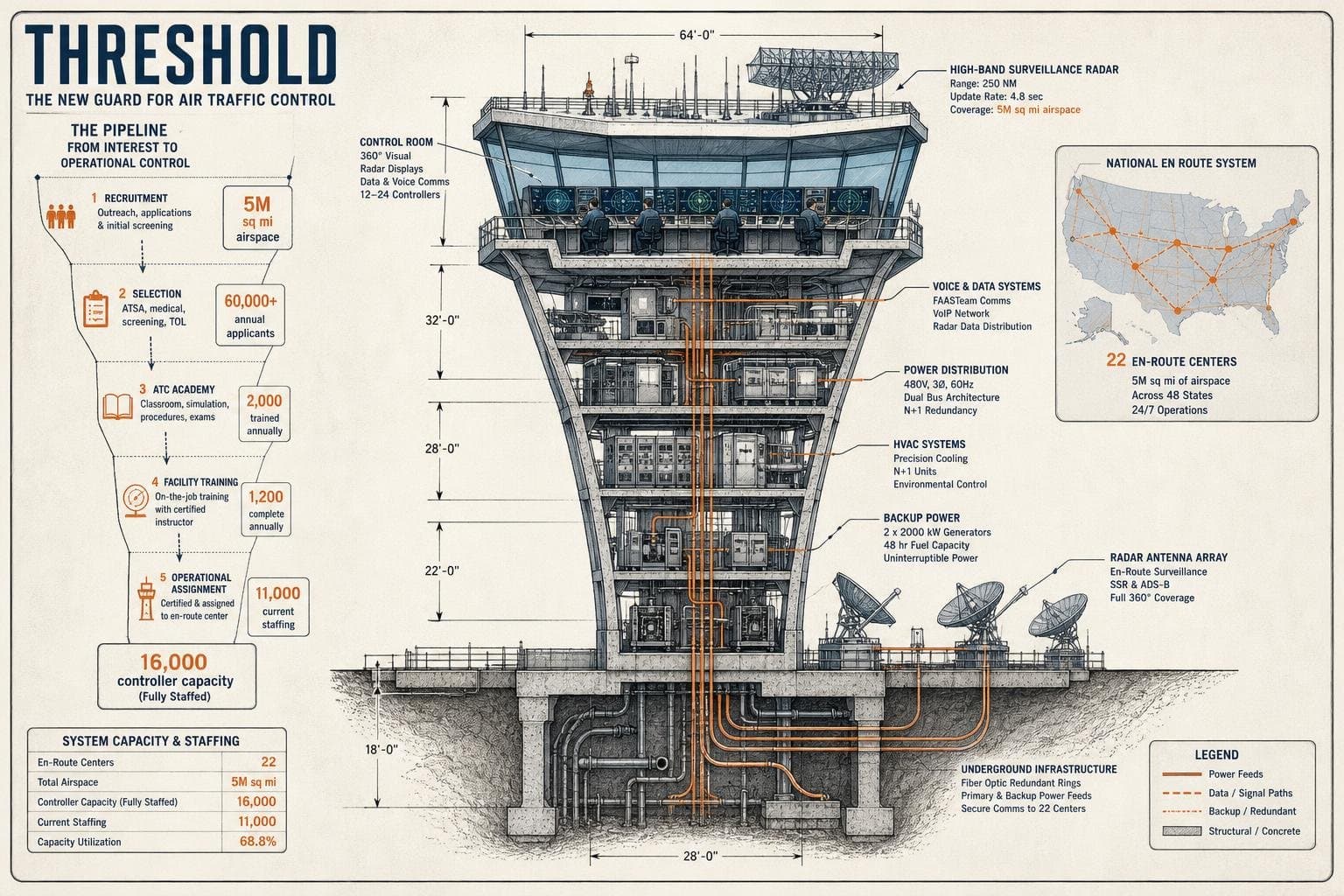
When I covered the FAA's staffing gap in May, the agency was running roughly 11,000 certified controllers against a stated need of around 16,000 — a shortfall of approximately 5,000 positions. Two months later, I noted the agency had lowered its own targets and was still missing them. Now, 2,000 recruits into a new hiring push, the structural problem hasn't changed. What's changed is the visibility of the bottleneck.
Hiring Is the Easy Part
The video gamer recruitment angle is genuinely clever. Skills like pattern recognition, multitasking under pressure, and spatial awareness do map onto what controllers do — tracking dozens of aircraft simultaneously in three-dimensional airspace. The Transportation Department's April campaign, complete with a YouTube ad set to electronic music and clips from Fortnite, reached a demographic that hadn't historically considered federal aviation careers.
But recruitment is the widest part of the funnel. The narrow part is what happens next.
According to an opinion piece in The Hill by University of Illinois professor Sheldon H. Jacobson, only about 10% of all applicants ultimately meet the eligibility requirements — age under 31, U.S. citizenship, and an extensive list of security and medical thresholds — and enroll in the training program. That's before a single hour of actual controller training. The attrition doesn't stop there: the pathway from enrollment to full certification is long, technically demanding, and has historically washed out a significant share of trainees.
This is the structural problem that 2,000 recruits doesn't solve. You can fill the top of the funnel as aggressively as you want. The output rate — certified controllers reaching operational facilities — is constrained by training capacity, facility throughput, and the irreducible complexity of the job itself. Lowering certification standards isn't an option when the consequence of error is measured in lives.
The Capacity Constraint Is Systemic, Not Just Numerical
The staffing shortage doesn't exist in isolation. The FAA controls more than 5 million square miles of domestic airspace through a network of airport towers, terminal approach control facilities, and 22 en-route centers handling high-altitude traffic. Each of those facilities depends on power systems, radar, navigation equipment, and weather infrastructure — much of it aging.
The Infrastructure Investment and Jobs Act allocated $5 billion over five years to address the maintenance backlog in air traffic facilities — roughly $1 billion per year. That's a meaningful down payment on deferred physical infrastructure, but it doesn't accelerate the human pipeline. A newly renovated facility still needs certified controllers to staff it.
The interaction between physical capacity and human capacity is where the real constraint lives. A facility running below certified staffing levels manages the gap through a combination of traffic flow restrictions, ground delays, and increased workload per controller. That last variable is the one that carries safety implications — not because any individual decision becomes unsafe, but because sustained high workload degrades the margin for error that the system depends on. The FAA's own operational data on controller workload and facility staffing levels would be the right place to quantify this precisely, but that granular data wasn't available in the current source pool.
What the Pipeline Actually Needs
Jacobson's analysis in The Hill frames the core problem clearly: adding people to the existing system does little when the pathway from recruitment to certification has a high structural attrition rate. The bottleneck isn't applicant interest. It's the training pipeline's throughput and the eligibility filters that exist for legitimate safety reasons.
The 2,000 hires announced in August represent candidates entering that pipeline — not certified controllers added to operational rosters. The distinction matters enormously. A recruit hired today won't be a fully certified, facility-assigned controller for years. The decade-long trend of controller numbers falling roughly 6% while air traffic demand grew means the system has been running on compressed margins for a long time. A single strong recruiting class doesn't reverse that trajectory.
The metric worth watching isn't how many people entered the pipeline. It's how many certified controllers reach operational assignment over the next 24 months — and at which facilities. The shortage isn't uniform across the system; high-traffic facilities near major hubs carry disproportionate load. Watch for FAA facility-level staffing reports in the coming quarters: those numbers will show whether the pipeline is actually delivering, or whether the bottleneck has simply moved downstream.


