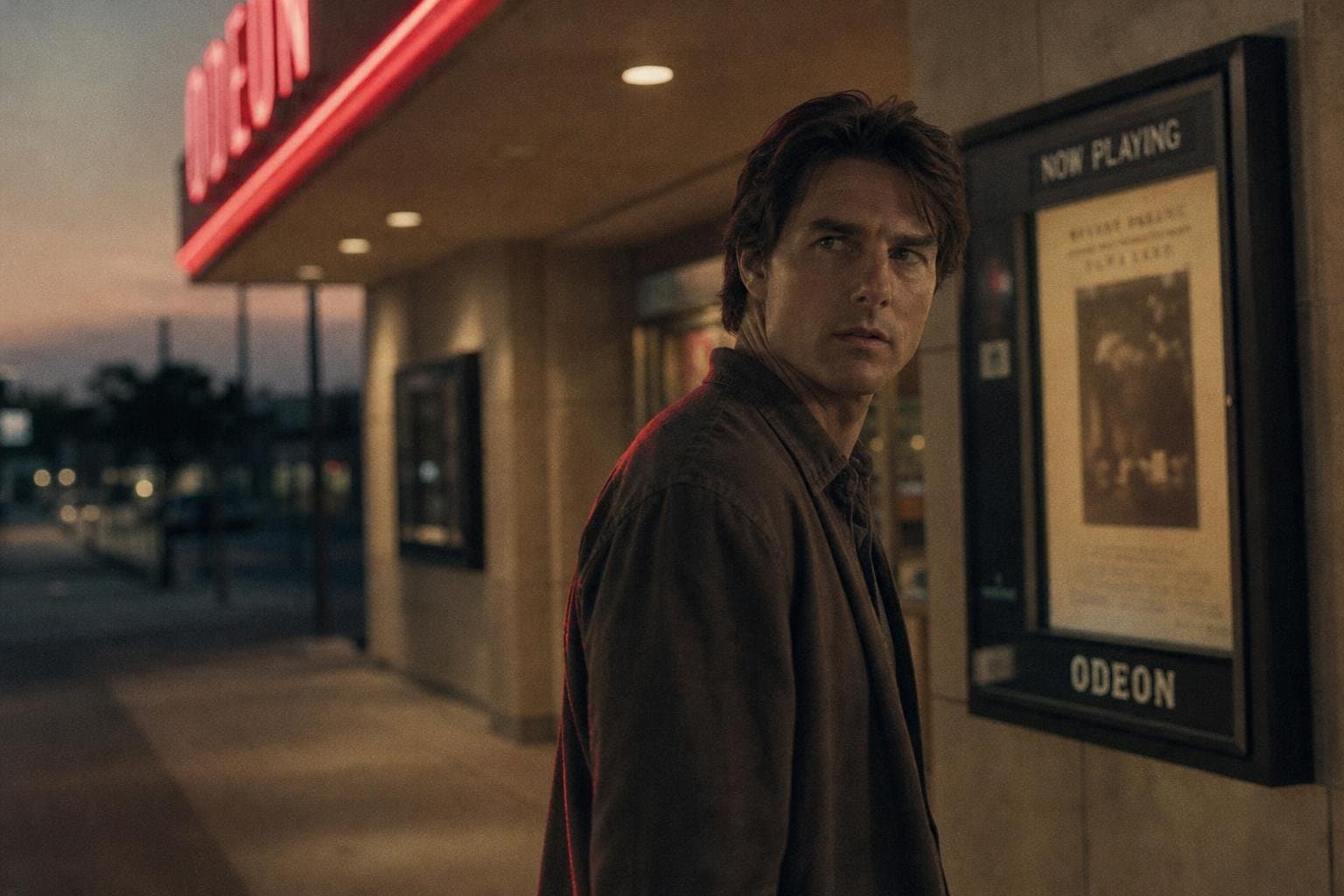

Tom Cruise told reporters this week that he's not chasing "opening weekend" numbers anymore — he's after "a lasting piece of cinema," as he put it in comments picked up by The Playlist. It's a nice sentiment, the kind stars reach for when a film needs a narrative that isn't the box office chart. Which is convenient, because the box office chart for Alejandro González Iñárritu's Digger is not kind to him. The film opened in the UK and Ireland with just under £1.1m from 660 sites — a £1,640 per-site average — and Screen Daily notes that's roughly in line with the openings of American Made and Rock of Ages, two films nobody holds up as high points of his career. Stateside, Screen Daily's own box-office tracker headlines the US debut as a "19-year US box-office low for Tom Cruise" (Screen Daily).
I don't think Cruise is lying about his priorities. I think he's describing an aspiration that the market doesn't especially care about. "Lasting piece of cinema" is a framing you reach for after the opening numbers come in soft, not before. And the contrast sitting right next to Digger on that same UK-Ireland chart makes the point sharper: Amazon MGM's Verity, adapted from the Colleen Hoover novel, opened with £3.4m from 639 sites — a £5,316 average, more than triple Cruise's per-site number on roughly the same footprint (Screen Daily). One film arrived with a built-in readership and a clear emotional pitch. The other arrived with an Oscar-pedigreed director, a movie star insisting the numbers don't matter, and an opening that suggests audiences weren't sure what they were being sold.
Craft Ambition Doesn't Always Land Where You Point It
A more interesting version of this gap is playing out around Luca Guadagnino's Artificial, which premiered at the 64th New York Film Festival at Alice Tully Hall on October 5 (IndieWire). Andrew Garfield and Yura Borisov star in what The Playlist's review describes as a "slippery AI drama" that is "fascinating, but strangely elusive." That's a review worth sitting with, because it's the kind of verdict that distinguishes real ambivalence from manufactured prestige-speak — the reviewer isn't dismissing the film, they're flagging that the formal choices (the slipperiness, presumably in how it handles perspective or genre) generate fascination without quite cohering into an argument. That's a different failure mode than the "desaturation and long takes" prestige-signaling I'm usually rolling my eyes at. Guadagnino is clearly trying something structurally unstable on purpose. Whether that instability earns its keep is exactly the question a single adjective-stacked pull quote can't answer, and it's worth tracking how the film's reception develops as it moves from festival premiere toward wider exposure.
What's notable is that this is a NYFF premiere, not a release date. Nothing in the available reporting confirms a theatrical rollout plan or date for Artificial beyond the festival screening — which means any "it's finally here" framing would be getting ahead of the actual distribution timeline. The film exists right now as a festival object generating critical conversation. That's a real and useful status, but it's not the same as a release, and conflating the two is exactly the kind of sloppiness that makes festival coverage unreliable.
Cannes Sales Are the Honest Version of Risk
Contrast that ambiguity with something cleaner: Sumerian Pictures' acquisition of Low Expectations out of Cannes' Directors' Fortnight. This is director Eivind Landsvik's feature debut, following two shorts — one a 2023 Cannes selection called "Tits," the other a 2021 Norwegian Film Critics Prize winner, "Sofia, Last Summer" (IndieWire). The film stars Marie Ulven — the Norwegian musician known as girl in red — opposite Anders Danielsen Lie, playing a version of a rising pop star whose public success doesn't match her private unraveling. It's the kind of casting-as-thesis move that either reads as a clever formal conceit or a gimmick, and I'd want to see the film before betting on which.
What makes this a clean example of distribution reporting done right is the specificity IndieWire provides: the film opened in Norway on September 11, and Sumerian will release it in North America in 2027 (IndieWire). That's a festival premiere, a foreign theatrical release that's already happened, and a distributor commitment to a future North American date — three distinct facts, reported as three distinct facts. No one is pretending the Norwegian opening means American audiences can see it this month. Compare that discipline to how a lot of outlets handle acquisition news, where "Sumerian buys the film" quietly becomes "coming to a theater near you" within a paragraph.
Neon's Open-Source Gambit Is a Press Release, Not a Release
Then there's the stunt. Neon announced it's developing a competing SCP Foundation horror anthology, positioned explicitly as a rebuke to A24's own SCP-inspired project, which had drawn pushback from the Foundation's writing community over licensing (IndieWire). Neon's pitch is that its version will honor the source material's Creative Commons license — meaning, per the terms the SCP Wiki community laid out, no DRM, free online release day-and-date with any theatrical run, and openness to derivative works. Neon is calling it an "open-source horror project."
I want to be clear about what this is and isn't. It is an announcement of intent. It is not a release date, not a confirmed distribution plan, and — per IndieWire's own reporting — not even attached to any specific talent yet. If Neon actually follows through on a CC-compliant, DRM-free, simultaneous theatrical-and-online release, that would be a genuinely unusual distribution model worth real scrutiny once it has a title, a date, and a filmmaker attached. Right now it's a press release weaponized against a competitor, dressed up in the language of creative openness. The gap between "we are vowing to make this" and "this exists" is the whole story, and it's a gap this newsletter has spent all year arguing people conflate too easily.
The Pattern Underneath All Four Stories
Line these up and a shape emerges. Cruise says box office doesn't matter to him while his box office says otherwise. Guadagnino delivers a film ambitious enough to generate real critical disagreement rather than consensus, which is more interesting than either a rave or a pan but still isn't the same as a film that's found its audience. Sumerian makes a clean, well-defined bet on an unproven director with a culturally specific hook. Neon makes a loud, structurally ambiguous promise that currently has no film attached to it.
The throughline isn't that talk is cheap — everybody in this industry talks. It's that the reporting around indie and adjacent film keeps collapsing four different kinds of claims (what someone says they value, what a festival screened, what a distributor acquired, what's actually playing where) into one undifferentiated stream of "buzz." The disentangling is the job. Watch whether Artificial lands a confirmed theatrical date out of its NYFF run, whether Low Expectations holds its 2027 window as Sumerian builds toward a release strategy, and whether Neon's SCP project ever attaches a director — because until one of those things happens, the announcement is the whole story, and announcements are not what any of us are actually here to watch.


