
There's a moment in the current box office story that should make every mid-budget indie filmmaker deeply uncomfortable. A 20-year-old YouTube creator with no feature credits just delivered the first film in A24's history to surpass $200 million worldwide. The film cost under $10 million. It opened wider than Civil War. And more than half the audience said they showed up specifically because of the Backrooms universe itself — not because of the cast, not because of a review, not because of an algorithm recommendation.
That's a distribution story. It's also a craft story. And it's worth sitting with both before the industry decides what lesson to draw from it.
What Backrooms Actually Did at the Box Office
Let's be precise about the numbers, because the headlines have been doing some rounding. Backrooms opened to $81.5 million domestically across 3,442 venues, making it A24's biggest opening weekend ever, surpassing Civil War's $25.5 million debut in 2024 by more than three times. By its second weekend, the film had reached $213 million globally, with $135.3 million domestic and a further $50.5 million international haul. It opened at number one in 42 international territories and set A24 opening records in the UK and 40 other countries.
The domestic second-weekend drop was steep — 68 percent — but that number requires context. When you open at $81.5 million on a sub-$10 million budget, a 68 percent drop still leaves you with a film that's already profitable before international receipts, home video, or streaming. A24 and Chernin Entertainment financed it; 21 Laps, Blumhouse, and Atomic Monster produced it. The infrastructure around Kane Parsons was, in other words, extremely professional. What was new was the filmmaker himself.
The audience breakdown is the genuinely striking part. Roughly 86 percent of opening-weekend viewers were under 35, around 66 percent were under 25, and 44 percent were under 21. That's not a horror audience. That's a Backrooms audience — a community that already existed, already had a relationship with the mythology, and showed up in groups. The film played like an event, not a release.
For comparison, consider what was happening in the same weekend: Curry Barker's Obsession, a Focus Features acquisition from TIFF 2025 reportedly made for around $750,000, was simultaneously climbing past $100 million domestic — gaining 14 percent in its third weekend, a feat that hadn't been matched outside of Christmas releases since E.T. in 1982. Two YouTube-native horror films, both massive hits, both in the same weekend. That's not a coincidence. That's a cohort.
The Craft Question Nobody Is Asking Loudly Enough
Here's where I want to push back against the pure distribution-triumph narrative. The numbers are real. The cultural phenomenon is real. But the question of whether Backrooms is a good film — formally, structurally, as a piece of cinema — is getting swamped by the box office story, and that's a problem for anyone who cares about what indie horror can actually do.
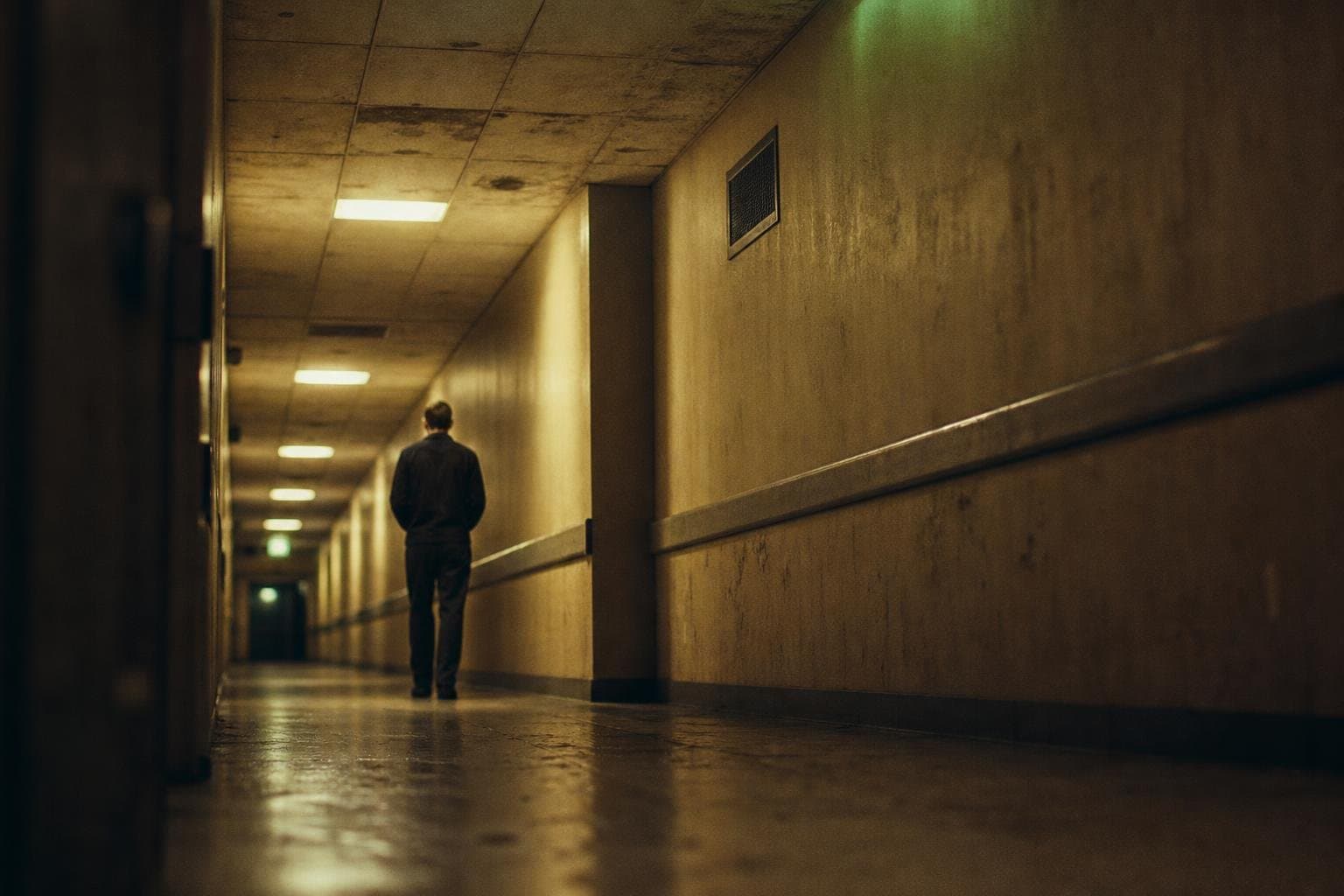
The Playlist's review frames Backrooms as a film that turns "creepypasta nightmare fuel into a terrifying mental-health tragedy" — which is a generous reading, and possibly a correct one, but it's also doing a lot of work to locate the film's emotional architecture. The premise involves a furniture store owner, played by Chiwetel Ejiofor, who discovers a seemingly endless labyrinth beneath his warehouse. That's a strong hook. The question is whether Parsons uses the formal language of found footage and liminal space horror to say something about interiority and dread, or whether he's executing a very polished version of what he already built on YouTube.
I haven't seen the film yet (it's still in wide theatrical release), so I won't pretend to adjudicate that question. But the critical conversation around it has been notably thin on formal analysis and heavy on cultural-moment framing. When a film makes $200 million, the reviews start reading like explanations rather than evaluations. That's a failure of criticism, not of the film.
What I can say is that the structural bet Parsons made — extending a YouTube mythology into a feature-length narrative with a cast that includes Ejiofor and Renate Reinsve — is genuinely interesting. Those are not YouTube-native casting choices. They're choices that signal an ambition to make the horror mean something beyond the lore. Whether the film earns that ambition is the conversation worth having.
The Streaming Counterpoint: What Backrooms Doesn't Tell You About Discovery
While Backrooms was rewriting A24's record books in theaters, IndieWire's June streaming guide was quietly making a different argument about where indie film lives for most viewers. The Criterion Channel's June slate — built around Pride Month LGBTQ+ classics, a wedding-season programming thread, and a collection of cinematic odysseys timed to upcoming summer blockbusters — is doing something Backrooms doesn't need to do: it's building an audience for films that have no built-in fanbase, no YouTube mythology, no pre-existing community.
That's the actual challenge of indie distribution in 2026. Backrooms solved the discovery problem before it was a film. Parsons had millions of subscribers who already knew the universe. The Criterion Channel is trying to introduce viewers to Portrait of Jason, The Watermelon Woman, and Misericordia — films that require the platform to do the curatorial work that the filmmaker can't do alone.
This is the structural divide that the Backrooms story obscures. The YouTube-to-theatrical pipeline works when you have an existing audience. For everyone else — the filmmaker making their first feature without a subscriber base, the arthouse director whose work requires context to land — the discovery infrastructure remains broken. Streaming platforms are the de facto solution, but they're uneven. Criterion does genuine curation. Most platforms do not.
The MUBI angle is worth watching here too. MUBI's planned wide theatrical push for Nicolas Winding Refn's long-gestating Maniac Cop represents a different bet: that a filmmaker with a cult following and a grindhouse premise can be positioned for theatrical success through platform-backed distribution. Refn has a pre-existing audience, but it's an arthouse audience, not a YouTube audience. Whether MUBI can replicate the community-activation effect that A24 achieved with Backrooms — for a very different kind of film, aimed at a very different kind of viewer — is one of the more interesting distribution experiments of the coming months. No release date has been confirmed as of this writing.
What the Indie Ecosystem Should Actually Learn From This
The wrong lesson is: find YouTube creators and give them money. That's already happening, and it will produce a lot of bad films alongside the occasional Backrooms. The right lesson is more uncomfortable.
Backrooms succeeded because it had a community before it had a distributor. The film's marketing was, in a meaningful sense, already done. A24 didn't have to build awareness from scratch — it had to convert an existing audience into ticket buyers. That's a fundamentally different problem than the one most indie distributors face, and it's one that traditional festival-to-acquisition pipelines are structurally ill-equipped to solve.
The festival circuit remains essential for a certain kind of film — the formally ambitious, narratively risky work that needs critical champions and word-of-mouth to find its audience. But it's a slow machine. Obsession was a $14 million TIFF 2025 acquisition by Focus Features that took months to reach theaters and then grew its audience week over week in a way that almost never happens anymore. That's a genuine anomaly — and it suggests that when a film connects with something real in the culture, the traditional release model can still work. But it requires patience, platform support, and a film that rewards repeat viewing and conversation.
The films that fall through the gap are the ones that are too formally ambitious for the YouTube pipeline and too niche for the slow-burn theatrical model. The mid-budget arthouse film with a strong festival run but no obvious community to activate. That's where the ecosystem is still failing, and no amount of Backrooms box office changes that structural reality.
The Refn Question and What Comes Next
The Maniac Cop situation is worth returning to as a forward-looking test case. Refn is a filmmaker with a genuine cult — Drive, Only God Forgives, The Neon Demon have all generated the kind of passionate, divisive response that builds lasting audiences. Maniac Cop is described as a long-gestating grindhouse obsession, which suggests a project that's been shaped by genuine creative investment rather than IP calculation. MUBI's backing signals that the platform sees theatrical viability in Refn's name recognition.
But Refn's films don't have pre-existing communities in the Backrooms sense. They have admirers, many of them film-literate adults who are exactly the audience this newsletter is written for. Whether that's enough to sustain a wide theatrical push — and what "wide" means when MUBI is the distributor — will tell us something important about whether the platform model can bridge the gap between arthouse credibility and genuine theatrical reach.
Watch for MUBI's release strategy announcement on Maniac Cop, and watch whether it comes with a confirmed date or stays in the "planned wide theatrical push" category. The gap between those two things is where most indie distribution stories quietly die.
The Backrooms number is real. The lesson is narrower than it looks.


