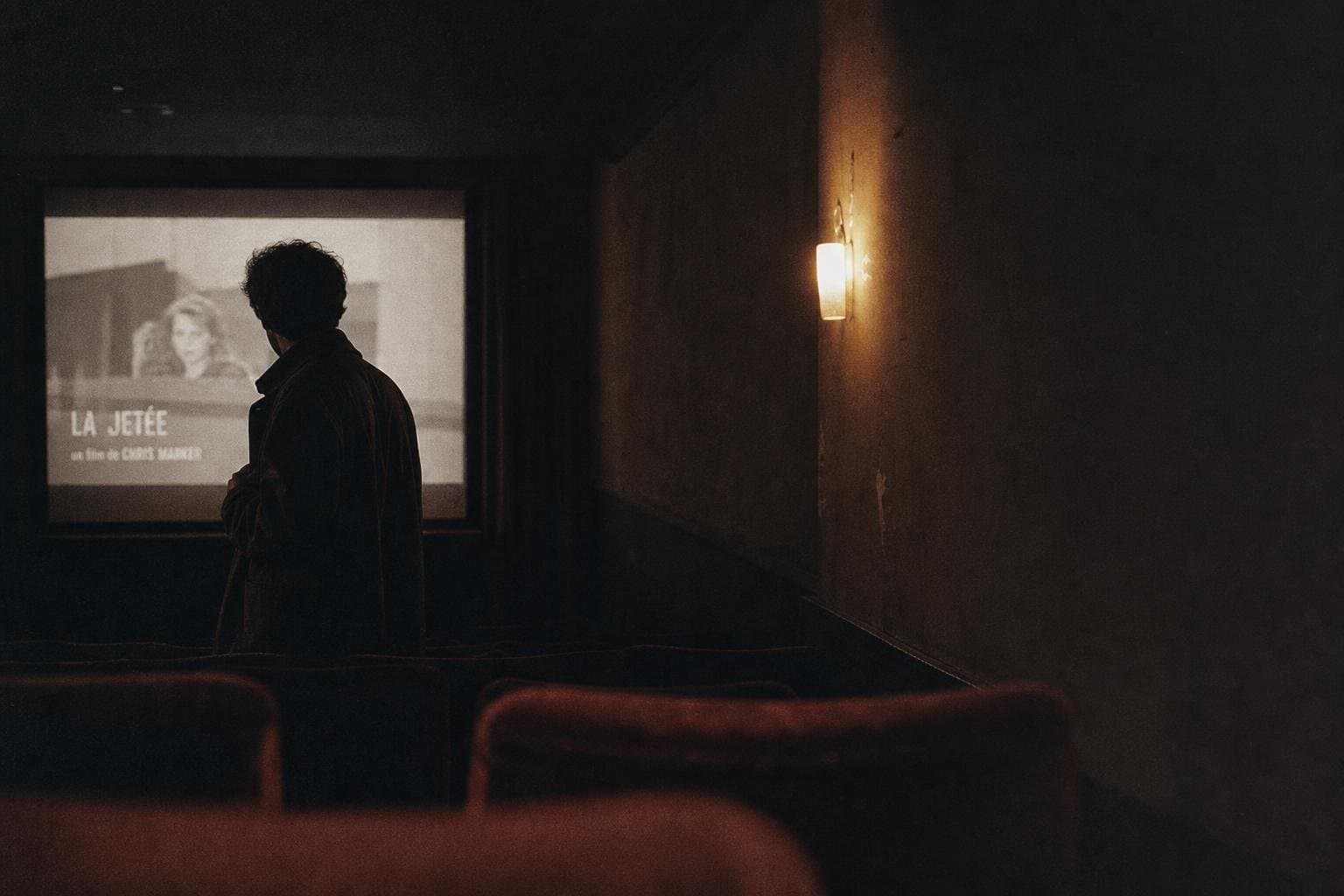

There's a scene that keeps playing in my head this week, and it has nothing to do with any film I actually watched. It's the mental image of a sold-out Friday night at Film Forum in New York — not for a prestige A24 release, not for a Neon acquisition with a Cannes pedigree, but for a self-released documentary about a Chicano playwright, playing on a single screen, pulling in roughly $7,500 in its opening weekend. That number is modest by any measure. The fact that it happened at all is not.
The week of July 24, 2026 is Christopher Nolan week. The Odyssey — a mythic action epic adapting Homer, produced by Universal Pictures and Nolan's Syncopy banner, with a cast that includes Matt Damon, Tom Holland, Anne Hathaway, Robert Pattinson, Lupita Nyong'o, Charlize Theron, and Zendaya — is the kind of film that doesn't just dominate the box office. It reorganizes the entire cultural conversation around itself. Everything else becomes a footnote. That's not a criticism; it's a structural reality of how summer moviegoing works. But it does create a specific problem for independent cinema, and how the ecosystem responds to that problem right now is more interesting than anything Nolan is doing with his IMAX cameras.
The Gravity Well Problem
When a film of The Odyssey's scale opens, it doesn't just take screens — it takes attention. Film-literate adults who might otherwise spend a Friday night at their local arthouse are, reasonably, going to see the Nolan. Letterboxd's own July roundup acknowledges this directly, noting that while The Odyssey "will certainly be top of mind for many members this month," the arthouse is still worth your time. That framing — the gentle reminder that other films exist — is telling. It's the indie ecosystem doing triage.
The gravity well problem is real and cyclical. It happens every summer, every awards season, every time a filmmaker with genuine cultural weight drops something new. The question is never whether the Nolan (or the Spielberg, or the Jenkins) will dominate. The question is what survives in its orbit, and whether the films that survive do so because of genuine craft and smart positioning or just because they happened to be in the right place at the right time.
This week, the answer is a mix of both — and the most instructive case study is a documentary that most people reading this haven't heard of yet.
American Pachuco and the Case for Self-Release
American Pachuco: The Legend of Luis Valdez won the Audience Award in the documentary category at this year's Sundance. It's a profile of the legendary Chicano playwright Luis Valdez, featuring interviews with Edward James Olmos, Lou Diamond Phillips, Dolores Huerta, Cheech Marin, and Linda Ronstadt, among others. Director David Alvarado navigated genuine controversy earlier this year when the film's subject matter intersected with sexual abuse accusations against Cesar Chavez, whose story is intertwined with Valdez's. Alvarado addressed that publicly, and the forthrightness appears to have helped rather than hurt.
The film is essentially self-released, with support from theater booker Michael Tuckman. It opened on one screen at Film Forum. It sold out a Friday night show. The numbers from Rentrak and from Tuckman himself differ slightly — Rentrak reported $5,072, Tuckman's figures put it closer to $7,500 — but either way, for a single-screen documentary opening with no major distributor behind it, that's a respectable launch. For context, IndieWire notes that Time and Water, another Sundance documentary that similarly opened on one New York screen this summer, made $8,048 in its first weekend and has since legged out to $86K domestic over seven weeks. American Pachuco is now rolling out to roughly a dozen Los Angeles theaters, with the San Francisco Bay Area to follow on July 31 and 20 additional markets after that.
What's worth sitting with here is the model. A Sundance Audience Award winner, a subject with genuine cultural weight, a director willing to engage with controversy rather than dodge it, and a booker who knows how to build a rollout market by market. No A24. No Neon. No MUBI. Just the film and the infrastructure of people who believe in it. That's either the future of a certain kind of documentary release or a cautionary tale about what happens when distributors pass on films they shouldn't — and I'd argue it's closer to the former.
What Streaming Is Actually Offering This Month
While American Pachuco builds its theatrical footprint the old-fashioned way, the streaming picture in July is doing something more interesting than usual. IndieWire's monthly streaming guide points to the Criterion Channel as the platform doing the most ambitious curatorial work right now, with a Harry Dean Stanton retrospective spanning from Monte Hellman's 1966 Ride in the Whirlwind — in which Stanton leads a trio of outlaws that includes a young Jack Nicholson — through to John Carroll Lynch's Lucky in 2017, Stanton's final leading role. The Channel also has a "Murderous Melodramas" package that pairs Douglas Sirk's Written on the Wind with Nicholas Ray's Bigger Than Life and Gerd Oswald's A Kiss Before Dying, a grouping that illustrates how melodrama functioned as subversive camouflage in mid-century American cinema.
This is exactly the kind of programming that streaming platforms should be doing and almost never do. The Criterion Channel's value proposition has always been curatorial intelligence — not just "here are good films" but "here is a context in which to watch them." The Stanton retrospective works because it traces an actor's career as a coherent artistic statement rather than a collection of supporting turns. The melodrama package works because it argues something about a genre rather than just licensing titles.
The contrast with how Netflix or even Prime Video approaches catalog programming is stark. Those platforms surface films based on algorithmic similarity or licensing availability. The Criterion Channel surfaces films based on what they mean next to each other. For the film-literate audience this newsletter is written for, that distinction matters more than any individual title.
The Festival Calendar Is About to Shift Everything Again
One thing that gets lost in the Nolan-dominates-summer narrative is that the festival calendar doesn't pause for blockbusters. Screen Daily's updated 2026 festival calendar shows Locarno opening August 5 and running through August 15, with Melbourne International Film Festival overlapping from August 6 to 23, Edinburgh from August 13 to 19, and Sarajevo from August 14 to 21. That's a dense three-week window in which a significant portion of the films that will define the fall specialized release season will either find distributors or not.
Locarno in particular is worth watching. It has a history of surfacing formally adventurous work that doesn't fit neatly into the Sundance-to-A24 pipeline — films that are genuinely strange, genuinely risky, and often genuinely difficult to place. The acquisitions that come out of Locarno in the next three weeks will tell you a lot about whether distributors are in a risk-taking mood or a consolidating one. Given what we've seen from the specialized box office this summer — cautious, screen-count-limited rollouts, heavy reliance on proven platforms — my read is that the consolidating instinct is winning. Which makes any Locarno acquisition that bets on something genuinely weird all the more significant.
TIFF follows in September, and The Playlist's recent coverage already has Peter Farrelly's I Play Rocky, Takashi Miike's Bad Lieutenant: Tokyo, and Anton Corbijn's A Talent for Murder set to world premiere there. That's a genuinely eclectic lineup of names — Farrelly and Miike in the same sentence is a sentence I didn't expect to write — and it suggests TIFF is positioning itself as a broad-tent festival rather than a prestige-only one. Whether that serves independent cinema or dilutes it is an argument worth having in September.
The Actual Question for the Next Six Weeks
Here's where I land: the indie ecosystem right now is operating in two registers simultaneously, and the tension between them is the most interesting story of the summer.
Register one is the American Pachuco register — films finding audiences through patience, market-by-market rollouts, and the kind of word-of-mouth that builds when a film has genuine community stakes. This is slow, unglamorous, and often invisible to the coverage cycle. It's also, historically, how the most durable specialized releases have worked.
Register two is the platform register — the Criterion Channel's curatorial intelligence, the streaming-first acquisitions, the films that bypass theatrical entirely and land on MUBI or Kino Film Collection. This is faster, more legible to the algorithm, and increasingly where the economics point.
What's missing is a third register: the mid-budget, mid-ambition specialized release that used to anchor the fall calendar. The $3-5 million acquisition that opened on 200 screens and built to 500. That register has been hollowing out for years, and nothing in the current source pool suggests it's coming back. What's replacing it is a barbell — tiny self-releases on one end, platform exclusives on the other — with not much in between.
The Locarno and TIFF acquisition windows will test that barbell theory. If a genuinely ambitious film comes out of either festival and finds a distributor willing to bet on a real theatrical run, that's news. If the acquisitions cluster at the platform end, that tells you something about where the risk appetite actually is.
Watch for what Kino Lorber, MUBI, and IFC announce in the two weeks following Locarno's close on August 15. Those announcements — not the Nolan grosses, not the TIFF red carpet — are the actual leading indicator for what independent cinema looks like in the fourth quarter.
In the meantime: American Pachuco is playing Film Forum now and expanding to Los Angeles this weekend. Go find it.


