


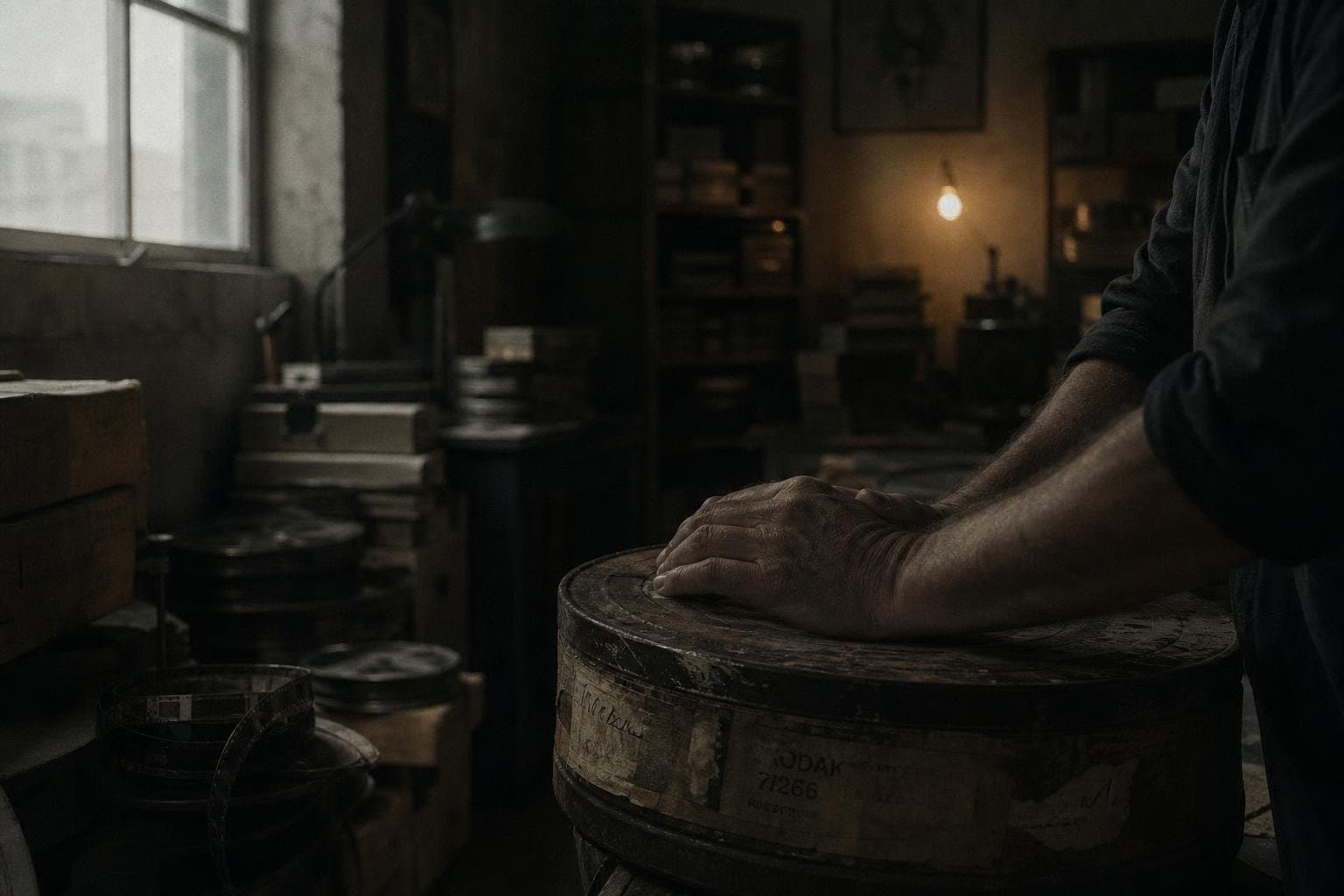

Werner Herzog spent part of last month calling an AI-generated film that borrowed his voice and sensibility "phenomenally, abysmally stupid," telling reporters flatly that the thing is "a failure, period" (The Playlist). It's a blunt verdict from a director who has spent sixty years building a specific, unmistakable authorial voice, aimed at a project that apparently tried to simulate that voice without him. I don't have the full context on what "About a Hero" actually is or who made it, and the source doesn't give me much more than Herzog's reaction — but the reaction itself is the story. It's a filmmaker publicly defending the idea that authorship means something, at a moment when the machinery for faking it has never been cheaper.
Put that next to a much quieter story happening on store shelves this month, and you start to see the real fight in independent cinema right now — not who gets into Cannes, but who controls the version of the film you actually watch.
The Restoration Wars Nobody's Covering
IndieWire's October home-video roundup is, on its surface, a service piece — Criterion is releasing a Stanley Kubrick box set, alongside new editions of Jerzy Skolimowski's "The Shout," Guillermo del Toro's "Frankenstein," and Uli Edel's "Christiane F." (IndieWire). But buried in that same list is a smaller, stranger story: Ngozi Onwurah's "Welcome II the Terrordome," an Afrofuturist feature that was the first by a Black British woman to get a UK theatrical release, only got its proper U.S. theatrical run this year — courtesy of Janus Films — decades after it was made. It arrives on Criterion Blu-ray October 6, with a commentary track featuring Onwurah herself (IndieWire).
That's not a nostalgia play. That's a film finally getting the access it should have had thirty years ago, and a distributor deciding the theatrical window and the disc are both worth doing properly.
Contrast that with the MUBI Notebook essay on "pirating the pirates" — a writer's account of trying to reconstruct a clean version of Sergio Leone's "The Good, the Bad and the Ugly" after MGM's early-2000s "restoration" extended the runtime, replaced missing dialogue with soundalikes, and remixed the mono soundtrack into a modern surround mix that was, for nearly a decade, the only commercially available version (MUBI Notebook). The piece quotes restoration critic Spencer Draper describing studio indifference bluntly: discs get released from "defective" masters with "frozen grain," and nobody at the corporate level cares (MUBI Notebook).
Here's the connective tissue: both stories are about the gap between a film as its maker intended it and a film as it's actually delivered to you. Herzog is fighting that gap at the point of fabrication — someone building something that never existed and attaching his name to it. The restoration essay is fighting it at the point of corporate neglect — a real film, degraded or altered by the people who technically own it, with no one accountable for the difference. Different mechanisms, same underlying problem: the audience usually has no way of knowing which version they're getting, or whether it's the right one.
What's Actually Worth Tracking
If you care about independent and arthouse film as something more than a release-date calendar, the disc shelf is doing more honest work right now than most festival press releases. Criterion and Janus correcting a thirty-year access gap for Onwurah's film is a bigger story for film culture than most of what's screening at the fall festivals currently in motion — New York Film Festival runs through October 12, and Busan, BFI London, and Warsaw all open or continue through the month, per Screen Daily's festival calendar (Screen Daily). Festivals generate premieres; they don't generate permanence.
The Herzog dispute is worth watching for the opposite reason — not because we know yet what "About a Hero" actually is, but because it's an early, loud test case for how filmmakers respond when their authorial identity gets treated as a style to extract rather than a body of choices to credit. Expect more of these fights, not fewer, and expect the ones that matter to come from directors with enough stature to say no in public the way Herzog just did.