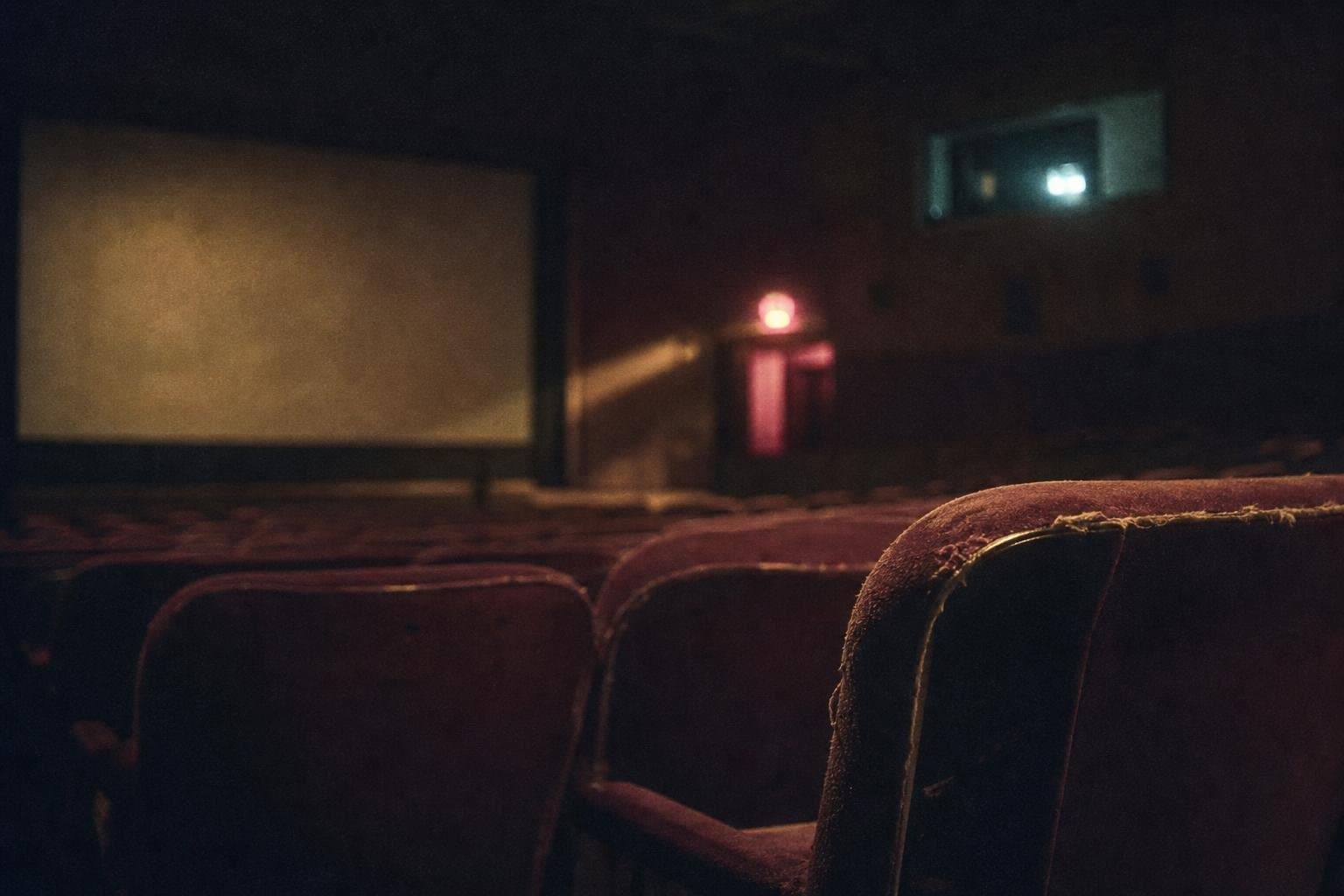

There's a version of the "save the moviegoing experience" argument that's become almost as exhausting as the problem it's diagnosing: vague appeals to communal magic, nostalgic hand-wringing about streaming, the same Scorsese quote recycled for the thousandth time. The Paris Theater in New York is making a different kind of argument — a programmatic one, built from 43 films and 16 70mm screenings, with Sofia Coppola and Isabella Rossellini showing up to talk about their work in person.
Big & Loud 2026 is the kind of event that deserves more attention than it's getting in a week dominated by Comic-Con noise and Nolan discourse. The festival's structure — a dense lineup anchored in large-format and repertory programming — is a direct rebuttal to the idea that theatrical exhibition survives by competing with streaming on streaming's terms. It doesn't. It survives by doing things streaming structurally cannot.
That's worth sitting with for a moment, because the indie film ecosystem has spent the better part of three years debating the wrong question.
The Wrong Debate Has Been About Survival. The Right One Is About Differentiation.
The standard theatrical-vs-streaming argument treats the two as competitors for the same audience attention, fighting over the same Friday night. By that logic, theaters lose almost every time: streaming is cheaper, more convenient, and increasingly capable of delivering prestige product day-and-date or within weeks of a theatrical window. The math doesn't work in theaters' favor unless you change the terms.
What Big & Loud does — and what the Paris Theater has been doing with increasing clarity — is refuse those terms entirely. Sixteen 70mm screenings aren't a nostalgia exercise. They're a capability demonstration. No streaming platform, however well-funded, can deliver the grain structure, the light-throw, and the sheer physical presence of a 70mm print in a properly equipped room. The format is the argument.
This matters for indie film specifically because the indie sector has been most vulnerable to the streaming-as-substitute logic. A24 and Neon titles migrate to platforms within weeks; MUBI has built an entire financing and distribution infrastructure around the idea that the right film finds its audience on a screen at home. These are real and often successful strategies — I've written about MUBI's model and Kino Lorber's acquisition approach at length in previous issues. But they've also created a creeping assumption that theatrical is optional, a marketing expense rather than an essential exhibition context.
The 43-film Big & Loud lineup pushes back on that assumption not through argument but through curation. When you put a film in a 70mm context alongside Q&As with the people who made it, you're creating an event that has no streaming equivalent. The film doesn't change. The experience does.
What the Criterion Channel Is Doing in July Rhymes With This
The parallel programming worth noting here is what the Criterion Channel is doing with its July slate, which IndieWire's monthly streaming guide describes as anchored by a Harry Dean Stanton retrospective — spanning from Monte Hellman's Ride in the Whirlwind in 1966 through John Carroll Lynch's Lucky in 2017 — alongside a "Murderous Melodramas" package that pairs Nicholas Ray's Bigger Than Life with Douglas Sirk's Written on the Wind and Gerd Oswald's A Kiss Before Dying.
The Criterion Channel's model is, in some ways, the streaming answer to what Big & Loud does in person: contextual curation that makes individual films mean more by placing them in conversation with each other. Watching Written on the Wind alongside A Kiss Before Dying in a shared thematic frame is a different experience than stumbling across either film in an algorithm-generated recommendation queue. The Channel is doing programming, not just licensing.
But here's where the two models diverge in ways that matter: the Criterion Channel's curation is experienced privately, asynchronously, at whatever pace the viewer chooses. Big & Loud's curation is experienced collectively, on a fixed schedule, in a room with other people and occasionally with Sofia Coppola in the Q&A seat. Both are legitimate. They're not the same thing.
The indie film ecosystem needs both to be healthy, and right now the streaming side of that equation is considerably more robust than the theatrical side. Which is why events like Big & Loud function as something more than programming exercises — they're proof-of-concept demonstrations that the theatrical experience, done with genuine ambition, still generates a kind of engagement that no platform can replicate.
The 70mm Question Is Also a Distribution Question
Sixteen 70mm screenings in a single festival is a meaningful number. It implies a level of logistical commitment — sourcing prints, maintaining projection equipment, scheduling around format constraints — that most venues have quietly abandoned. Christopher Nolan's public comments about The Odyssey staying under three hours due to IMAX projection limits are a useful reminder that large-format exhibition has real physical constraints that shape creative decisions at the highest levels of filmmaking. The format isn't just aesthetic; it's infrastructural.
For indie film, the 70mm question has a specific valence. The films most likely to benefit from large-format presentation — formally ambitious, visually dense work that rewards the kind of attention a darkened theater demands — are exactly the films that struggle most to find theatrical footing in a market where screen counts are allocated based on projected returns. A film that would be transformative on 70mm often ends up on a 200-seat digital screen in a four-wall deal, or skips theatrical entirely.
Big & Loud sidesteps this problem by creating a dedicated context for large-format work rather than trying to compete for screens in the general market. It's a festival model applied to repertory and contemporary programming simultaneously — which is, when you think about it, what the best film festivals have always done. Venice and Toronto and Locarno (both running in the coming weeks, per Screen Daily's festival calendar) create contexts in which films mean more than they would in ordinary release. The Paris Theater is applying that logic to year-round programming.
The distribution implication is worth spelling out: if specialized theatrical is going to survive as a meaningful sector, it probably survives as a festival ecosystem rather than as a traditional release pipeline. Not every film needs a 200-city rollout. Some films need twenty cities with the right venues, the right programming context, and the right audience. The infrastructure for that model exists — it's just underused.
Gregg Araki's I Want Your Sex and the Festival Circuit's Unresolved Distribution Problem
The other film worth discussing this week in the context of theatrical exhibition is Gregg Araki's I Want Your Sex, which has been making its way through the festival circuit — Sundance, Phoenix, Miami, Wisconsin, Seattle, and others, per its Letterboxd release history — with a cast that includes Olivia Wilde, Cooper Hoffman, Mason Gooding, Chase Sui Wonders, Daveed Diggs, and Charli xcx, and a premise that puts Araki squarely back in the erotic-thriller-as-social-commentary territory he's owned since the '90s.
The Letterboxd page currently lists the film as "not streaming" — which, combined with its extensive festival run, raises the question that follows every well-reviewed festival film that hasn't announced a distributor: where does it actually land?
This is the distribution problem that the indie ecosystem hasn't solved, and Big & Loud inadvertently illuminates it. The Paris Theater can program 43 films and 16 70mm screenings because it's working with a combination of repertory titles (where rights are established) and contemporary work that fits its curatorial frame. A film like I Want Your Sex — provocative, formally confident, built around a director with a genuine cult following — is exactly the kind of work that should find a theatrical home. Whether it does depends on acquisition decisions that haven't been made public yet.
The Playlist's interview with Cooper Hoffman and Gregg Araki touches on the film's wild sex scenes and its relationship to Araki's earlier work — including Roger Ebert's famous hostility toward The Doom Generation — which suggests the film is generating the kind of critical conversation that precedes acquisition interest. But conversation and acquisition are different things, and a Sundance premiere with no confirmed distributor is not a release date.
What's notable about Araki's position is that he's one of the few filmmakers whose work genuinely requires theatrical context to land properly. The New Queer Cinema films of the '90s were made for and about communal experience — the shock, the laughter, the discomfort of watching transgressive work in a room full of strangers. Streaming Nowhere alone at midnight is a different proposition than seeing it with an audience that's either with it or visibly not. If I Want Your Sex ends up platform-only, something real is lost, not just aesthetically but culturally.
What the Next Six Weeks Will Tell Us
The festival calendar is about to get very busy. Locarno opens August 5, Melbourne August 6, Edinburgh August 13, Sarajevo August 14 — and then Venice on September 2, Telluride on September 3, and Toronto on September 10. The acquisition season that follows Venice and Toronto will tell us more about where the indie theatrical market actually stands than any amount of think-piece speculation.
Watch specifically for: whether I Want Your Sex announces a distributor before or after its remaining festival dates; whether any of the Locarno or Edinburgh premieres generate the kind of acquisition heat that Big & Loud's model could absorb; and whether the Paris Theater's 70mm commitment influences other specialized venues to make similar infrastructure investments.
The argument Big & Loud is making — that theatrical survives through differentiation, not competition — is the right argument. The question is whether the rest of the ecosystem is listening, or whether it's still trying to win a race it structurally cannot win on streaming's terms.


