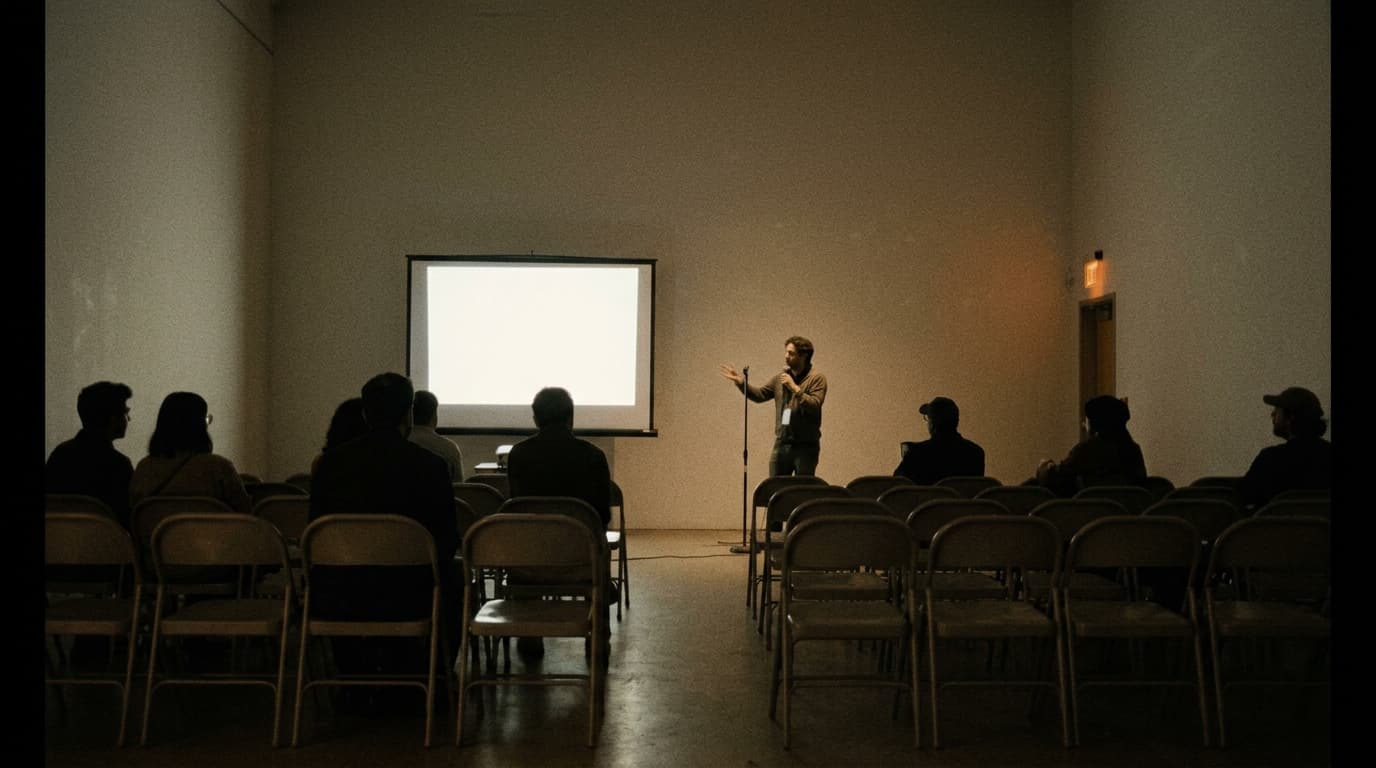

There's a scene early in The Travel Companion — Travis Wood and Alex Mallis's debut feature — where a filmmaker at a small festival Q&A gives a rambling non-answer to a rambling non-question, and everyone in the room performs enthusiasm anyway. IndieWire's review describes it as "painfully awkward" and notes that the film captures "the cringe-inducing details" of indie film culture with unusual precision. It's a small moment, but it points at something real: the indie ecosystem has become self-aware enough to satirize itself, which is either a sign of maturity or a sign that the whole thing has calcified into ritual.
Looking at what's actually moving through the system right now, I'd argue it's neither — or rather, it's both at once, and the tension between those two states is producing some genuinely strange and interesting work.
The Debut Feature Is Having a Moment (For Real This Time)
IndieWire's running best-of-2026 list names Sophy Romvari's Blue Heron "a debut for the ages" and flags Sho Miyake's Two Seasons, Two Strangers as confirmation of "a major new voice in Japanese cinema." Neither of these are festival darlings coasting on buzz — they're films that apparently earned their praise through formal accomplishment. That's worth noting because the festival circuit has spent the better part of a decade rewarding debuts that signal ambition without delivering on it.
Then there's Ryuya Suzuki, who wrote, directed, edited, and entirely hand-drew Jinsei himself over 18 months. The film premiered at Annecy 2025, ran at Tokyo International, and is now set for a U.S. premiere at IFC Center on June 5 before expanding nationwide June 12. One person, 18 months, a feature-length anime — the kind of project that sounds like a Kickstarter pitch but apparently exists as a finished, distributable object. Greenwich Entertainment picked it up. It's getting a real release.
The pattern here isn't "scrappy underdog makes good." It's something more specific: filmmakers who have internalized the constraints of independent production and built their formal choices around those constraints rather than against them. Suzuki's hand-drawn style isn't a limitation he's apologizing for — it's the film's identity. That's a different posture than the prestige-indie move of shooting on 16mm to signal seriousness while telling a story that could have been a Hulu drama.
Cannes Is Confirming the Veteran Problem — And Complicating It
I wrote two weeks ago about the 2026 Cannes Competition being a veteran's game, and the Directors' Fortnight lineup announced by Screen Daily adds texture to that argument without exactly reversing it. The parallel section — historically where the riskier bets live — opens with Kantemir Balagov's Butterfly Jam, starring Barry Keoghan and Riley Keough, and closes with a new Quentin Dupieux animated film described as "unclassifiable." Dupieux is also in the Official Selection with Full Phil, which means he's doing double duty. That's either a sign that Cannes programmers genuinely can't get enough of him, or that the festival is leaning on known quantities even in its supposedly adventurous sidebar.
The more interesting Fortnight entry is Once Upon a Time in Harlem — a documentary about a 1972 gathering at Duke Ellington's house that Neon acquired after its Sundance premiere. It's one of three documentaries in the Fortnight selection, which artistic director Julien Rejl says reflects a deliberate push toward doc and animation. That's a curatorial choice worth watching: if the main Competition is where the auteur brand gets reinforced, the Fortnight is quietly becoming where the form experiments actually happen.
What The Travel Companion Gets Right About the Ecosystem
Back to Wood and Mallis for a moment, because their film is doing something the best-of lists tend to undervalue. The Travel Companion isn't formally radical — IndieWire notes it's "not entirely safe from cliches" — but it's doing the harder work of accurately representing the social texture of indie film culture: the way aspiring filmmakers perform certainty they don't have, the way every unfinished project becomes a "proof-of-concept," the way the ecosystem sustains itself on deferred ambition.
That kind of satirical self-examination is only possible when a culture has enough distance from itself to see its own tics clearly. The indie world has been so defensive for so long — always arguing for its own relevance against the studio machine — that films willing to puncture its pretensions from the inside feel genuinely fresh. The fact that this one is apparently good at it makes it worth seeking out.
The through-line connecting Jinsei, Blue Heron, and The Travel Companion isn't genre or geography. It's that all three are films that know exactly what they are and commit to it without hedging. In a moment when the prestige-indie formula (desaturated palette, elliptical structure, festival pedigree) has become as legible and predictable as any studio genre, that kind of clarity reads as the actual risk.
Watch for Jinsei's IFC Center opening on June 5 — if it plays as well as the Annecy response suggested, it'll be the distribution story of early summer.


