
Venice opens September 2. Telluride follows the next day. Toronto arrives September 10. The festival calendar is about to become a firehose, and when it does, the critical conversation will narrow to whatever premiered in the Lido's competition and whatever A24 or Neon is positioning for awards. Everything else — the weird stuff, the small stuff, the stuff that's already here and waiting — gets buried.
So before the consensus machine kicks into gear, here's a case for three films that deserve more attention than they're getting right now: a docufiction that premiered at Rotterdam and is heading toward a September theatrical release, a streaming pick that's quietly one of the best films of the year, and a Letterboxd Video Store experiment that's testing whether the platform can actually move the needle on distribution. They don't have much in common formally. What they share is that they're all doing something genuinely strange, and they're all findable — which, as this newsletter has argued repeatedly, is the minimum requirement for a film to matter.
Chronovisor Is the Most Interesting Trailer Drop of the Summer — And the Film Sounds Even Better
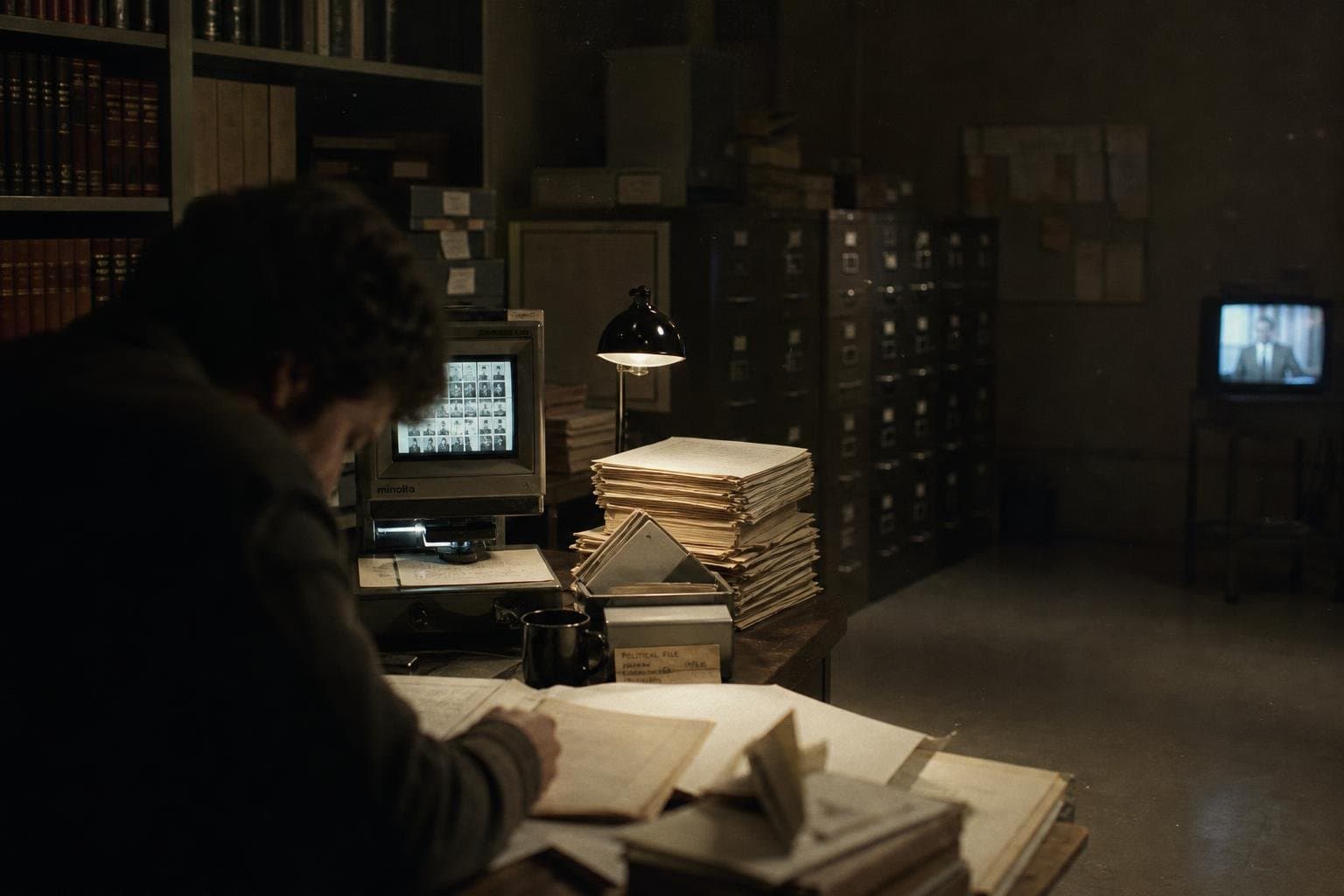
Start with the premise: a respected academic becomes obsessed with a Vatican-connected device that allegedly allows viewers to watch historical events — including the crucifixion — on a small television screen. The film is structured largely as text on screen, with the protagonist poring over decades of archival documents that the filmmakers translate in real time. It premiered at Rotterdam earlier this year and was also a New Directors/New Films selection.
IndieWire's exclusive trailer debut describes the film as reaching "Bill-Morrison-meets-Alex-Garland levels of indescribably unsettling visual chaos," which is either the most accurate sentence written about a movie this year or the most ambitious piece of trailer copy. The film is the debut feature from filmmakers Kevin Walker and Jack Auen, working under the name Cosmic Salon, and it's shot on 16mm in New York City. The Playlist notes that IndieWire contributor Vadim Rizov, writing out of Rotterdam, flagged "Vatican secrecy and ominous disappearances" swirling around a narrative with "unexpected, sinister ramifications."
What makes Chronovisor worth tracking before you've seen a frame: the formal choices are genuinely unusual. A film that unfolds primarily as text on screen, set in New York's research libraries, built around archival obsession — that's a structural bet, not just a stylistic one. Either the accumulation of documents and text creates genuine dread, or it collapses into a graduate seminar. The Rotterdam premiere suggests the former. The New Directors/New Films selection — a program with a strong track record for identifying formally adventurous work — adds weight to that read.
The distributor is Grasshopper Film, and the release is described as September. That's a limited theatrical release, almost certainly in New York and Los Angeles to start, timed to arrive just as the fall festival conversation is dominating everything else. Which means Chronovisor risks being exactly the kind of film that gets overlooked not because it's bad but because the timing is wrong. Mark it now.
The Criterion Channel Is Doing Something Quietly Radical With Its August Slate
The Criterion Channel's August programming is, on its face, a collection of themed retrospectives: a "Rock Biopics that Don't Suck" series, a Southern Gothic package, a Desert Trips retrospective anchored by Zabriskie Point and Paris, Texas, a Ringo Lam package. IndieWire's streaming guide notes that David Lynch's Wild at Heart appears in both the rock biopics and Southern Gothic series, which is either a programming oversight or the most correct editorial decision of the month.
But the real argument here is about Blue Heron, Sophy Romvari's feature debut, which IndieWire calls "one of the very best films of the year" and describes as "an utterly wrenching cold-sweat memory piece" — a personal and poignant meditation on time, grief, and memory. It's available to stream on the Criterion Channel starting August 1.
I wrote about Blue Heron back in July when it landed on the Channel, and the argument then was about what it means when the right film finds the right home. The argument now, with a month of August streaming behind it, is slightly different: the Criterion Channel's curatorial framing matters. Placing Blue Heron alongside Paris, Texas and The Night of the Hunter isn't just programming — it's a critical argument. The Channel is saying: this belongs in this conversation. That's a form of advocacy that no aggregator score can replicate, and it's one of the few things a streaming platform can do that actually shapes how a film gets received.
The broader August slate reinforces the point. The "Rock Biopics that Don't Suck" series is a genuinely funny act of counter-programming against the Bohemian Rhapsody industrial complex — IndieWire's framing, and they're right — and it demonstrates that the Channel's programming voice has a personality. That personality is doing real work for films like Blue Heron that don't have marketing budgets or wide theatrical footprints. If you haven't watched it yet, the excuse window is closing.
Letterboxd's Video Store Is Running the Most Interesting Distribution Experiment Nobody's Discussing
The Letterboxd Video Store's August "Unreleased Gems" shelf is worth examining as a structural phenomenon, not just a content recommendation. The platform's journal describes the program's mission as helping films "find passionate audiences outside of their initial festival or regional appearances" — and then immediately offers the most compelling evidence that the model works: Alex Ullom's It Ends, a horror-thriller debut that was an original Unreleased Gems selection, was subsequently acquired by Neon and is heading to US theaters.
That's the loop closing. A film with no distributor gets a digital window on Letterboxd, finds an audience among the platform's film-literate users, and that demonstrated demand becomes leverage in acquisition conversations. It's not a guaranteed pipeline — one example isn't a trend — but it's a proof of concept that the platform's audience can function as a discovery mechanism with real downstream consequences.
The August slate runs from August 26 to September 25 and includes what the platform describes as "buzzy SXSW entrants, award-winning Cannes premieres and an export from Letterboxd's beloved home country of New Zealand." The films span stoner comedies to neo-colonial dramas to character studies. Regions and prices vary by title. One of the selections is Downbeat, directed by Danny Madden — the source excerpt cuts off before providing more detail, so I'll leave the description there rather than speculate.
The more interesting question is what this model reveals about the current distribution moment. The traditional path — festival premiere, acquisition, limited theatrical, streaming — is expensive and slow, and it filters out a lot of genuinely interesting work that doesn't fit the acquisition calculus of the major indie distributors. Letterboxd's Video Store is proposing a different path: skip the acquisition step, go directly to the platform's audience, and let demonstrated demand do the work that a distributor's marketing budget would otherwise do. The It Ends example suggests this can work. The question is whether it scales, or whether it only works for genre films with built-in audience hooks.
What the Fall Preview Actually Tells You About the Indie Ecosystem Right Now
Pull back and look at what these three films have in common, structurally. Chronovisor is a debut feature from filmmakers with no prior theatrical track record, distributed by Grasshopper Film, heading into a September release window that will be dominated by Venice and Toronto coverage. Blue Heron is a Canadian feature debut on the Criterion Channel, getting its widest exposure through a streaming platform's curatorial programming rather than through theatrical distribution. The Letterboxd Unreleased Gems selections are films that haven't been acquired at all, reaching audiences through a rental platform built by and for film obsessives.
None of these are the A24 story or the Neon story. None of them have the marketing infrastructure that drives specialized box office. What they have is: a distributor willing to take a formal risk (Chronovisor), a streaming platform with genuine curatorial authority (Blue Heron), and a community platform that has figured out how to monetize its own audience's taste (Letterboxd). Three different models, all operating in the space that the major indie distributors don't cover.
This is where the ecosystem is actually doing interesting work right now, and it's the part that gets least coverage. The Venice competition will generate hundreds of dispatches. The Neon and A24 acquisitions will generate breathless deal coverage. The films that are already here, already findable, already doing the thing — those get a paragraph in a streaming roundup if they're lucky.
Jane Schoenbrun's Teenage Sex and Death at Camp Miasma opened theatrically in the UK on August 21 via MUBI, per Screen Daily's UK release calendar — a film I covered at length earlier this month when it opened in the US. The fact that it's still rolling out internationally while the fall festival conversation is about to begin is a reminder that distribution is a long game. Films don't stop existing when the next festival starts.
The practical takeaway before Venice swallows the next six weeks: Chronovisor in September, limited theatrical, watch for the Grasshopper Film rollout. Blue Heron on the Criterion Channel now, no excuse to miss it. The Letterboxd Unreleased Gems shelf opens August 26 — thirty days to watch films that may not exist in any other accessible form. The festival dispatches will be here when you get back.


