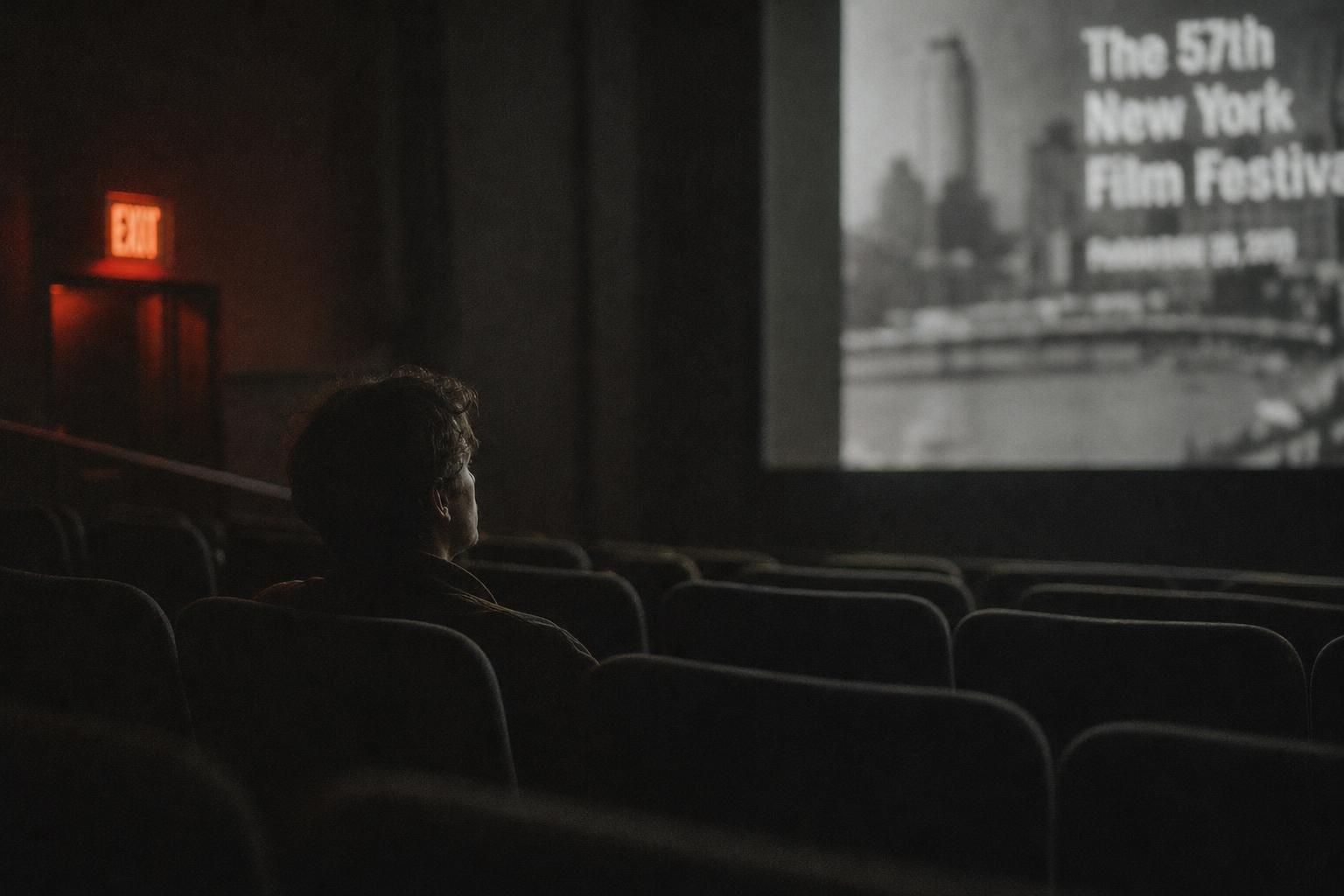

Somewhere between the two poles of indie distribution — a scrappy festival hit scrounging for a distributor, and a platform giant writing an eight-figure check for awards consideration — there's a third option nobody in this newsletter talks about enough: just putting the film online for free and letting people watch it. This fall, that's exactly what happened with one of the most talked-about documentaries out of the New York Film Festival, and it should make you reconsider what "release" even means right now.
A Film About Collateral Damage Is Becoming Collateral Damage of the Theatrical System
Yuval Abraham and Rachel Szor's NAZA, which screened at this year's New York Film Festival, investigates Israel's military campaign in Gaza through interviews with former soldiers and intelligence officers who recount the mechanics of what the military classifies as "collateral damage" — NAZA, in the Hebrew acronym — up to and including strikes that one subject recalls resulting in "500 NAZA," per Film Comment's account of the film. The film is co-produced by The Guardian and, according to that same Film Comment piece, is set to release for free on the paper's website in the coming weeks — not a theatrical booking, not a streaming licensing deal, just an open publication model more associated with investigative journalism than with cinema distribution.
Paired with it at NYFF was Jonathan Glazer's 38-minute Joy of Joys, which Film Comment describes as assembling footage shot by children in Gaza and other conflict zones, intercut with children playing at Abbey Road Studios in London — a film that, notably, Glazer executive-produced NAZA alongside directing himself, per the Film Comment piece. Neither film has a theatrical distributor attached as far as the available reporting shows. Neither needs one, if the plan is a free web release.
I want to be careful here about what I'm arguing and what I'm not. I'm not claiming the free-online model is inherently superior to theatrical distribution — Film Comment's own analysis raises real questions about NAZA's reliance on Israeli military sources over Palestinian ones, a tension the magazine treats with more nuance than I can replicate secondhand. What I'm arguing is narrower: when a NYFF selection this discussed chooses a publication's website over a distributor, it tells you something about where the pressure in nonfiction film distribution is actually coming from. It isn't coming from audiences wanting to pay for a ticket. It's coming from urgency — a film that needs to exist in front of the widest possible audience as fast as possible, box office and theatrical windows be damned.
Apple's Awards Play Is the Exact Opposite Bet
Contrast that with the other big documentary-adjacent title in this week's field: Siân Heder's Being Heumann, a biopic of disability rights activist Judy Heumann starring Ruth Madeley, which IndieWire's November streaming roundup flags as "Apple's big awards play this year," following the studio's Oscar run with Heder's previous film CODA, per IndieWire. This is a platform-exclusive release, not a theatrical one as described in that roundup — a traditional, resourced, campaign-driven strategy built entirely around a service most people already pay for.
Put these two side by side and you get a useful snapshot of 2026's bifurcated distribution logic. On one end: a scripted biopic with recognizable festival pedigree (Heder's film premiered at Sundance in 2021 with CODA, and this follow-up is being positioned the same way, per IndieWire's review excerpt) gets the full platform-exclusive treatment, timed for an awards calendar that rewards patience and marketing spend. On the other: a documentary about live atrocity gets routed around the entire apparatus because the apparatus is too slow, too risk-averse, or simply beside the point for what the film is trying to do. Both are "distribution." Neither looks anything like the theatrical rollout that used to define what a serious film's release meant.
The Short Film Circuit Has Already Solved This Problem, Quietly
If you want proof that bypassing the traditional pipeline isn't even a new phenomenon — just one finally visible at the level of NYFF premieres — look at the short film circuit, where it's been standard practice for years. "DISC," directed by Blake Winston Rice and co-written by Victoria Ratermanis, premiered at the 2025 Toronto International Film Festival before playing more than 50 festivals, including Tribeca, Clermont-Ferrand, and Palm Springs ShortsFest, according to IndieWire. It's now available to stream on Vimeo and Kanopy, timed to this year's Best Live Action Short conversation. Jim Cummings, who stars in the short alongside Ratermanis, built his career on exactly this kind of circuit-hopping — "Thunder Road" broke at SXSW in 2018 before he made "The Wolf of Snow Hollow" and "The Beta Test," per the same IndieWire piece.
Nobody expected "DISC" to get a theatrical booking. Shorts never do, outside of the occasional festival block. But the model — festival laps, then a direct landing on a streaming platform with no theatrical pretense at all — is the one more and more nonfiction and even some narrative features are adopting by necessity, not choice. The difference this fall is that it's happening to films with real stakes attached, not just awards-season short-film contenders nobody outside the industry tracks.
Letterboxd's Rental Window Is the Same Instinct, Dressed Up as a Product
I wrote last week about Letterboxd's 30-day rental window for undistributed festival titles, and the worry that it comforts an industry that should be panicking instead. The November edition of that program — what Letterboxd calls "Unreleased Gems," running from November 12 to December 12 — continues that pattern: a mix of Tribeca and Slamdance standouts and a SXSW premiere the platform's own editors call among their favorite films out of Austin, all landing there specifically because no distributor picked them up, per Letterboxd.
That's three distinct distribution failures or innovations — depending on your mood — happening in the same month: a politically urgent documentary skipping theaters for a newspaper's website, a short film using the festival circuit as a stepping stone to direct streaming availability, and a batch of unnamed festival favorites landing on a thirty-day rental clock because the traditional acquisition market didn't want them. None of these are the same problem. But they rhyme.
Meanwhile, the Old Machine Still Grinds On
It's worth noting that traditional theatrical distribution hasn't disappeared — it's just gotten noisier and more crowded. Screen Daily's UK release calendar for this Friday alone lists A24's You Can See Everything opening alongside titles like Josephine from Curzon and The Match from Disney, with MUBI's Minotaur following the next week, per Screen Daily. The theatrical calendar keeps filling up even as the highest-profile NYFF documentaries of the season route around it entirely. Both things are true simultaneously, and that's the actual condition of independent film distribution heading into 2027 — not a single narrative of collapse or innovation, but a fracturing into parallel tracks that rarely intersect.
What to Watch For
Keep an eye on whether NAZA actually lands on The Guardian's site in the coming weeks as described, and whether that free-release model gets adopted for other urgent nonfiction work premiering out of winter festivals. Also worth tracking: whether Apple pushes Being Heumann toward any theatrical qualifying run before awards voting closes, the way platform exclusives sometimes do for a week of Oscar-eligibility bookings — IndieWire's current framing treats it as a streaming title, full stop, which is itself a signal about how confident Apple is in a pure platform campaign this cycle. The films worth your attention this month aren't necessarily the ones with the loudest acquisition news. They're the ones quietly testing whether a theater is even a requirement anymore.


