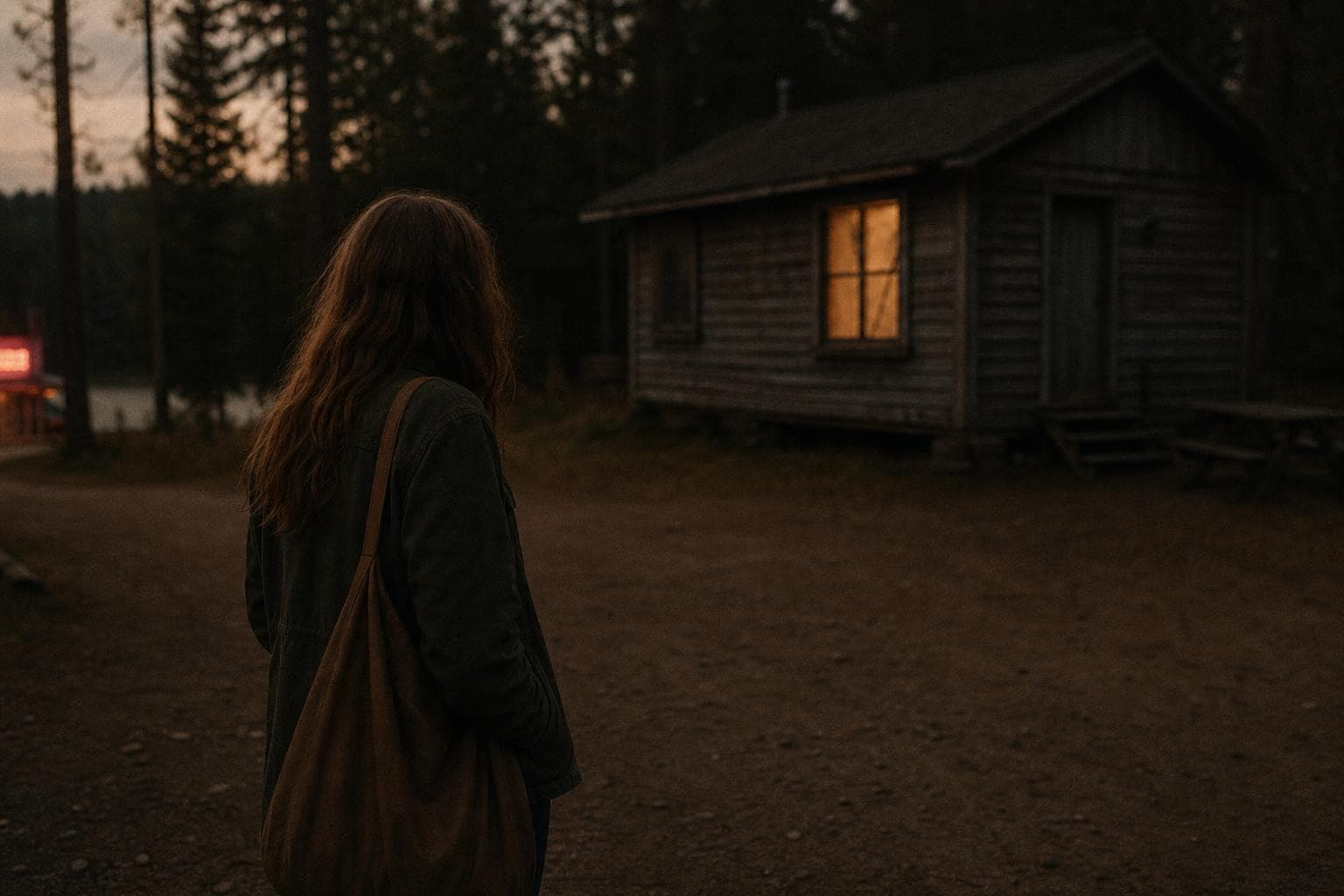

There's a moment in the trailer for Teenage Sex and Death at Camp Miasma where the film seems to fold in on itself — a movie about making a movie about a movie, with Hannah Einbinder's young director Kris standing in a space that exists simultaneously as a real campground and a constructed set. It's the kind of image that announces a filmmaker operating at full frequency. It's also, as of this writing, heading to a MUBI theatrical release starting August 7 — not a wide release, not a platform dump, but a deliberate summer theatrical run from a streamer that has spent the last few years quietly becoming the most interesting distributor in arthouse cinema.
That combination — Schoenbrun's escalating formal ambition, MUBI's particular distribution model, and a film that emerged from Cannes as one of the festival's most acclaimed titles — makes this the story worth tracking right now. Not just as a film recommendation, but as a case study in what the indie ecosystem actually rewards when it's working correctly.
The Film Schoenbrun Made, and Why It Matters That They Made It
Teenage Sex and Death at Camp Miasma is, by Schoenbrun's own account at Cannes, a film about "coming into one's own body, one's own identity, one's own sexuality, for me, for the first time in my life at age 34." That's a filmmaker describing their most personal work while simultaneously delivering what looks, structurally, like a genre exercise — a sapphic meta-horror about a young director hired to resurrect a fading slasher franchise called "Camp Miasma," who visits the original film's reclusive star (Gillian Anderson) and falls into what IndieWire's review calls "gory, delirious psychosexual freefall."
The formal architecture here is doing real work. The film-within-a-film structure isn't a clever conceit bolted onto a conventional story; it's the story's actual subject. Kris's creative awakening and her sexual awakening are the same awakening, and the meta-horror framing lets Schoenbrun externalize that collapse of boundaries — between self and performance, between the film being made and the film being watched — in ways that straight drama couldn't. The matte paintings that serve as backdrops in both the film-within-the-film and the film containing it, the return of I Saw the TV Glow cinematographer Eric Yue, the acoustic contributions from musician Alex G: these aren't prestige signifiers. They're a coherent formal vocabulary that Schoenbrun has been developing across three features.
I wrote back in April that Schoenbrun was the only genuinely risky bet in the Cannes lineup. The Cannes reception — "one of the most acclaimed movies out of the 2026 Cannes Film Festival," per IndieWire — confirms that the risk paid off critically. The more interesting question is what happens next.
What MUBI's Theatrical Bet Actually Signals
MUBI acquiring Teenage Sex and Death at Camp Miasma for a theatrical release starting August 7 is not a neutral distribution fact. It's a statement about what kind of films get theatrical runs and who's willing to make that bet.
The context matters: MUBI has been building financing and distribution infrastructure in ways that most streamers haven't bothered with. A theatrical release for a formally experimental sapphic meta-horror film in August — traditionally a graveyard for anything that isn't a franchise tentpole — is a genuine swing. It's also consistent with MUBI's positioning as the distributor willing to treat arthouse cinema as a theatrical event rather than a streaming afterthought.
Compare this to the alternative: a film like Teenage Sex and Death at Camp Miasma, in a different market moment, might have landed on a platform with minimal theatrical presence, gotten a week in a handful of cities, and disappeared into an algorithm. The fact that it has a named theatrical release date, a distributor with genuine arthouse infrastructure, and a summer window that gives it room to build word of mouth — that's the ecosystem functioning as it should. Schoenbrun told IndieWire at Cannes that the film is "about as commercial as I can do, which is maybe not commercial." MUBI is betting that "not commercial" and "theatrical event" aren't mutually exclusive.
The Cannes Cohort Around It, and What the Competition Actually Rewarded
Teenage Sex and Death at Camp Miasma didn't win the Palme d'Or. That went to a different film entirely — but the awards story from Cannes 2026 is worth parsing for what it reveals about the competition's actual priorities.
Fatherland, Pawel Pawlikowski's black-and-white post-war road movie starring Sandra Hüller as Erika Mann and Hanns Zischler as her father Thomas Mann, was widely tipped for the Palme d'Or and walked away with Best Director — shared with Los Javis for The Black Ball. The film follows father and daughter traveling from U.S.-controlled Frankfurt to Soviet-dominated Weimar in 1949, and IndieWire's review notes "the aching black-and-white, the Academy aspect ratio, the streak of fatalism running between dueling identities" — all the formal signatures of Pawlikowski's work on Cold War and Ida. It's also, per the same coverage, already positioned as a major Oscar contender, with Hüller in potential Best Actress contention alongside her performance in Markus Schleinzer's Rose (also coming from MUBI).
The pattern here is familiar: Cannes rewarded the formally rigorous, historically grounded European art film with its craft prize, while the more formally disruptive American work — Schoenbrun's — generated the critical heat without the hardware. That's not a complaint about the jury's choices. It's an observation about what "acclaimed" means at Cannes and how that translates (or doesn't) to the distribution story that follows.
Meanwhile, Hirokazu Koreeda's Sheep in the Box — a near-future drama about grieving parents who adopt a humanoid AI replica of their late son — received a notably muted response despite Koreeda's recent run of critical success. IndieWire described audiences as "surprised," expecting an AI dystopia and getting something stranger and less emotionally coherent. Koreeda himself acknowledged the reception: "It seems a lot of people were expecting some AI dystopian, controlled-by-robots story and that they are surprised that it doesn't end that way." That gap between expectation and execution is its own kind of formal risk — one that didn't land the way Schoenbrun's did.
The A24 Wildcard and What It Tells You About the Moment
While Schoenbrun and MUBI represent one pole of the current indie moment — formally adventurous work finding a distributor willing to treat it as a theatrical event — Backrooms represents something different and equally revealing.
Kane Parsons, 20 years old and described by IndieWire as the youngest director ever commissioned by A24, adapts his own YouTube series — itself based on an internet creepypasta — into a feature that stars Chiwetel Ejiofor as a furniture salesman drawn into a maze of transmogrifying rooms. The film begins as found footage, set in June 1990, and builds outward from there. IndieWire's review calls it "mind-bending but occasionally brain-freezing" — technically accomplished, formally inventive, and occasionally inert in the way that happens when a filmmaker's visual imagination outpaces their narrative instincts.
What's interesting about Backrooms isn't the film itself — it's what A24 commissioning it says about where the studio thinks the audience is. Parsons built his following on YouTube, taught himself Blender at 16, and created a digital mythology that already had a devoted audience before A24 came calling. That's a different acquisition logic than "we saw this at Sundance and believed in it." It's closer to "we identified a creator with an existing community and gave them a feature budget." Whether that logic produces better films than the festival-discovery model is genuinely unclear — Backrooms is a mixed result — but it's a real shift in how A24 is thinking about where new directors come from.
The contrast with Schoenbrun is instructive. Schoenbrun came up through the festival circuit, built a reputation on We're All Going to the World's Fair and I Saw the TV Glow, and earned Cannes through a decade of formal development. Parsons arrived via YouTube and a platform-native audience. Both ended up with major distributors willing to give them theatrical releases. The indie ecosystem, for all its dysfunction, is currently running two parallel pipelines for new filmmakers — and both of them, this summer, are producing work worth arguing about.
What August Actually Looks Like
The practical question for readers of this newsletter: what's worth your time, and where can you find it?
Teenage Sex and Death at Camp Miasma has a confirmed MUBI theatrical release starting August 7. That's a real date with a real distributor — not a festival premiere with acquisition rumors attached. Fatherland is positioned as an Oscar contender with MUBI also attached for distribution, though a specific theatrical date hasn't been confirmed in the sources available. Backrooms is an A24 release; no theatrical date is confirmed in current sources, but A24's standard practice for horror with an existing fanbase suggests a theatrical window is likely.
What this summer is shaping up to be, at the arthouse level, is a test of whether formally ambitious work can find audiences when the distribution infrastructure is actually behind it. MUBI's bet on Schoenbrun is the clearest version of that test. If Teenage Sex and Death at Camp Miasma builds the kind of theatrical word-of-mouth that I Saw the TV Glow generated — and it has the critical reception to support that — it will be evidence that the ecosystem can still make space for the genuinely strange.
Watch for how MUBI positions the August 7 opening: screen count, city rollout, and whether they're treating it as a platform release that expands or a limited run that stays limited. That decision will tell you more about the health of arthouse distribution than any acquisition announcement.


