


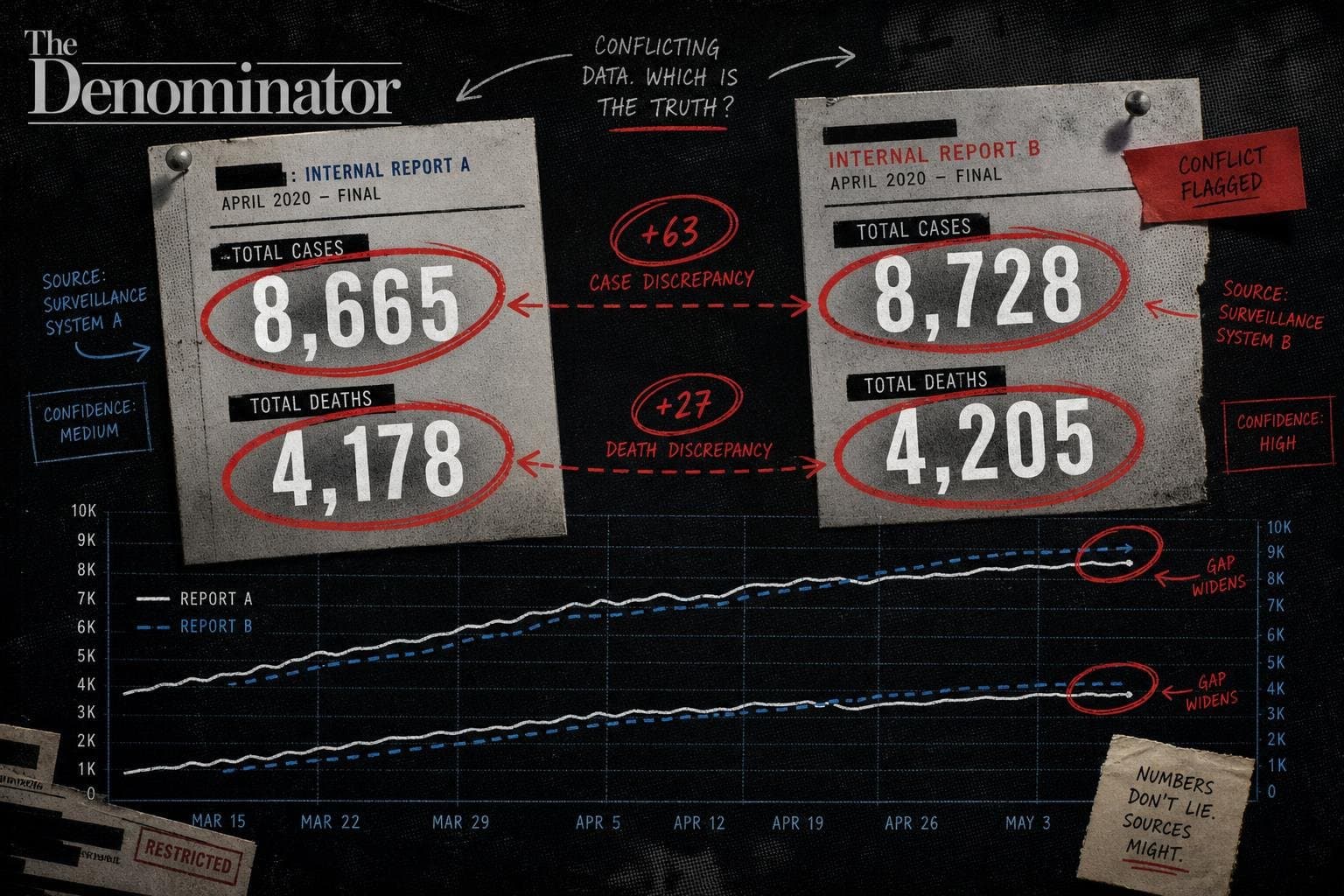

On October 7, the WHO Director-General told reporters the Congo Ebola outbreak stood at 8,665 confirmed cases and 4,178 deaths, with signs of slowing in some areas and continued growth in others (WHO briefing, Oct 7). The WHO's own Disease Outbreak News bulletin, dated to data "as of 6 October," put the count higher: 8,728 cumulative confirmed cases and 4,205 deaths, for a crude case fatality rate of 48.2% (WHO Disease Outbreak News).
That's two official WHO documents, a day apart in publication, disagreeing on a number that should be identical or at least moving in one direction. The briefing — issued after the date the bulletin's data was pulled from — reports fewer cases and fewer deaths than the bulletin itself. Not a huge gap in absolute terms, 63 cases and 27 deaths, but the direction is backwards. A press briefing citing older or differently-reconciled data than the technical bulletin it should postdate is the kind of thing that erodes confidence in exactly the numbers people are trying to track week over week.
What the gap probably means, and what it doesn't
This is almost certainly a reconciliation lag, not fraud or a cover-up. Outbreak case counts get revised as suspected cases are confirmed or reclassified, and a verbal briefing often draws on whatever cut of the data was available when the remarks were drafted, not the most current one. The bulletin itself shows how fluid the picture is: contact tracing coverage swung from 87.6% on September 16 down to 74.7% by September 25, then back up to 80.4% by October 4 (WHO Disease Outbreak News) — a 13-point drop and partial recovery inside three weeks, which tells you the underlying surveillance system is itself noisy enough to produce exactly this kind of cross-document mismatch.
None of that means the trend is fake. The seven-day average of new cases did rise to 72 per day as of October 6, per the bulletin, and North Kivu's provincial CFR of 57.7% is real and worse than the national figure. But when two arms of the same agency publish different topline numbers for close to the same date, the honest takeaway isn't "the outbreak is worse than reported" or "better than reported." It's that single-point case counts in an active outbreak carry more uncertainty than headlines convey, and the number you should trust is the one with a clear "as of" date attached — not whichever one a reporter grabs first.