
A single scientific paper, published in 2004, convinced a generation of policymakers that climate change was solvable without fundamentally disrupting the fossil fuel economy. It appeared in Science. Al Gore cited it in his Oscar-winning documentary. U.S. presidents from George W. Bush to Joe Biden incorporated its framework into policy. The United Nations' climate panel worked it into at least three major reports over more than a decade.
The paper was called "Wedges." And according to a joint investigation by ProPublica and Drilled, BP helped shape it.
That's the kind of sentence that requires unpacking. Not because it's implausible — the fossil fuel industry's influence on climate research is well-documented — but because the specific mechanism matters enormously for how we evaluate the numbers that came out of it. This isn't a story about fabricated data. It's a story about which data got emphasized, which technologies got depicted as proven, and who was in the room when those editorial choices were made.
The Claim That Traveled the World
The "Wedges" framework, developed by Princeton scientists Robert Socolow and Stephen Pacala, argued that humanity already possessed the tools to stabilize atmospheric CO2. No technological breakthroughs required. The solution was to deploy a portfolio of existing strategies simultaneously — renewable energy, efficiency improvements, nuclear power, and crucially, carbon capture and storage (CCS).
The rhetorical elegance was the point. Each "wedge" represented roughly one billion tons of carbon emissions avoided per year by 2055. Stack enough wedges, and you hold the line.
Carbon capture and storage was presented as one of the most scalable wedges available. The paper depicted CCS as a proven technology ready for industrial deployment. That framing mattered: it meant the world could keep burning fossil fuels, provided it captured and buried the resulting CO2.
The problem, as ProPublica's investigation documents, is that this characterization stretched the facts. CCS was not then — and is not now — operating anywhere near the scale the "Wedges" framework implied it could.
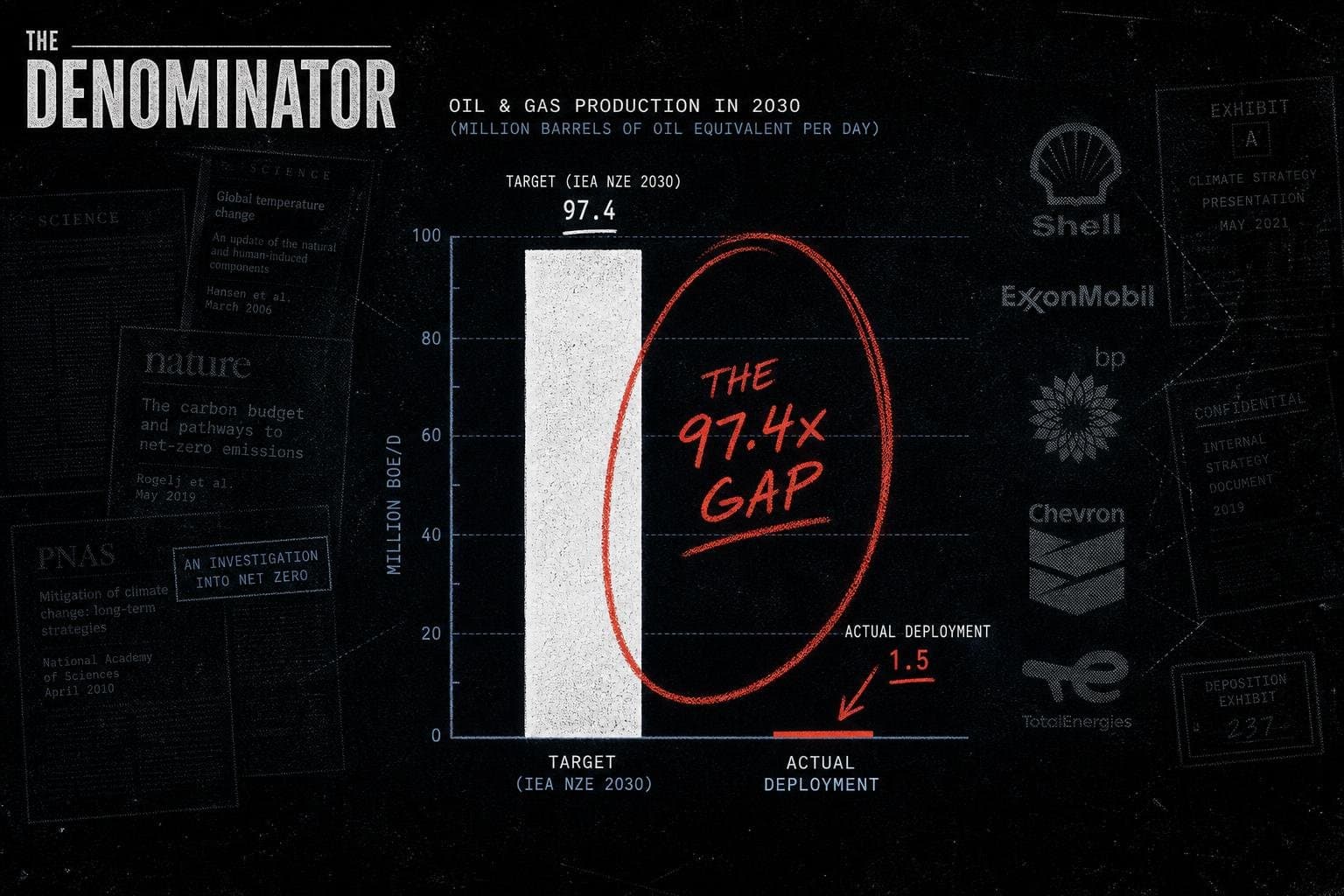
Here's the number that anchors the whole story: in 2008, the International Energy Agency projected that to avoid dangerous warming, the world would need to be permanently burying approximately 1.6 billion tons of CO2 per year by 2025. That deadline has now passed. According to ProPublica's reporting, globally we are currently burying less CO2 than a single large power plant emits in a year.
Read that again. The target was 1.6 billion tons annually. The actual figure is less than what one power plant produces. That's not a gap. That's a different order of magnitude.
Who Was in the Room, and What They Were Selling
The ProPublica/Drilled investigation reveals that BP sponsored an elite Princeton research center — the Carbon Mitigation Initiative — with the explicit goal of addressing climate change in ways that did not require the public to stop using oil and gas. The company handpicked scientists aligned with its interests. And according to the investigation, the Princeton scientists who wrote "Wedges" coordinated with BP executives, showing them multiple drafts before publication.
This is the part where the "compared to what?" question becomes essential.
Is it normal for corporate sponsors to see drafts of research they fund? Sometimes, yes — disclosure agreements and review processes exist across academia. The question isn't whether BP saw the paper. The question is whether that access shaped what the paper claimed, and whether those claims were accurate.
ProPublica reports that the paper was criticized by other scientists as making solutions seem "easy" — and that the researchers depicted CCS as "proven and in use at industrial scale," a characterization the investigation describes as having "stretched the facts."
That phrase — "stretched the facts" — is doing a lot of work. Let's be precise about what it means in this context. CCS had been demonstrated at small scale. Some CO2 had been pumped underground. The technology existed in a laboratory and pilot-project sense. What had not been demonstrated was deployment at anything approaching the billions-of-tons scale that the "Wedges" framework required to function as a climate solution. Presenting the former as evidence of the latter is a classic base-rate error: the denominator (what's needed) was quietly swapped out for a much smaller numerator (what exists).
The distinction between "this technology works in controlled conditions" and "this technology can scale to solve a planetary problem" is not a minor methodological quibble. It is the entire argument.
The Amplification Machine
A paper that overstates a technology's readiness is a problem. A paper that overstates a technology's readiness and then gets cited by the IPCC, incorporated into presidential policy, and featured in an Oscar-winning documentary is a different category of problem.
"Wedges" became what researchers sometimes call a "load-bearing citation" — a paper so frequently referenced that its assumptions get laundered into the background of subsequent work. When the IPCC models presume CCS succeeds, that presumption doesn't arrive with a footnote explaining that actual deployment has fallen catastrophically short of projections. It arrives as a modeling assumption, invisible to most readers of the final report.
This is how statistical misinformation propagates most effectively: not through outright fabrication, but through a chain of citations in which each link inherits the previous link's framing without re-examining the underlying data. By the time a number reaches a policy document or a news headline, its original methodological context has been stripped away entirely. It's the same dynamic this publication traced in the BLS independence debate earlier this month — institutional credibility gets borrowed by downstream claims that haven't earned it.
The IEA's 2008 projection of 1.6 billion tons per year by 2025 is a useful stress test for this dynamic. That projection was made 17 years ago. The 2025 deadline has passed. The actual deployment figure is, by ProPublica's account, a rounding error compared to the target. And yet the models used in the latest UN climate assessment still presume the technology succeeds — because the alternative is to acknowledge that the math doesn't work without it.
IEA representatives and UN modelers say their projections reflect what the world has to do to achieve climate goals, not what it is currently doing. That's a defensible methodological position. It is also a position that is almost never communicated clearly to the policymakers and journalists who consume the resulting reports.
"Studies show carbon capture can work" and "models assume carbon capture must work at a scale it has never approached" are not the same sentence. They have been treated as interchangeable for two decades.
The Fossil Fuel Funding Problem Is a Denominator Problem
Here's where the statistical lens becomes most useful. The ProPublica/Drilled investigation is, at its core, a story about selection bias in research design — which is a denominator problem wearing a lab coat.
When BP funds a research center tasked with finding climate solutions that don't require reducing fossil fuel consumption, it has already defined the denominator. The universe of acceptable solutions excludes the most direct intervention. Every paper that emerges from that framework is answering a constrained question: given that we keep burning fossil fuels, what else can we do?
That's a legitimate research question. It becomes illegitimate when the constraint is invisible — when the resulting papers are presented as comprehensive assessments of climate solutions rather than as analyses conducted within a funder-imposed boundary.
The "Wedges" paper did not disclose, in its original framing, that it was produced within a research center whose corporate sponsor had a direct financial interest in the conclusion that CCS was viable and scalable. Whether that sponsorship constituted a conflict of interest that should have been disclosed more prominently is a question the scientific community continues to debate. The Reuters fact-check operation has documented repeatedly how missing context — not outright fabrication — is the primary mechanism by which misleading claims survive public scrutiny. The "Wedges" case is a textbook example of that pattern operating at the highest levels of academic publishing.
This is why the publication's standing rule — when citing a study, note the funding sources — exists. It's not a bureaucratic formality. It's the difference between "Princeton scientists found CCS is viable" and "Princeton scientists, at a center funded by BP, found CCS is viable." Same words. Different information content.
What the Actual Deployment Numbers Tell Us
Set aside the funding question entirely and just look at the data.
The IEA's 2008 target: 1.6 billion tons of CO2 buried per year by 2025. The actual figure as of ProPublica's reporting: less than one large power plant's annual emissions. This post won't invent a precise current figure where the source doesn't supply one — but the directional claim is unambiguous and sourced to a primary institution.
Some CCS advocates point to CO2 pumped underground for enhanced oil recovery as evidence the technology works. ProPublica addresses this directly: that process isn't designed to function the same way as permanent carbon storage and isn't monitored as stringently. Using enhanced oil recovery as a proxy for CCS deployment is another denominator substitution — replacing the relevant measure (permanently sequestered CO2) with an available but non-equivalent measure (CO2 used to extract more oil).
The pattern is consistent across every layer of this story. A technology is depicted as proven based on small-scale demonstrations. A projection is made assuming massive scale-up. The scale-up doesn't happen. The projection gets incorporated into subsequent models anyway. The gap between projection and reality grows. And the original paper, shaped in part by a funder with interests in the conclusion, continues to be cited as foundational.
It's worth situating this against how other scientific institutions handle the same challenge. The WHO's framework for assessing research impact — the subject of an active global coalition convened this week — explicitly foregrounds the question of who commissions research and how that shapes what gets measured. The "Wedges" case is precisely the failure mode that framework is designed to catch: research that demonstrates societal value to its funder while obscuring its limitations from everyone else.
The Lesson Isn't "Don't Trust Science"
The tempting misread of this story is that it's an argument for climate nihilism — if the research was compromised, maybe the whole enterprise is suspect. That's exactly backwards.
The lesson is that the tools for evaluating research — checking funding sources, examining methodology, comparing projections to actual outcomes, asking "compared to what?" — are not optional accessories for specialists. They are the minimum equipment for reading any consequential claim. This is precisely the kind of evidence-assessment challenge that researchers like those behind the CDC's emerging infectious disease modeling work grapple with explicitly: how do you build primary prevention strategies when the data on rare, high-consequence events is thin and the pressure to act on incomplete evidence is enormous? The answer isn't to overstate what small-scale evidence proves. It's to be transparent about the gap between what's demonstrated and what's assumed.
The "Wedges" paper was not fabricated. Its authors were not frauds. The data on small-scale CCS demonstrations was real. What was missing was the denominator: the honest accounting of how far actual deployment fell short of what the framework required, and the disclosure of who had a financial interest in that gap going unexamined.
Watch for whether the IPCC's next major assessment cycle — and the policy documents that follow it — begins to reckon explicitly with the CCS deployment gap. The models have been assuming success for two decades. At some point, the distance between assumption and reality becomes too large to paper over with another optimistic projection.
The number to watch isn't a percentage or an index. It's tons of CO2 permanently sequestered per year, compared to what the models require. Right now, those two figures are not in the same conversation.


