
A single scientific paper, published in 2004, convinced presidents, the United Nations, and Al Gore that climate change was solvable without abandoning fossil fuels. The trick was carbon capture and storage: grab the carbon dioxide from smokestacks, bury it underground, and keep burning oil and gas while the planet stabilizes. The paper made it sound not just possible but straightforward — a matter of doing a little of everything and letting the effects add up.
The paper was called "Wedges." And according to a joint investigation by ProPublica and Drilled, the numbers behind its most consequential claim were never close to right.
This is a story about how a single dataset — or rather, the absence of one — shaped two decades of climate policy. And it's a story about what happens when the gap between a projection and a measurement gets papered over with optimism, institutional prestige, and oil company money.
The Projection Was Specific. The Reality Was Not.
Start with the number that matters.
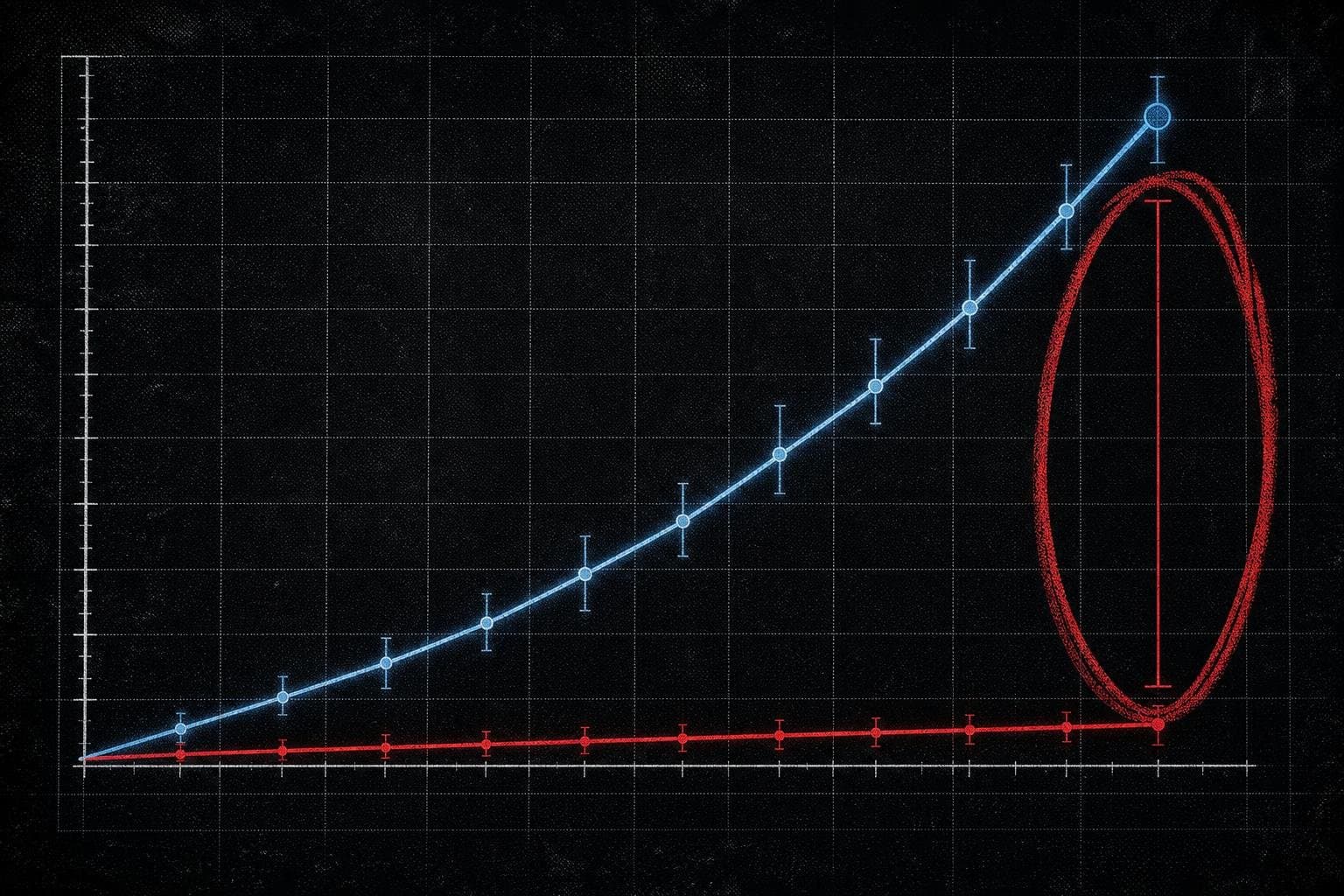
In 2008, the International Energy Agency projected that to avoid dangerous levels of warming, the world would need to be permanently burying approximately 1.6 billion tons — 1,600 megatons — of CO₂ per year by 2025. That's the target. That's what "carbon capture works" would have to look like at scale.
Here's where we actually landed: right now, globally, we're permanently burying less CO₂ than a single large power plant can emit in a year.
Read that again. Not "we fell short of the target." Not "we're behind schedule." We are burying, at industrial scale, a quantity of carbon that one power plant produces. The gap between the IEA's 2008 projection and 2025 reality isn't a rounding error. It isn't a setback. It's a ratio so large it defies the word "shortfall."
The ProPublica/Drilled investigation is careful not to state this as a simple failure of technology. The more troubling finding is about how the gap was managed — not by revising the projections downward, but by continuing to issue optimistic new ones. The models used in the latest UN climate assessments, as the ECDC's own communicable disease surveillance apparatus illustrates in a different domain, are only as reliable as the assumptions baked into them — and when those assumptions go unexamined, the gap between projection and reality compounds silently. In climate modeling, the presumption that CCS would scale has been doing the work that the evidence cannot.
This is the statistical sleight of hand worth naming precisely: when a projection is treated as a baseline rather than a hypothesis, the failure to meet it disappears from the accounting. You don't see a 1,600-megaton miss. You see a "need to accelerate deployment."
BP Funded the Research. Then Coordinated on the Drafts.
The "Wedges" paper wasn't just influential. According to ProPublica and Drilled's reporting on the paper's origins, it was shaped — at the draft stage — by the company with the most to gain from its conclusions.
BP sponsored an elite Princeton research center specifically to address climate change without requiring the public to stop using fossil fuels. The investigation found that Princeton scientists who wrote "Wedges" coordinated with BP executives and showed them multiple drafts. The paper's characterization of carbon capture and storage as "proven and in use at industrial scale" — a characterization the investigation describes as stretching the facts — survived into the published version.
The funding structure matters here for the same reason it matters in any research context: it shapes which questions get asked and which findings get emphasized. This is precisely the kind of methodological flag that Pew Research Center's published methodology documentation models well — disclosing sample designs, fieldwork timelines, and funding structures so readers can assess what the data can and cannot support. The "Wedges" paper, as it circulated through presidential policy documents, UN reports, and Gore's documentary, carried no equivalent disclosure. The coordination with BP executives was not surfaced.
This is the conflict-of-interest problem wearing a lab coat. And the scale of the downstream effect is almost impossible to overstate: U.S. presidents from George W. Bush to Joe Biden incorporated ideas from the paper into policy. The UN's climate panel worked it into at least three major reports over more than a decade. Classrooms taught it. The paper became, in the investigation's framing, "a phenomenon."
A phenomenon built on a projection that was off by a factor that makes the petrol chart I wrote about in April look like a minor rounding dispute.
The "Small Tests Worked" Problem Is a Denominator Error in Disguise
Defenders of carbon capture point to proof of concept: small tests have worked. CO₂ gets pumped underground in enhanced oil recovery operations. The physics is real. The chemistry is real.
This is where the denominator problem becomes acute.
The ProPublica/Drilled investigation notes that boosters of CCS often point to enhanced oil recovery — pumping CO₂ underground to help extract more oil — as evidence the technology works. But that process isn't designed to function the same way as permanent carbon storage, and it isn't monitored as stringently. Using it as proof of concept for climate-scale CCS is like pointing to a garden hose as evidence that a municipal water main is feasible.
The scale problem is the argument. For CCS to work at the level now envisioned by climate models, the world would need to devote almost unimaginable resources — and even then, it might prove impossible to trap so much CO₂ inside the earth. The investigation doesn't say this is theoretically impossible in the way that, say, faster-than-light travel is impossible. It says the gap between demonstrated capacity and required scale is so large that treating CCS as a near-term solution in policy models is a category error.
The category error has a specific shape: it confuses "this works in a test" with "this works at the denominator the problem requires." This is structurally identical to the problem that researchers at Cornell, Johns Hopkins, and UCLA identified in a June 2026 paper in Emerging Infectious Diseases about pandemic prevention: insights from small, frequent spillover events of poorly-spreading viruses cannot be straightforwardly extrapolated to the rare, high-consequence events that actually drive pandemic risk. Small-scale success is real data. It's just the wrong denominator for the claim being made.
This is the same error that produces "95% success rates" from cherry-picked trial populations, or "record low unemployment" figures that exclude discouraged workers. The numerator is real. The denominator is chosen to make the ratio look good.
What Two Decades of Misplaced Confidence Actually Cost
The "Wedges" paper was published in 2004. We are now in 2026. That's twenty-two years during which carbon capture and storage occupied a central place in climate policy modeling — not as a speculative technology requiring aggressive development, but as a near-term solution that justified continued fossil fuel use.
The opportunity cost of that framing is not directly measurable. But the ProPublica/Drilled investigation makes a structural argument: for more than 40 years, oil companies funded research at prestigious universities into climate solutions that would not require the public to stop using oil and gas. CCS was the favored fix. The research shaped the policy. The policy shaped the investment. And the investment went into a technology that, as of 2025, is burying less carbon than one power plant emits.
Meanwhile, the alternatives — renewable energy, efficiency, demand reduction — were framed in the "Wedges" model as pieces of a portfolio, not as the primary solution. The paper's rhetorical genius was its pluralism: do a little of everything. That framing made it politically palatable. It also made it mathematically convenient for fossil fuel interests, because "a little of everything" included "keep burning oil and gas while CCS catches up."
CCS never caught up. The IEA kept projecting that it would. The UN models kept assuming it would. And the gap between projection and reality kept growing, invisibly, because the projections were always about the future.
The Statistical Lesson Is About Projection Hygiene
There's a specific methodological failure worth naming here, because it recurs across domains — not just climate science.
When a projection is issued with high confidence and then fails to materialize, there are two honest responses: revise the projection downward, or explain why the model was wrong. The dishonest response — the one the ProPublica/Drilled investigation documents in the CCS literature — is to issue a new, equally confident projection for a later date, without accounting for the failure of the previous one.
This is projection laundering. Each new optimistic forecast implicitly treats the previous miss as a data point about implementation speed, not about whether the underlying claim was sound. The question "compared to what?" never gets asked, because the comparison would require acknowledging that the 2008 projection for 2025 was off by a factor that should have triggered a fundamental reassessment.
The problem isn't unique to climate science. Consider how Reuters fact-checkers routinely find viral claims that are technically sourced to real projections, from real institutions, that themselves rest on assumptions that were never validated. The source is real. The methodology is invisible. The conclusion is treated as established. "Studies show" carbon capture can work. The studies are real. The sample size is "small tests." The extrapolation to planetary scale is the part that was never earned.
The BLS nominee confirmation hearings earlier this month offered an instructive contrast. Brett Matsumoto, Trump's pick to lead the Bureau of Labor Statistics, told the Senate HELP Committee that BLS decisions should be led by career staff, not political appointees — a commitment to methodological independence that is precisely what was absent from the "Wedges" research process. Statistical integrity requires that the people checking the numbers aren't also invested in the answer.
What to Watch Next
The ProPublica/Drilled investigation is ongoing. The specific thing worth tracking: whether the next round of UN climate modeling revises its CCS assumptions in light of the deployment gap, or continues to treat the technology as a near-term solution on the basis of projections that have been consistently wrong since 2008.
Watch also for how the "Wedges" paper's authors and the Princeton center respond to the reporting on BP coordination. The investigation names specific scientists and specific coordination. A substantive methodological response — one that engages with the deployment numbers rather than defending the paper's intentions — would be genuinely useful. A non-response, or a defense that doesn't address the 1,600-megaton gap, would be its own kind of data.
The number that matters is still the same one: less CO₂ permanently buried than one power plant emits, against a target of 1,600 megatons per year. Everything else is a projection.


