
The Headline Number
"How is it that we've seen the biggest growth in manufacturing employment last quarter that we have seen in this country since Donald J. Trump was president the first time?" — Vice President JD Vance, Kansas City, Missouri, May 18, 2026
The Audit: When the Denominator Is a Calendar Date
There's a specific statistical trick that's older than polling itself: you pick your comparison window after you've seen the data. Not before. After. You find the starting point that makes your number look best, and you present it as though that starting point were the only natural one. Statisticians call it cherry-picking. Vance's team apparently calls it a speech.
Let's trace the claim.
CNN's fact-check found that in Q1 2026, the U.S. economy added 18,000 manufacturing jobs — 2,000 in January, 1,000 in February, 15,000 in March. That's a real number. It's not fabricated. The trick is entirely in the comparison class Vance chose.
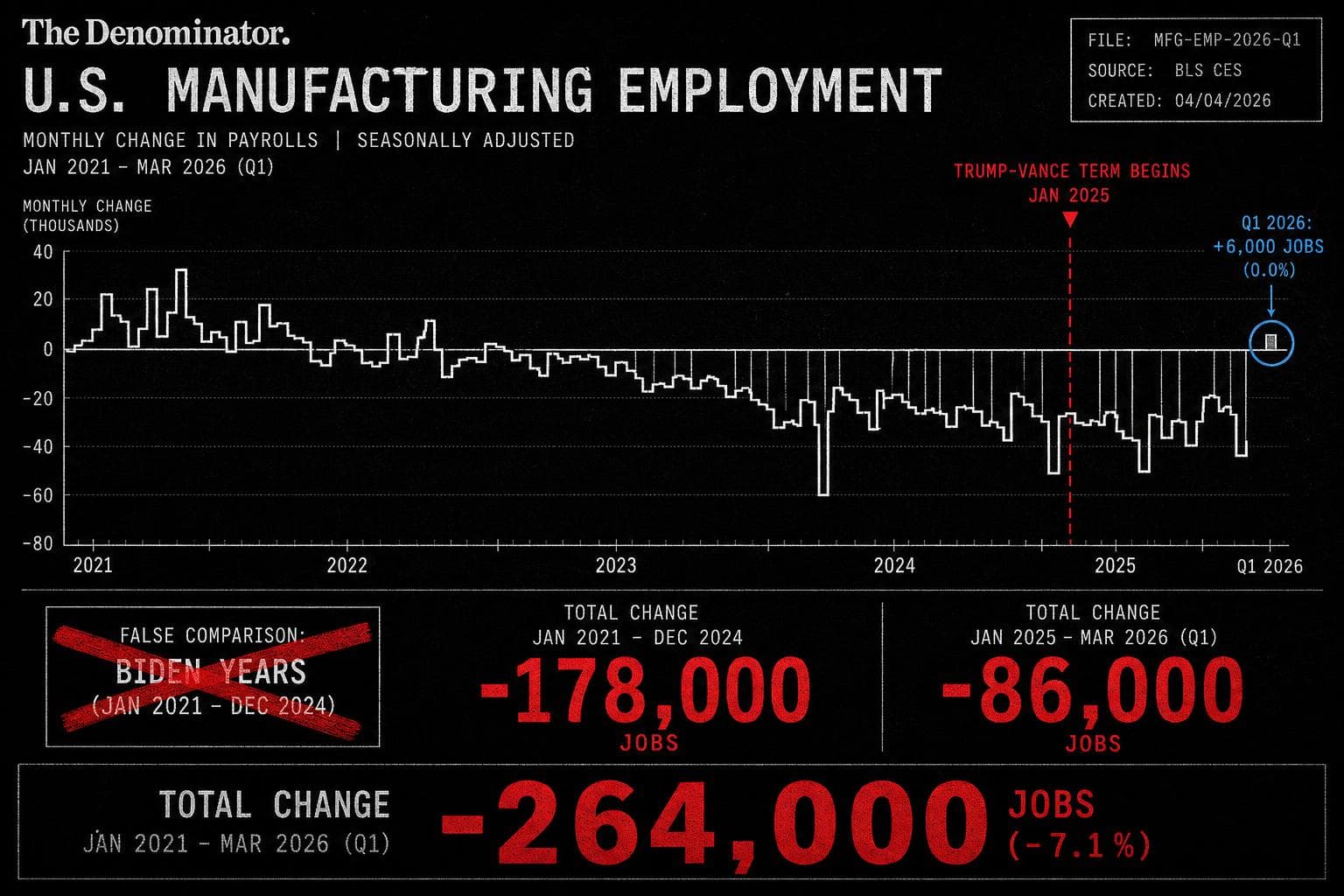
He said it was the biggest manufacturing job growth "since Donald J. Trump was president the first time." That framing quietly excludes the Biden administration's record — which, by the actual BLS data CNN cites, included six of seven full quarters in 2021 and 2022 that each exceeded 18,000 manufacturing jobs added. Q1 2022 alone: 137,000 jobs. That's not a rounding error. That's a factor of roughly seven.
So the accurate version of Vance's claim would be: "We had the best manufacturing quarter since Q4 2023." Which is true. And which is a very different sentence.
The Denominator Problem Is a Window Problem
Here's the deeper issue, and it's one I keep returning to in different forms: the choice of comparison window is itself a statistical claim, and it's almost never disclosed as such.
When Vance says "since Trump's first term," he's implicitly asserting that the Biden years are not a valid baseline. But they are the most recent baseline. They are, by any conventional statistical standard, the first place you look when evaluating a trend. You don't get to skip four years of data because those years are politically inconvenient.
This is the same structural error as the denominator problems I've written about in the Voting Rights Act context — where the Supreme Court's majority opinion cited Black voter turnout figures calculated against the total over-18 population rather than the citizen voting-age population, which excluded people legally barred from voting. In both cases, the number is technically derived from real data. The manipulation is in what you put in the denominator — or in Vance's case, what you put at the left edge of the time axis.
The Alito ruling and the Vance speech share an architecture: find a methodology that produces the conclusion you want, present the output without disclosing the methodology, and let the audience assume the standard approach was used.
The Second Claim Is Worse
The Monday speech was misleading. The Tuesday follow-up was something closer to a direct contradiction of documented reality.
When asked about the economy on Tuesday, Vance cited "great rebounds under the Trump administration" in manufacturing jobs. CNN's reporting is unambiguous on the underlying data: even including the Q1 2026 gain of 18,000, the economy has shed 77,000 manufacturing jobs since the start of the Trump-Vance administration. Manufacturing employment fell every month of 2025 and, per preliminary data, again in April 2026.
A "rebound" implies you went down and came back up. The net figure is still deeply negative. Calling a single positive quarter a "rebound" when the cumulative trend is -77,000 is like calling a patient's temperature "improving" because it dropped from 104 to 103.8.
This is the missing-denominator problem in its most literal form: Vance gave you the numerator (18,000 jobs added in one quarter) while omitting the denominator context (77,000 jobs lost across the full term). The number he cited is accurate. The story it implies is false.
Why This Pattern Keeps Winning
I want to be precise about something: this is not a partisan observation. The window-selection trick and the missing-denominator trick are used across the political spectrum, and I've written about both from multiple directions. What makes the Vance case worth examining in detail is how clean the example is. The debunking requires only arithmetic. No methodology disputes, no sampling arguments, no confidence intervals. You just extend the time window by four years and the claim collapses.
That cleanness is actually what makes it dangerous. When a misleading stat requires a PhD to unpack, most readers shrug and move on. When it requires only a calendar and a BLS table, the fact that it still circulates unchallenged tells you something about how little the correction infrastructure matters once a claim has been delivered from a podium.
The hantavirus misinformation pattern documented by STAT News is instructive here by analogy: false claims don't spread because people are gullible; they spread because the infrastructure for distributing them is faster and more emotionally resonant than the infrastructure for correcting them. A vice president at a manufacturing plant in Kansas City is a better distribution mechanism than a CNN fact-check published three days later.
The correction is always downstream of the claim. That's not a new problem. But the gap keeps widening.
The Verdict
Misleading. The Q1 2026 manufacturing job gain is real. The comparison class Vance chose — "since Trump's first term" — silently excludes six Biden-era quarters that each exceeded it. The "rebound" framing on Tuesday is harder to defend: the net figure for the full term is -77,000 manufacturing jobs. A single positive quarter does not a rebound make. Vance's office declined to comment.
Watch the May jobs report, due in early June, for the April manufacturing revision. Preliminary data already shows another monthly decline. If that holds, the Q1 "rebound" narrative will need a new starting line.
By the Numbers
22.3% — The share of South Korean high school seniors who took the science section of the national college entrance exam in May 2026, per Seoul Economic Daily. That's roughly half the 44.8% recorded in 2021 when the integrated exam launched — a collapse that happened while South Korea was simultaneously expanding tech talent initiatives. The policy and the incentive structure are pointing in opposite directions.
1 of 2 — The number of presidential elections in which Black voter turnout in Louisiana exceeded white voter turnout, when calculated using the citizen voting-age population rather than the total over-18 population. The Guardian's analysis found Justice Alito's majority opinion cited the broader denominator, which includes non-citizens and people with felony convictions who cannot legally vote — yielding "two of five" instead of "one of five." The methodology choice was not disclosed in the opinion.
8 cases, 3 fatal — The confirmed scope of the hantavirus outbreak linked to the MV Hondius cruise ship, per STAT News, which the WHO assessed as low broader public health risk. Online, the outbreak generated enough misinformation volume to fill an epidemiologist's DMs before public health agencies had issued detailed guidance. The ratio of signal to noise in health emergencies is not improving.


