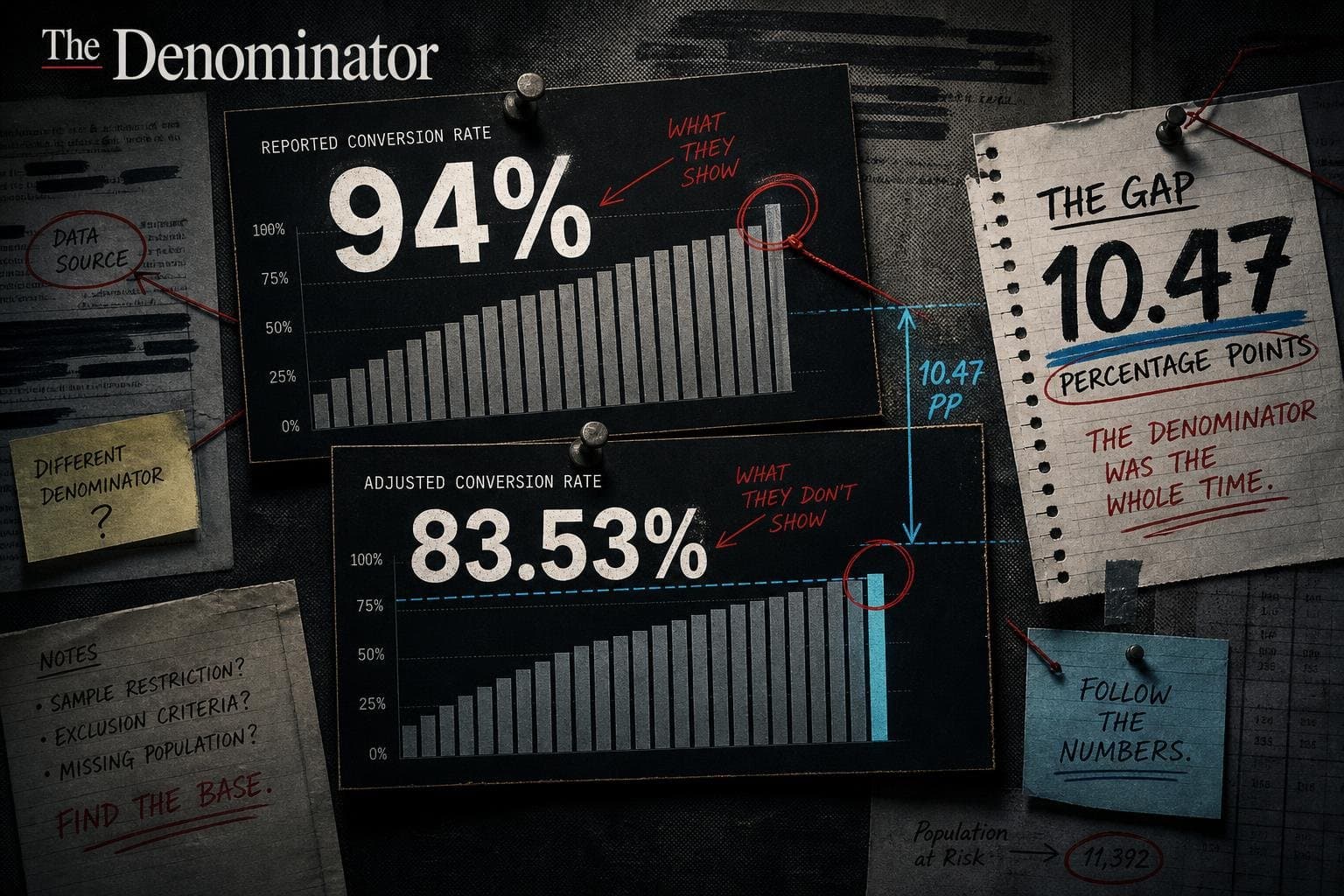

Here's a number that sounds great until you ask what it's measuring: 94%. That's the accuracy rate the Department of Veterans Affairs attached to its October 15 announcement that it processed a record 3,111,399 disability compensation claims in fiscal year 2026, up from 3,001,734 the year before — about 3.7% more claims, per HadIt.com's review of the VA's own release. A government agency announcing it got faster and more accurate at the same time is the kind of headline that writes itself. It's also the kind of headline that collapses the moment you ask which 94% they mean.
This week gave me two versions of the same trick, playing out an ocean apart. One is the VA's claims-processing victory lap. The other is a UK political fight over whether Palantir's NHS data platform is actually improving care. Different agencies, different continents, same move: report the number that flatters you, skip the one that doesn't, and let "accuracy" or "benefit" do more work than the underlying data can support.
The VA Has Two Accuracy Numbers. It Only Announced One.
The VA's press materials led with 94% accuracy. What they didn't lead with — though VA's own published data contains it — is that the agency tracks accuracy two different ways, and they don't agree. Per HadIt.com, citing VA's Detailed Claims Data published September 28, 2026, issue-based accuracy (whether individual issues within a claim were decided correctly) came in at 93.94%. Claim-based accuracy (whether the entire claim was free of error) came in at 83.53%. That's a 10.41 percentage point gap between "basically what got announced" and "the stricter measure VA also calculates but didn't put in the headline."
This matters because a single VA claim can bundle multiple disability issues — some granted, some denied, some processed correctly, some not. Issue-based accuracy grades each piece separately and lets a claim look clean even when the whole isn't. Claim-based accuracy requires the whole package to be right. Pick the first measure and you get 94%. Pick the second and you get 83.5%. Neither number is fabricated. The problem is which one got the press release.
The same release touted a backlog reduction of "more than 70%" and grants on "more than 60%" of claims, but as HadIt.com points out, a claim isn't a veteran — one claim can contain multiple issues with mixed outcomes, and VA's methodology doesn't disclose how partial grants feed into that 60% figure. Meanwhile, pending Higher-Level Reviews — the appeals veterans file when they think VA got it wrong — rose nearly 74% between September 2025 and September 2026, per the same source. A record-setting processing year and a surge in people asking VA to look again aren't necessarily contradictory. But they're also not the story a 94% headline tells on its own.
I'll say this plainly because it needs saying: none of this means VA lied. It means VA reported the version of "accuracy" that required the least explanation, in an announcement designed to be read in fifteen seconds. That's not fraud. It's just lazy numeracy wearing a government seal.
The NHS Found a Correlation and Called It a Benefit
Across the Atlantic, a near-identical pattern showed up in a very different fight. Palantir's newly appointed UK senior vice president, Tom Watson, wrote a letter accusing Labour MP Clive Lewis of making "incorrect claims" about the company's NHS contracts, reported by The Register. In it, Watson said the NHS Federated Data Platform was live at 142 trusts and that "137 are already reporting benefits."
Those numbers are real. What Watson's letter left out is that the UK's own statistics regulator, the Office for Statistics Regulation, had already told NHS England to stop presenting this kind of figure without a caveat. Per The Register, NHS England added language to its published figures on June 6 reading: "We cannot therefore draw conclusions about cause and effect as other variables have not been controlled for." That's about as direct a correlation-versus-causation disclaimer as a government body gets, and Watson's letter simply didn't include it.
The specific claim at issue: NHS England said an Inpatient Care Co-ordination Solution built on the platform was associated with 111,589 additional patients undergoing procedures in operating theaters, per The Register's reporting on data obtained by the campaign group Foxglove. Associated with — not caused by. And the aggregate number hides a messier picture underneath it. Of the 41 trusts actually using the tool, 13 reported carrying out fewer operations, not more, per the same reporting. So the headline figure is a net calculated across trusts moving in opposite directions, more than a third of which saw the metric go the wrong way. That's not evidence the platform doesn't work. It's evidence the 111,589 number can't tell you whether it does.
What Good Denominator Discipline Actually Looks Like
It's worth pointing out what the alternative looks like, because it exists and institutions do sometimes reach for it. The OECD's handbook on building composite indicators lays out, in granular detail, how aggregation and weighting choices should be documented and stress-tested before a single index number gets published, per the OECD's own methodology guide. The whole document exists because the OECD learned the hard way that a composite number without a transparent construction method is an invitation to be gamed, by the publisher and by anyone citing it afterward. Neither the VA's press release nor Watson's letter does anything close to that level of methodological housekeeping. They state a number and move on.
You see the same denominator failure in completely unrelated domains this month. Reuters' fact-checkers flagged that France's 2027 education budget rises in cash terms, but secondary schools and universities lose hundreds of millions of euros in purchasing power once inflation is factored in — a government post touted the cash increase and skipped the inflation adjustment entirely, per Reuters. Same move, different country, different subject: report the number from the year you'd rather compare against, not the one that tells the fuller story.
The Common Failure Isn't Lying. It's Choosing the Easy Number.
Line up the VA's accuracy rate and NHS England's benefit claim and you don't get a story about institutional dishonesty. You get a story about institutions defaulting to whichever statistic survives a fifteen-second read. Issue-based accuracy beats claim-based accuracy because it's higher. "137 of 142 trusts reporting benefits" beats "13 of 41 trusts using this specific tool saw volume drop" because it's simpler. In both cases the harder number existed, was calculated by the same institution, and sat one click away from the headline.
This is the pattern I keep coming back to in this newsletter: the gap between a true number and a misleading one is rarely fabrication. It's selection. VA didn't invent an accuracy rate. It picked the more flattering of two it already had. NHS England didn't invent 111,589 patients. It aggregated a number across trusts with wildly different results and called the net positive a benefit, until a regulator made it add a footnote.
What to watch: the OSR said it asked NHS England to "keep it informed of its progress" on more careful before-and-after reporting, per The Register — that's a regulatory relationship worth checking back on, particularly if the £330 million NHS contract Watson is defending comes up for renewal review. On the VA side, the Higher-Level Review backlog — up nearly 74% year over year as of September 2026 — is the number to track next quarter, because it's the one metric that tells you whether veterans are satisfied with decisions made under VA's record year, independent of which accuracy rate the agency chooses to announce.
Neither of these institutions needs to invent anything to mislead you. They just need you not to ask which denominator they used.


