
The Headline Number
"Black voters now participate in elections at similar rates as the rest of the electorate, even turning out at higher rates than white voters in two of the five most recent Presidential elections nationwide and in Louisiana." — Justice Samuel Alito, majority opinion, Louisiana v. Callais (2026)
The Audit
Last week I wrote about the Supreme Court's voter turnout claim failing the "compared to what?" test. This issue goes deeper into the specific methodology problem at the center of that ruling — because the Guardian's analysis has now surfaced the exact denominator swap that made the number work, and it's worth walking through precisely.
The claim appears in Alito's opinion gutting Section 2 of the Voting Rights Act. It was lifted nearly verbatim from a Department of Justice amicus brief. The argument it supports is structural: that the discrimination which once made the VRA necessary no longer exists, evidenced by Black voters now turning out at rates comparable to — or exceeding — white voters.
That's a significant empirical claim to hang a landmark ruling on. So: compared to what?
The denominator the DOJ chose
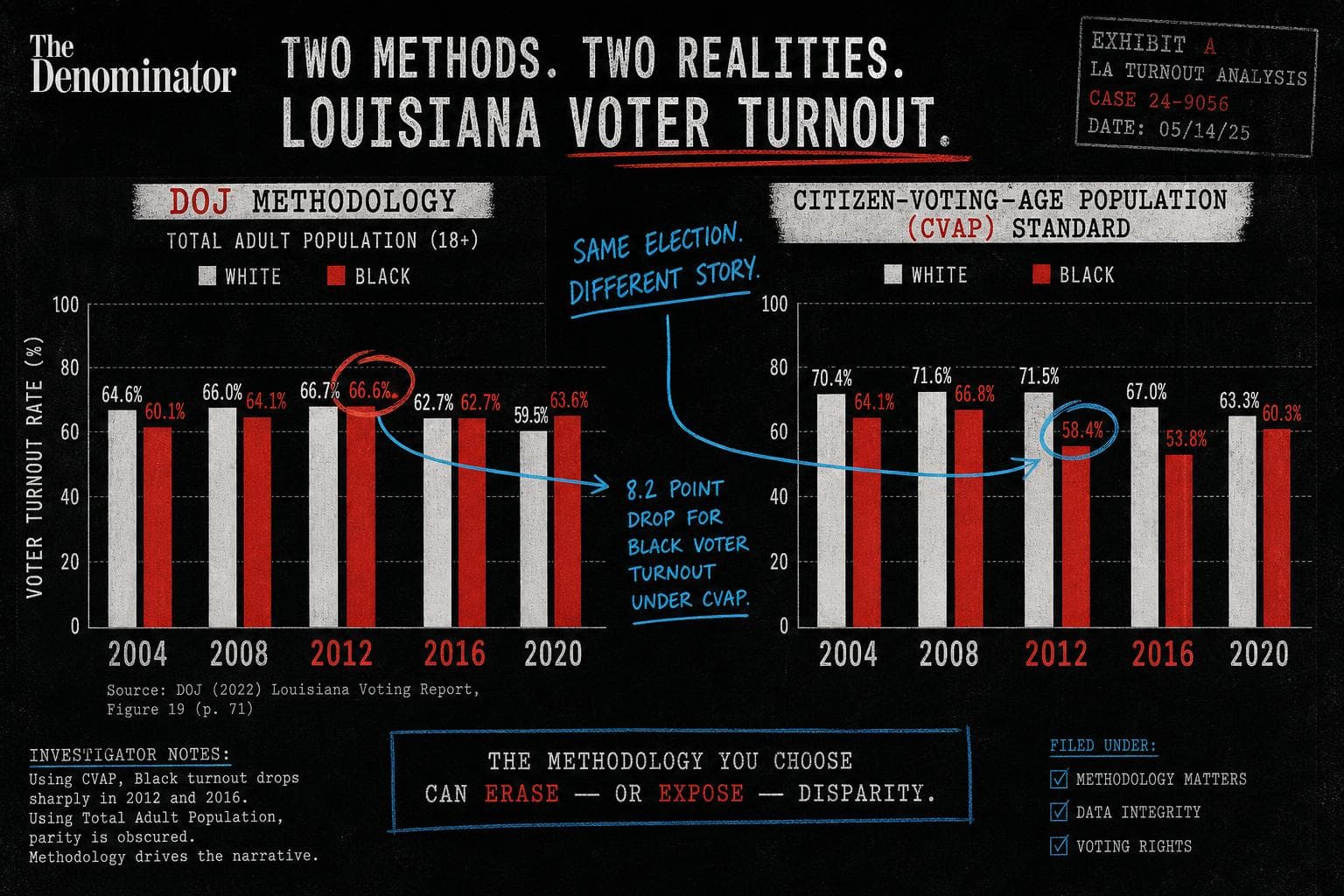
The DOJ brief calculated Black and white voter turnout in Louisiana as a share of each group's total population over age 18. Divide votes cast by total adult population, compare the ratios, done.
The problem is that the over-18 population includes people who cannot legally vote: non-citizens, people with felony convictions, and others who are legally ineligible. Louisiana has one of the highest incarceration rates in the country, and its felony disenfranchisement laws are broad. These populations are not randomly distributed across racial groups.
When you use total adult population as your denominator, you're dividing by a number that includes people who were never eligible to vote in the first place. If one group has a higher share of ineligible adults, their "turnout rate" will look artificially higher than it actually is — because the denominator is inflated by people who couldn't have voted regardless.
The denominator experts actually use
The standard approach, as the Guardian's analysis found, is to calculate turnout as a share of the citizen voting age population (CVAP) or the voter eligible population (VEP) — both of which strip out non-citizens and, in the VEP case, the felony-disenfranchised.
When the Guardian ran Louisiana's numbers using CVAP, the result changed materially. Black voter turnout in Louisiana exceeded white voter turnout in exactly one of the five most recent presidential elections — 2012 — not two. The second data point Alito cited, 2016, disappears under the standard methodology.
One data point versus two. That's the difference between a pattern and an outlier. Alito's framing — "two of the five" — implies something closer to parity or a trend. "One of the five" implies an exception.
Why this particular error is dangerous
Most denominator problems I write about are in viral charts or advocacy reports. They're sloppy, sometimes cynical, but they don't carry the force of law.
This one does. Alito's majority opinion used the two-of-five figure as affirmative evidence that the conditions justifying Section 2 no longer exist. The ruling guts a provision of the Voting Rights Act that has been used to challenge discriminatory redistricting for decades. The empirical claim isn't decorative — it's load-bearing.
The DOJ's methodology isn't technically fabricated. The numbers are real. The data source is real. But the choice of denominator — total adult population instead of citizen voting age population — is, in the words of the experts the Guardian consulted, "misleading." It produces a result that the standard methodology does not support.
That's the trick. Not a lie. A denominator choice that happens to yield the conclusion you need.
The pattern should be familiar by now. The CBP chart I covered in April used real government data and still misrepresented reality, because it double-counted encounters and used population percentages that obscured what was actually being measured. The 98.2% number I audited twice was real arithmetic applied to a misleading base. The mechanism is always the same: find the denominator that gives you the number you want, present it without explanation, and let the audience assume the standard methodology was used.
Here, that assumption was made by six Supreme Court justices.
By the Numbers
1 in 277 — The share of PubMed-indexed papers published in the first seven weeks of 2026 that contain at least one fabricated reference, according to a Lancet analysis led by Columbia's Maxim Topaz. That's up from 1 in 458 in 2025 and 1 in 2,828 in 2023 — a 12-fold increase in two years. The reframe: over 98% of papers identified as containing fake references had seen no publisher action at the time of the audit.
2 of 5 — The number of recent presidential elections in which Alito claimed Black turnout exceeded white turnout in Louisiana. The standard methodology yields 1 of 5. The difference is one denominator choice, made in a DOJ brief, copied into a Supreme Court opinion, and now embedded in federal law.


