


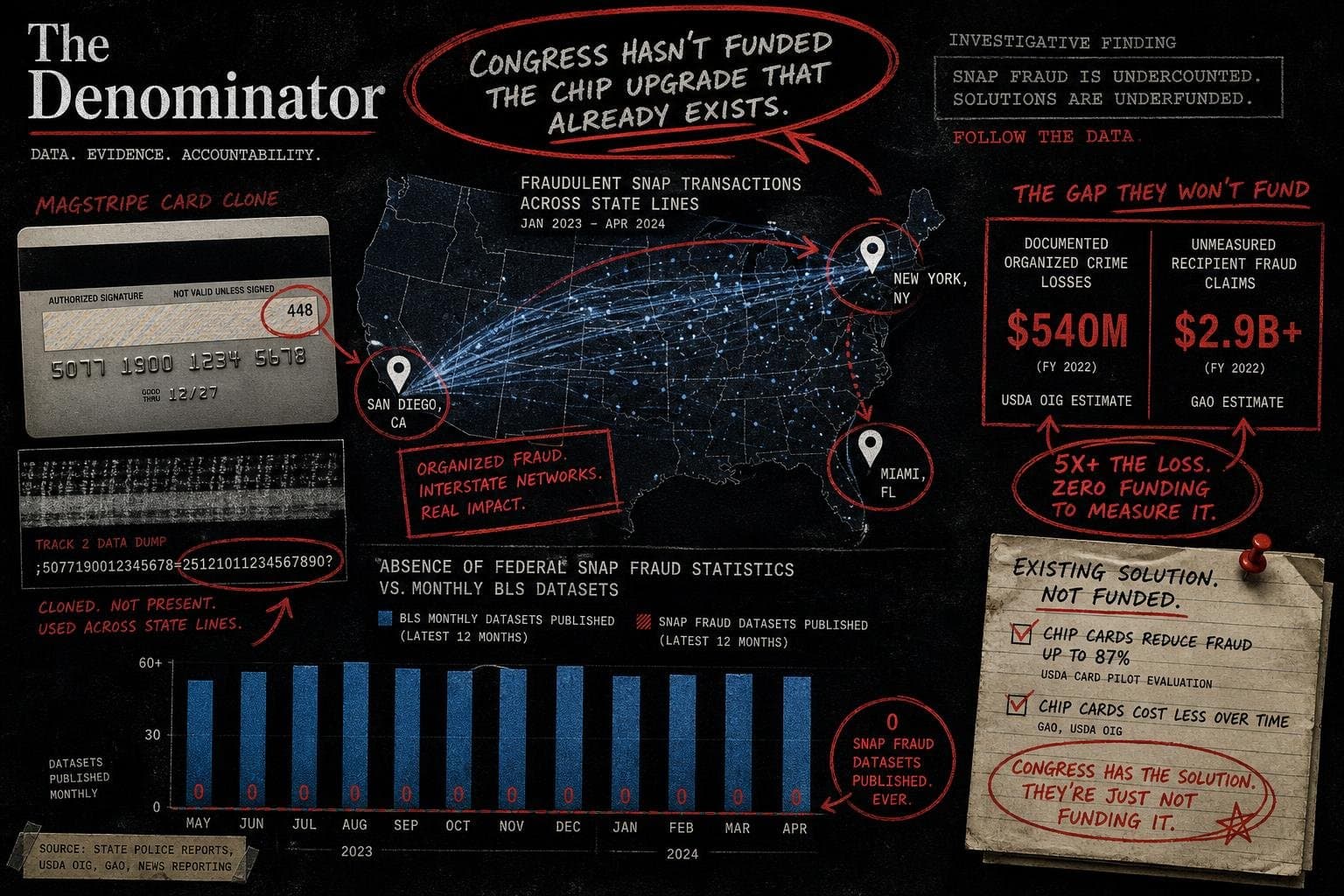

A grocery store in San Diego sold 3,960 cans of Red Bull and 720 cans of Monster Energy to four strangers with the same accent, who paid with 25 different cards that looked like hotel key cards, for a final tab of $10,747.05, according to ProPublica. Within days, people as far away as New York and Florida were calling the same store, confused about why their food-stamp balances had been drained at a location they'd never visited.
That's the anatomy of a SNAP skimming operation, not a SNAP fraud case. The distinction matters, because the two get collapsed into one story in a lot of current political rhetoric — and they are not the same crime, or the same criminal.
The Claim vs. the Data
Trump administration officials have framed SNAP recipients themselves as a major source of program abuse. The reporting counters that framing directly: the people losing money from these schemes are overwhelmingly the recipients, not the perpetrators. The operation described — what investigators called the "Red Bull Crew" — traces back to transnational organized crime, specifically networks with roots in Romania that pivoted from credit and debit card theft to SNAP card skimming once the easier target presented itself, per ProPublica.
I'll flag the limit of what I can verify here: there's no published sample size or national percentage for how much total SNAP loss comes from organized skimming versus recipient-side fraud, so I'm not going to manufacture one. The federal statistical infrastructure that would normally produce that kind of breakdown — the same apparatus that publishes monthly employment and price data through sites like bls.gov — hasn't put out a comparable public accounting for SNAP theft specifically. That absence is itself informative. When an agency is set up to measure something, as the Bureau of Labor Statistics is for the labor market, the lack of an equivalent dataset for benefit fraud tells you where the political attention has gone and where the measurement hasn't followed.
What's documented is a mechanism — magnetic-stripe cards are trivially cloned, EBT holders have little recourse, and the financial damage lands on low-income households rather than on whoever Congress imagines when it says "fraud."
Why the Obvious Fix Isn't Happening
The technical solution already exists and is already deployed elsewhere: microchips, the same tech that replaced magnetic stripes on nearly every other card in your wallet years ago. SNAP cards remain magnetic-stripe only in most states, which is precisely what makes them an easy target for skimmers, according to ProPublica. Congress has the ability to fund the upgrade. Reporting indicates it hasn't.
That's the actual denominator problem in this story. The number getting reported — recipient fraud, as a political talking point — isn't backed by the kind of base-rate data this newsletter insists on before treating a figure as real. The number that is documented, with a named crew, a named transaction, and a named technology gap, is the one nobody in Congress seems to be acting on.
International bodies that track inequality in who bears the cost of policy gaps — the kind of work the OECD does across member countries on health and welfare outcomes, or the kind the WHO does in its forthcoming inequality reporting — share a structural lesson with this story: when you don't measure who actually bears a cost, the most politically convenient narrative fills the vacuum.
What I'm Not Going to Tell You
I don't have a verified government breakdown of SNAP fraud by category to put a hard percentage on recipient-side abuse versus organized skimming — and a publication built on demanding sample sizes shouldn't skip that requirement just because the gap is inconvenient. If a USDA Office of Inspector General dataset or equivalent surfaces with that breakdown, that's the next thing worth tracing.
Watch For
Whether a farm bill reauthorization or standalone appropriations rider includes funding for EBT chip conversion — the fix that exists but remains unfunded. That's the concrete milestone that would tell you whether this is a policy problem Congress intends to solve or a talking point it intends to keep.