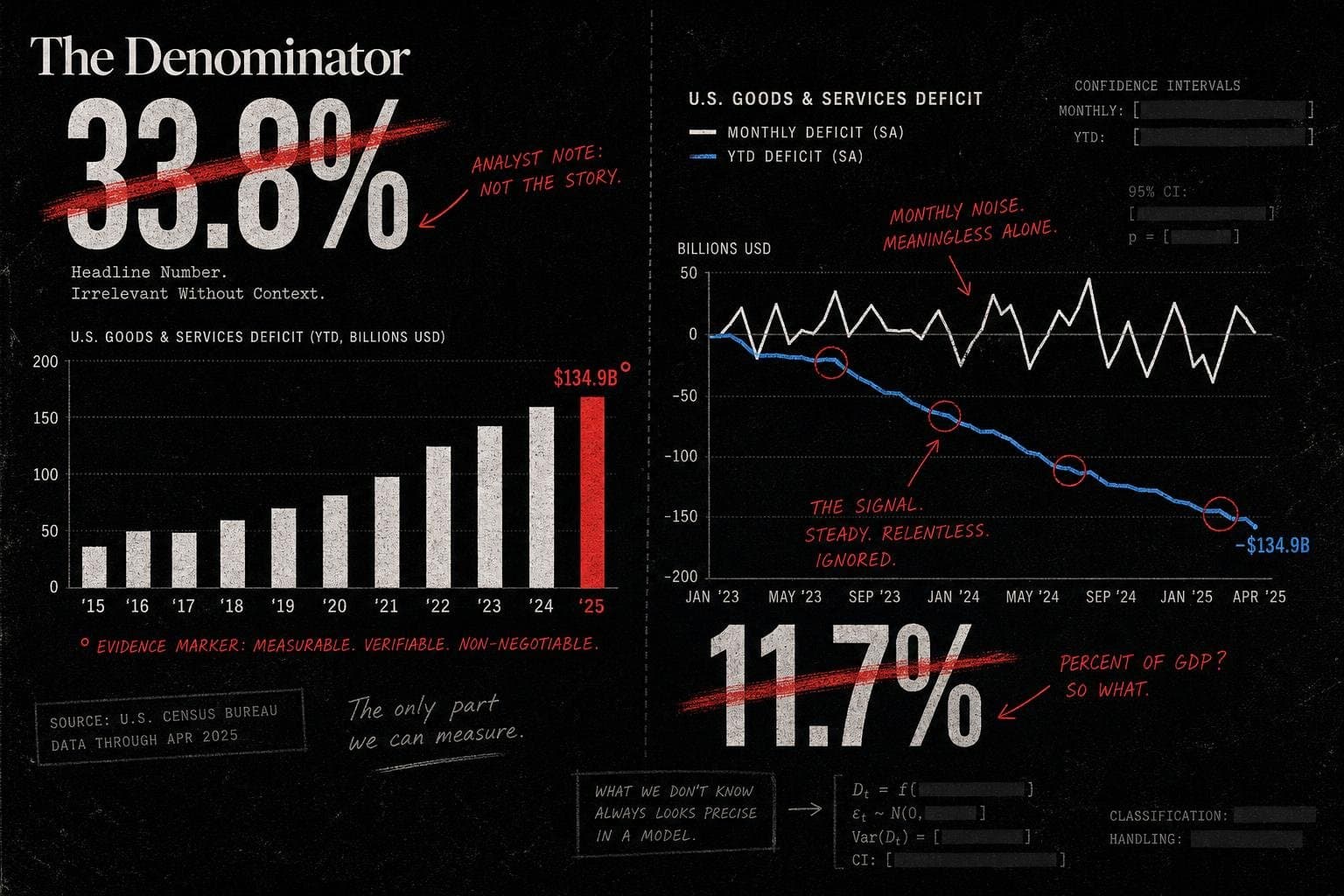

Here's a small, satisfying detail buried in Wednesday's advance economic indicators release: the Census Bureau put a confidence interval on wholesale inventories (up 0.6 percent, ±0.2 percent) and on retail inventories (up 0.3 percent, ±0.2 percent), but not on the headline trade deficit number everyone will actually quote. The September goods deficit, $134.9 billion, up $2.8 billion from August's $132.1 billion, carries a little degree symbol instead of a margin of error — Census's own notation for "statistical significance is not applicable or not measurable" (Census Bureau).
Translation: the bureau is comfortable telling you, with a stated error band, that wholesale inventories grew. It is not willing to tell you, with any error band, that the trade deficit actually widened rather than just wobbled. One of those caveats will make it into headlines. Guess which one.
The Advance Report Measures Goods. The "Real" Deficit Includes Services — and Services Usually Help
This is where the September number needs a second caveat, one Census doesn't put in bold: the advance report only covers trade in goods. It doesn't include services, where the United States typically runs a surplus. Compare the full report for June, which combines both: a $73.3 billion goods-and-services deficit, itself down $4.4 billion from a revised May figure, with the goods deficit alone sitting at $102.1 billion and a $28.8 billion services surplus offsetting it (Census Bureau/BEA).
So when you see "$134.9 billion" attached to September and start doing mental math against a number like "$73.3 billion" from June, you're not comparing the same thing. One is goods only. One is goods plus services. Services subtract, not add, from the headline — meaning the full September figure, whenever it's finally published with services included, will almost certainly read as a smaller deficit than the advance goods number suggests. Reporting "$134.9 billion" as the U.S. trade deficit, full stop, overstates it by construction.
That same June report also contains the sentence that actually deserves attention: the year-to-date goods-and-services deficit was down 33.8 percent compared with the same period in 2025, driven by an 11.7 percent jump in exports against essentially flat imports (Census Bureau/BEA). A monthly deficit tick of a couple billion dollars, with no confidence interval attached, is noise layered on top of a multi-month trend running the opposite direction. I flagged this exact asymmetry when the August revision came through showing an 11.5 percent jump that Census's own footnote said wasn't statistically measurable. The September release repeats the pattern almost mechanically: another month-over-month increase, another unmeasurable footnote, another set of headlines that will treat it as fact anyway.
None of this means the deficit is secretly shrinking. It means the monthly advance number is the wrong instrument for the question "is the trade position getting worse?" It's a goods-only snapshot with an explicit "don't trust this for significance" label, being asked to carry a narrative it isn't built to support.
The Jobs Report Says "Little Change" Six Times. Believe It.
The September employment report, released October 2 after a monthly delay typical of CPS data cycles, is a useful companion piece because the Bureau of Labor Statistics does something the trade release doesn't: it tells you, in its own language, when a number isn't moving. Nonfarm payrolls rose 29,000. The unemployment rate held at 4.2 percent. BLS describes both as having "changed little" (BLS).
That's not evasive hedging — it's methodologically honest. The unemployment rate has sat in a 4.1-to-4.3 percent band since March, a seven-month window with essentially no net movement (BLS). A single month's print inside that band isn't a trend. It's a data point confirming the band.
The number worth sitting with isn't the headline rate. It's 1.9 million — the count of long-term unemployed, people out of work 27 weeks or more, who now make up 27.1 percent of all 7.1 million unemployed Americans (BLS). That 27.1 percent has a clean base: it's 1.9 million divided by 7.1 million, both figures reported in the same household survey, for the same September reference period. Unlike the trade deficit's phantom confidence interval, this ratio is at least internally consistent. What it can't tell you, on its own, is why long-term unemployment is a growing share of a flat unemployment rate — whether that's a sign of a labor market sorting people into harder-to-exit joblessness, or just a mechanical consequence of a smaller unemployed pool overall. The household survey (CPS) measures labor force status by demographic characteristics; it doesn't measure the reason someone has been out of work seven months versus three. That's a real limit, not an oversight, and it's worth naming before anyone turns 27.1 percent into a crisis narrative or a dismissal.
One demographic line moved more than "little": the unemployment rate for Black workers rose to 7.0 percent in September, while the rates for white (3.6 percent), Asian (2.9 percent), Hispanic (4.7 percent), adult men (3.9 percent), and adult women (3.6 percent) workers showed no meaningful change over the month (BLS). A single-month increase in one subgroup's rate, without a comparison to its own multi-month range the way the headline rate gets one, is exactly the kind of number that needs a "compared to what" before it travels any further. BLS didn't give that comparison in this release. I'm not going to invent one.
A Different Kind of Small-Number Problem: Contact Tracing in Nigeria
Switch domains entirely, and the "what's the denominator" instinct still applies — just to public health instead of economics. On October 20, Nigeria confirmed its first imported case of Ebola Bundibugyo virus disease, in a woman with recent travel history to Uganda whose symptoms began October 7, four days after arrival. The case made Nigeria the fifth country to detect the virus since the outbreak was declared in the Democratic Republic of the Congo on May 15, 2026. Nigerian health authorities report 44 contacts identified and under monitoring (WHO Africa).
Forty-four is a number that will mean almost nothing in isolation a month from now. It's not a rate, not a percentage, not compared to anything — it's a raw count of a contact-tracing effort at a single point in time, days after confirmation. Whether containment worked depends entirely on what happens to that number next: does it stay at 44, or does it grow as investigators reconstruct the patient's full travel and exposure history? The WHO release itself notes Kenya has reported nine cases linked to a separate imported case in recent weeks, which is the kind of comparison that actually tells you something — a small denominator (one imported case) producing a non-trivial numerator (nine linked cases) is a different story than a small denominator staying small. Right now, Nigeria's 44 is a snapshot, not a verdict, and anyone reporting it as evidence of success or failure before the follow-up count is published is reading a half-finished sentence.
What to Actually Watch
Three numbers deserve a follow-up, not a one-time headline. The October trade advance report, due November 27, will show whether September's $2.8 billion increase was the start of something or noise that reverts next month — and whether Census attaches a confidence interval to it the second time around (Census Bureau). The next Employment Situation release will show whether the 27.1 percent long-term-unemployed share keeps climbing inside a flat headline rate, which is the more honest story than any single month's payroll print. And Nigeria's contact-tracing count — 44 as of October 20 — will either stay flat or start moving, and that movement, not the initial number, is the actual data point worth citing.
The common failure mode across all three isn't fabrication. It's a single month's number doing the work of a trend, a goods-only figure doing the work of a full trade balance, a raw contact count doing the work of a containment assessment. Wait for the second data point before you believe the first one meant anything.


