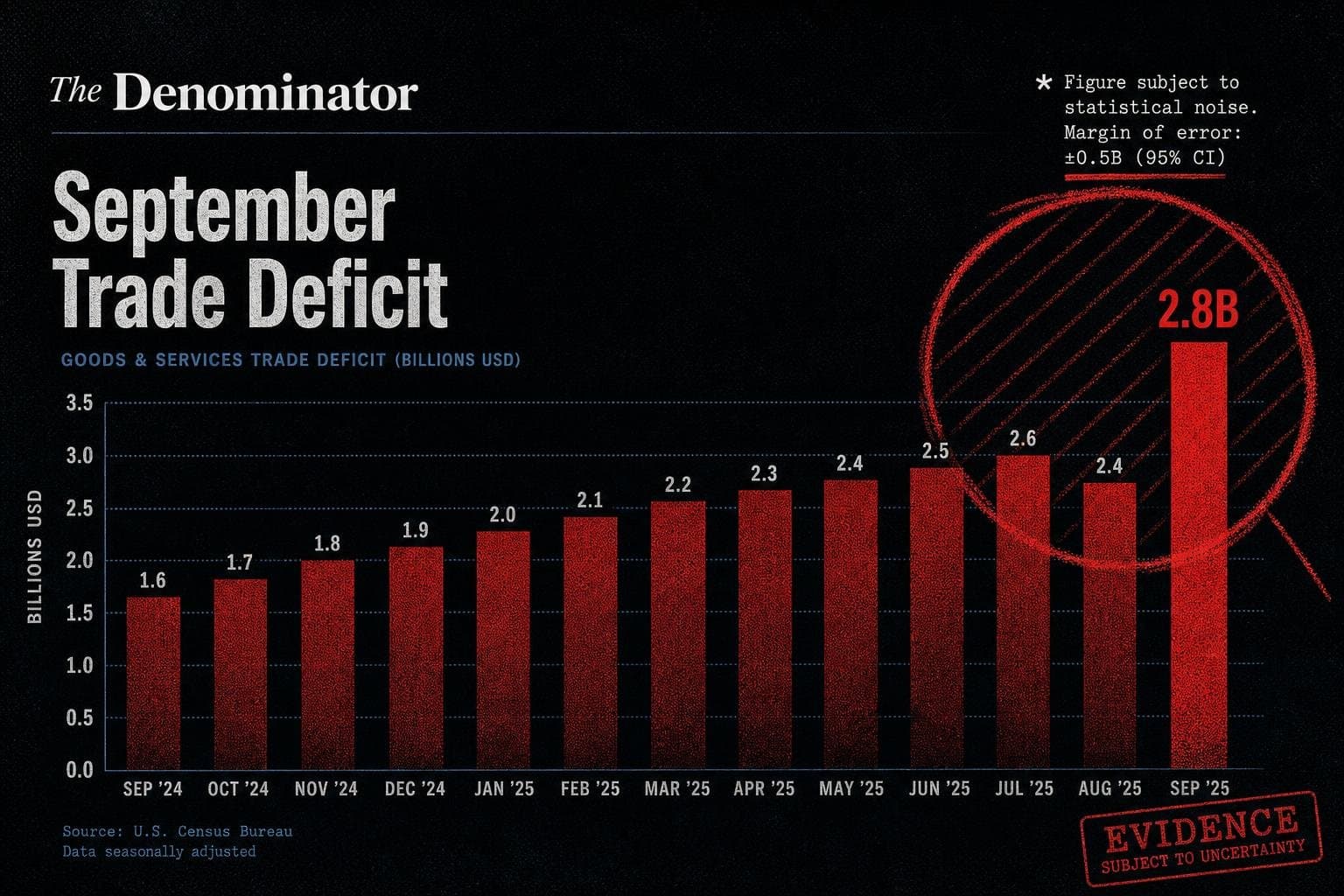

Three weeks ago I wrote about the August trade deficit, which the Census Bureau reported had widened 11.5% — only to have the agency's own confidence-interval footnote say the measured change wasn't statistically distinguishable from zero. Now the September advance report just landed, and the same marker is back. This isn't a one-month fluke. It's baked into how this series works every single release.
What the report actually says
The Census Bureau's Advance Economic Indicators Report, released October 28, puts the September international trade deficit at $134.9 billion, up from $132.1 billion in August — a $2.8 billion, 2.1% increase. Exports rose $5.3 billion to $209.2 billion; imports rose faster, $8.1 billion, to $344.1 billion.
Here's the part that gets stripped out of every headline: next to that 2.1% figure sits a small circle, and the footnote underneath it reads, "Statistical significance is not applicable or not measurable." That's not boilerplate. It's the agency telling you, in writing, that the month-over-month trade figures in this specific release don't come with a confidence interval tight enough to say the number moved by a meaningful amount versus random noise in the estimate.
The pattern shows up everywhere in this release, not just trade
The same report carries inventory data with actual published margins of error, and it's instructive to see where those margins land:
- Wholesale inventories: up 0.6% from August to September, with a stated margin of ±0.2 percentage points — a real, measurable move.
- Retail inventories: up 0.3% from August to September, margin ±0.2 points — also measurable.
- But the July-to-August retail revision moved from a preliminary +0.2% to a revised +0.3%, and the Bureau flags that the preliminary figure's 90 percent confidence interval "includes zero" — meaning there was insufficient evidence the actual change differed from zero at all.
So within one release, the Bureau is capable of publishing a number, a margin of error, and an honest statement that the margin swallows the result. It does this for inventories. It does not do it — because the methodology for the trade-in-goods series doesn't produce a comparable interval — for the headline deficit number that every wire story will lead with today.
This matters beyond trade data. The habit of stripping caveats out of a headline figure is the same mechanism at work when plastics-industry-backed bills in Congress push "mass balance" recycling math that lets a product claim recycled content when almost none of it is actually reprocessed — the number survives, the asterisk doesn't, as ProPublica documented. Different domain, same failure mode: a precise-sounding figure outlives the methodology note that would complicate it.
Why "not measurable" isn't the same as "not meaningful"
To be clear: "statistical significance is not applicable or not measurable" doesn't mean the $134.9 billion deficit is fake, or that trade didn't shift. It means the Bureau isn't in a position to tell you whether a $2.8 billion move is distinguishable from sampling and seasonal-adjustment noise around a $130-plus billion base. A $2.8 billion swing on a $134.9 billion total is about 2%. Whether that's signal or wobble is a different question from whether trade deficits are rising or falling as a trend — which requires a specified comparison window, not a single month.
Contrast that with how a well-constructed trend claim should read. The 2026 Lancet Countdown report, released the same week as the trade data, states that annual heat-related deaths rose nearly 36% in the years following the Paris Agreement "compared with the previous decade," per WHO. That's a trend claim with its time window built into the sentence. It's the structure every monthly trade headline should be borrowing and almost never does. For a sense of how volatile a single labor-market ratio like youth unemployment can look month to month even under standardized collection, the OECD's indicator series is worth the same scrutiny — any one-month jump deserves the same "compared to what, over what window" question before it gets repeated as fact.
Three things worth watching
- The October release, due November 27, per Census's own schedule — watch whether the same marker reappears on the headline deficit figure.
- Revisions compounding: the August-to-September retail inventory change got revised upward once already; nothing prevents the same drift happening to September's numbers next month.
- Full annual trade data, which carries tighter standard errors than the monthly advance estimates, is the number to cite if you want to say something firm about whether the deficit is actually widening year over year — not this release.
None of this means ignore the advance report. It means read the asterisks before you read the headline. The Bureau already did the hard part — it told you exactly where its own numbers stop being trustworthy. Most coverage just doesn't scroll down far enough to see it.


