


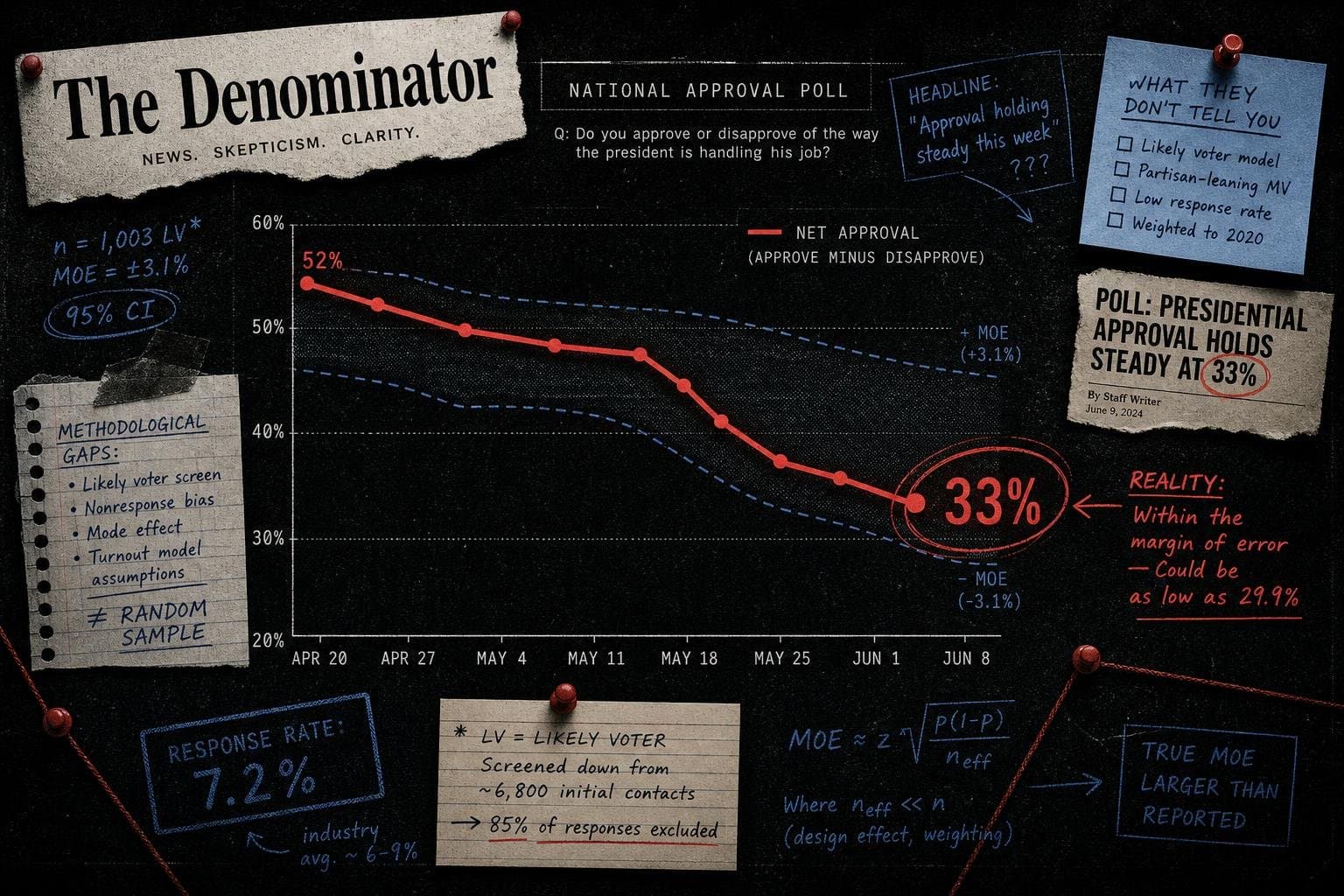

A 33% approval rating is a striking figure. Reuters/Ipsos published it Monday with the headline "lowest of his presidency," and that framing is accurate as far as it goes. But the number is doing more work than a single poll can handle, and the coverage is mostly not telling you why.
The Number You're Not Being Given
Every approval rating is a fraction. The numerator — 33% — is getting all the attention. The denominator is the part that matters for interpretation.
The Reuters/Ipsos release describes a "four-day survey" that concluded Monday, August 17. What it does not prominently feature in the headline coverage: the sample size, the margin of error, or the methodology breakdown (online panel? phone? weighted how?). The Reuters article notes the rating dropped from 35% "in a poll that closed earlier this month." That's a two-point movement. Two points on a typical national poll of ~1,000 respondents carries a margin of error of roughly ±3 percentage points — meaning the movement from 35% to 33% is, statistically, noise. It may be real. It may not be.
The historically meaningful comparison — that 33% ties the lowest point of Trump's first term, reached in December 2017 — is buried in the article. That's the number worth examining. A tied low across two terms, separated by years, is a more durable signal than a two-point week-over-week shift. But "ties eight-year-old record low" is a harder headline to write than "lowest of his presidency."
The poll also finds that 80% of respondents expect U.S. involvement in Iran to continue for an extended period — a finding that contextualizes why approval may be falling, but which requires its own scrutiny: "extended period" is undefined, and agreement with a vague statement tells you less than you think.
None of this means the 33% figure is wrong. It means a single poll is a data point, not a verdict. The correct response to one poll showing 33% is: find the polling average, check whether other trackers are converging on the same number, and note the methodology. The incorrect response — which is what most of the coverage is doing — is to treat the headline number as a precise measurement of a precise thing.
The most dangerous phrase in political journalism might be "a new poll shows." It implies a level of precision that polling, by design, cannot deliver. The number to watch isn't 33%. It's whether the average of credible polls is trending in the same direction over the next two to three weeks.
That's the denominator nobody's reporting.