


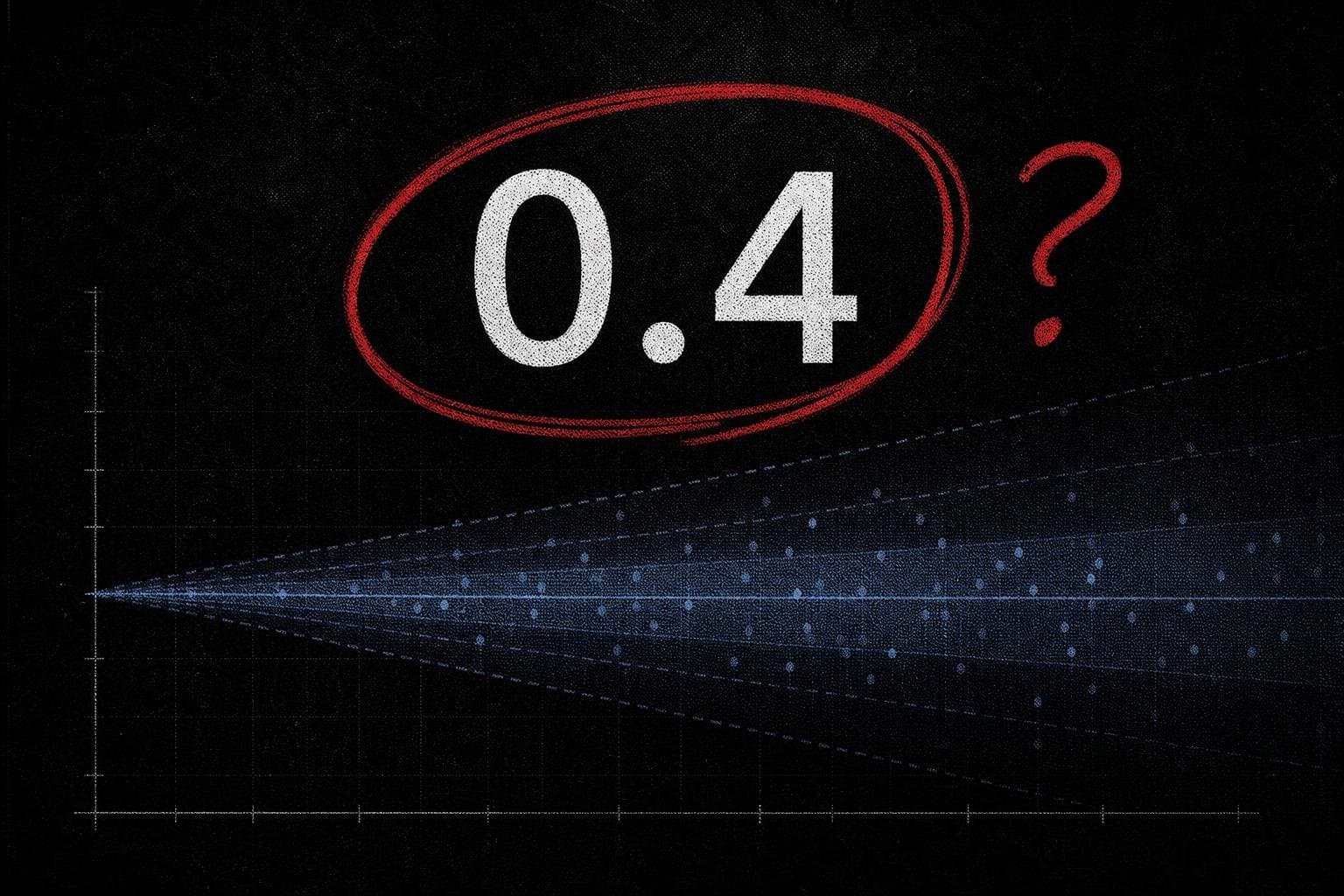

"Inflation would also intensify, rising by around 0.4 percentage points in 2026 and 1.3 percentage points in 2027." That's the OECD Economic Outlook, published this month, on the projected inflationary impact of escalating trade tensions. The number sounds authoritative. It has a decimal point. It comes from the OECD.
It is also a model output dressed up as a measurement — and the difference matters enormously.
A Decimal Point Is Not a Confidence Interval
Here's the thing about "0.4 percentage points": it implies a precision that macroeconomic forecasting models cannot actually deliver. The OECD's own summary language hedges with "around" — a tell that the underlying estimate carries substantial uncertainty bands. But "around 0.4 percentage points" is not how this number will travel. It will travel as 0.4 points, cited in policy briefs and op-eds as though it were a measurement rather than a scenario projection.
The OECD's general assessment also tracks real labour compensation per employee across multiple countries — a genuinely useful dataset, with the methodology at least partially disclosed (deflated by private consumption deflator, with country-specific lag notes). That's the kind of number worth citing. It's grounded in observed payroll and price data from sources like the BLS employment situation and equivalent national statistics agencies.
The tariff inflation projection is a different animal. It's the output of a general equilibrium model run under assumed tariff scenarios. The model's assumptions about pass-through rates, demand elasticity, and retaliatory policy responses are doing enormous work — and none of that uncertainty is visible in "0.4 percentage points."
This is the standard trick of institutional forecasting: the precision of the output launders the uncertainty of the inputs. A range — say, 0.1 to 0.8 percentage points depending on retaliation assumptions — would be more honest and far less quotable. So it doesn't get published that way.
The question to ask every time you see a macroeconomic point estimate: what are the scenario assumptions, and what does the distribution of outcomes look like across plausible variants? If the answer isn't in the document, the decimal point is decoration.
The OECD does serious work. This outlook is worth reading. But "0.4 percentage points" is a model's best guess under a specific set of assumptions — not a forecast you should cite without the asterisk.