


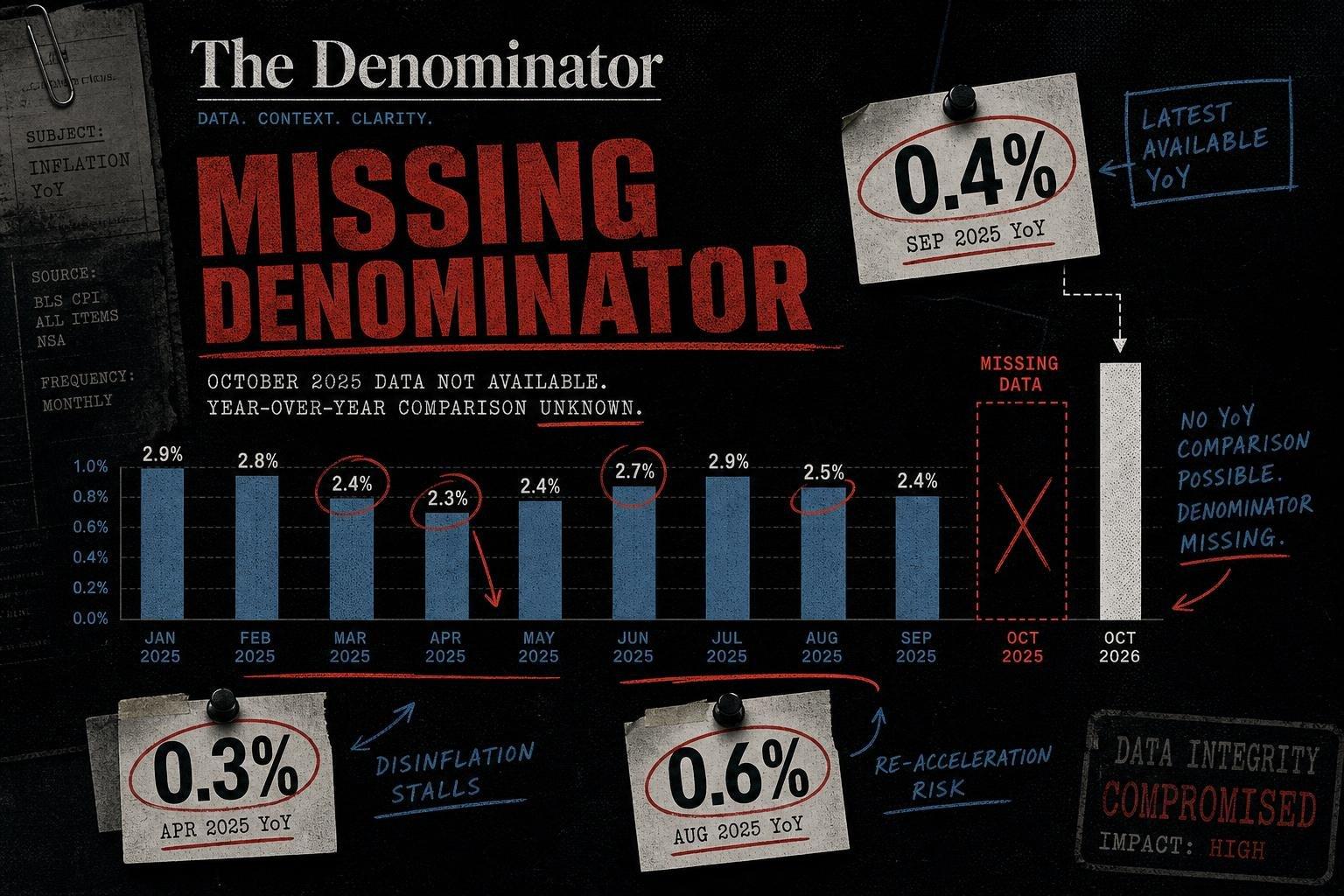

Here's a sentence that should stop you cold: the Bureau of Labor Statistics released the October 2026 Consumer Price Index this week, and it cannot tell you the annual inflation rate. Not "won't." Can't. The October CPI release says plainly that BLS "did not collect survey data for October 2025 because of a lapse in appropriations," which means there's no October 2025 index to divide into for most series. The 12-month percent change — the number that gets quoted in every headline, every Fed statement, every "inflation is cooling/heating up" argument — is simply missing.
What you do get is the month-over-month comparison: prices rose 0.4 percent in October after a 0.6 percent increase in September. Shelter was up 0.3 percent and accounted for more than 30 percent of that gain. Core CPI, excluding food and energy, rose 0.3 percent for the third straight month. Those numbers are real and they're useful. But month-over-month is a noisier, choppier signal than the year-over-year number everyone's trained to care about, and this release can't give you the latter. The denominator — last October's index value — doesn't exist in usable form.
This isn't a methodology scandal. It's the data equivalent of a building missing a load-bearing wall because the contractor got furloughed mid-project. BLS flags it honestly, with a link to its own explainer on approximating missing data. That's the right call. What won't be handled as carefully is the next six months of news coverage, where someone inevitably stitches together a year-over-year comparison anyway, using whatever imputed or interpolated figure BLS publishes as a stopgap, and reports it with the same confidence as a clean annual rate.
Watch for two things. First, whether BLS's approximation method, once applied, gets footnoted the way the September trade deficit figures routinely get marked "not statistically measurable" — or whether it gets reported as a hard number with no asterisk. Second, watch the November release, due next month, for whether the October 2025 gap keeps propagating forward, since any 12-month comparison through October 2026 inherits the same missing base.
The lesson isn't that this month's inflation number is wrong. It's that a chunk of 2026's inflation reporting is going to be built on a denominator that technically doesn't exist, and almost nobody saying "inflation is up" out loud is going to mention that part.