


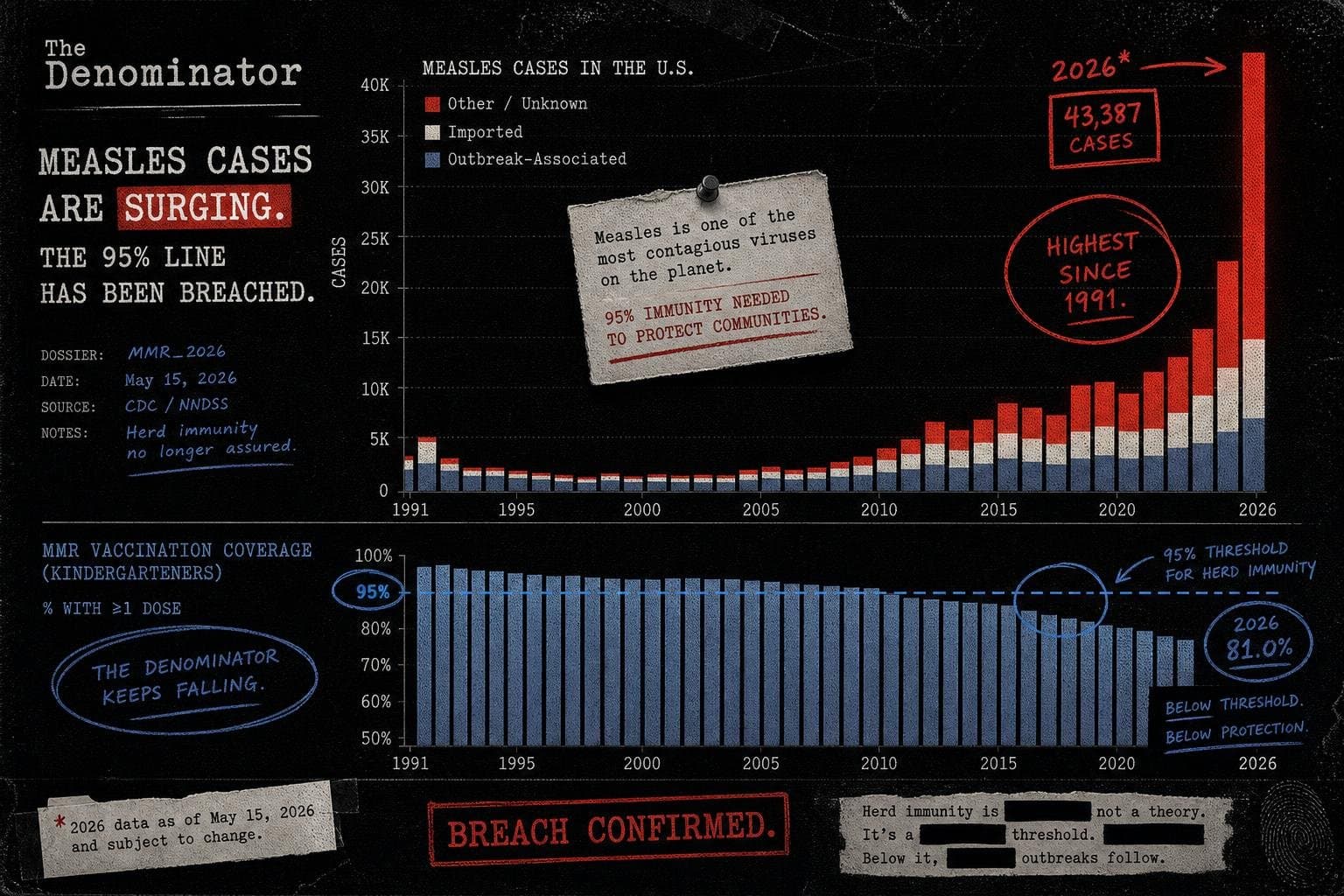

More measles cases have been reported to the CDC in 2026 than in any year since 1991 — and we're not even through August. According to ProPublica, the U.S. crossed that threshold as of July 23, having already surpassed the three-decade high set just last year. It took less than seven months.
That's the headline number. Here's the denominator that explains it.
The Vaccine Rate Is the Base Rate Everyone Is Skipping
Measles doesn't spread because the virus got stronger. It spreads when the share of immune people in a population drops below a threshold — roughly 95% vaccination coverage, the level epidemiologists consider necessary for herd immunity against a pathogen this contagious. The virus is essentially unchanged. What changed is the denominator: the proportion of people protected against it.
ProPublica's reporting documents more than 4,850 infections since the beginning of last year, with three deaths — including two unvaccinated girls in West Texas whose cases drew national attention. The piece also traces what happens in countries that let vaccination coverage slip even modestly: rubella returned and caused babies to be born blind, deaf, and with intellectual disabilities; diphtheria came back; polio paralyzed children. These weren't countries that abandoned vaccination wholesale. They made what looked like "subtle changes" to immunization policy and paid for it years later.
That lag is the part that makes the math so dangerous. You don't see the consequences of a declining vaccination rate immediately. The virus finds the gaps slowly, then all at once.
"Record High" Needs a Comparison Year
The 1991 reference point in the ProPublica piece is worth pausing on. That year sits just before the U.S. launched a major two-dose MMR vaccination push that drove measles cases down to near-elimination by 2000. The CDC declared measles eliminated from the United States in 2000, meaning there was no longer continuous transmission — any cases that appeared were imported or traced to imported sources.
So when we say 2026 has more cases than any year since 1991, we're saying the U.S. has now recorded more cases than at any point during the 25-year period when measles was considered eliminated. That's the comparison that matters. The record isn't just a big number. It's a number that crosses back over a threshold the country spent decades building toward.
The three deaths reported so far are a small absolute number. They are not a small rate. Measles kills roughly 1-2 per 1,000 infected people in high-income countries with access to modern medical care — higher in malnourished or immunocompromised populations. Apply that to 4,850+ cases and the deaths are roughly consistent with what the epidemiology would predict. The virus is performing as expected. The protection rate is not.
The Institutional Denominator
ProPublica's investigation also points to a structural shift in the federal public health apparatus under the current administration — specifically, the role of HHS Secretary Robert F. Kennedy Jr. and President Trump in reshaping an agency that for decades promoted vaccination as a core public health function. The piece doesn't quantify this shift in terms of vaccination rates (that data would take years to fully surface), and I won't overstate what it shows. What it does establish is that the institutional infrastructure that maintained high vaccination coverage is under pressure at exactly the moment when the measles numbers are telling us that coverage is slipping.
This is correlation, not causation — the data to establish a direct causal link between specific policy changes and specific vaccination rate declines doesn't yet exist in the sources available. But the directional signal is worth naming clearly: the entity responsible for maintaining the denominator (vaccination coverage) is changing its posture toward the thing that maintains the denominator.
What the Record Actually Tells You
The "record since 1991" framing is accurate but undersells the story. The more precise framing: the U.S. has now recorded more measles cases than in any year since the disease was considered eliminated. That's a different sentence. It describes not just a big number but a reversal of a decades-long public health achievement.
The cases themselves are the lagging indicator. The leading indicator is vaccination coverage, and that data — broken down by state, county, and school district — is where the real story lives. When coverage in a school district drops below 90%, the math on herd immunity starts to fail. The virus doesn't need a majority. It needs a gap.
Watch the CDC's school-level vaccination data when it publishes for the 2025-26 school year. That's the denominator that will tell you whether this year's record is a ceiling or a floor.