


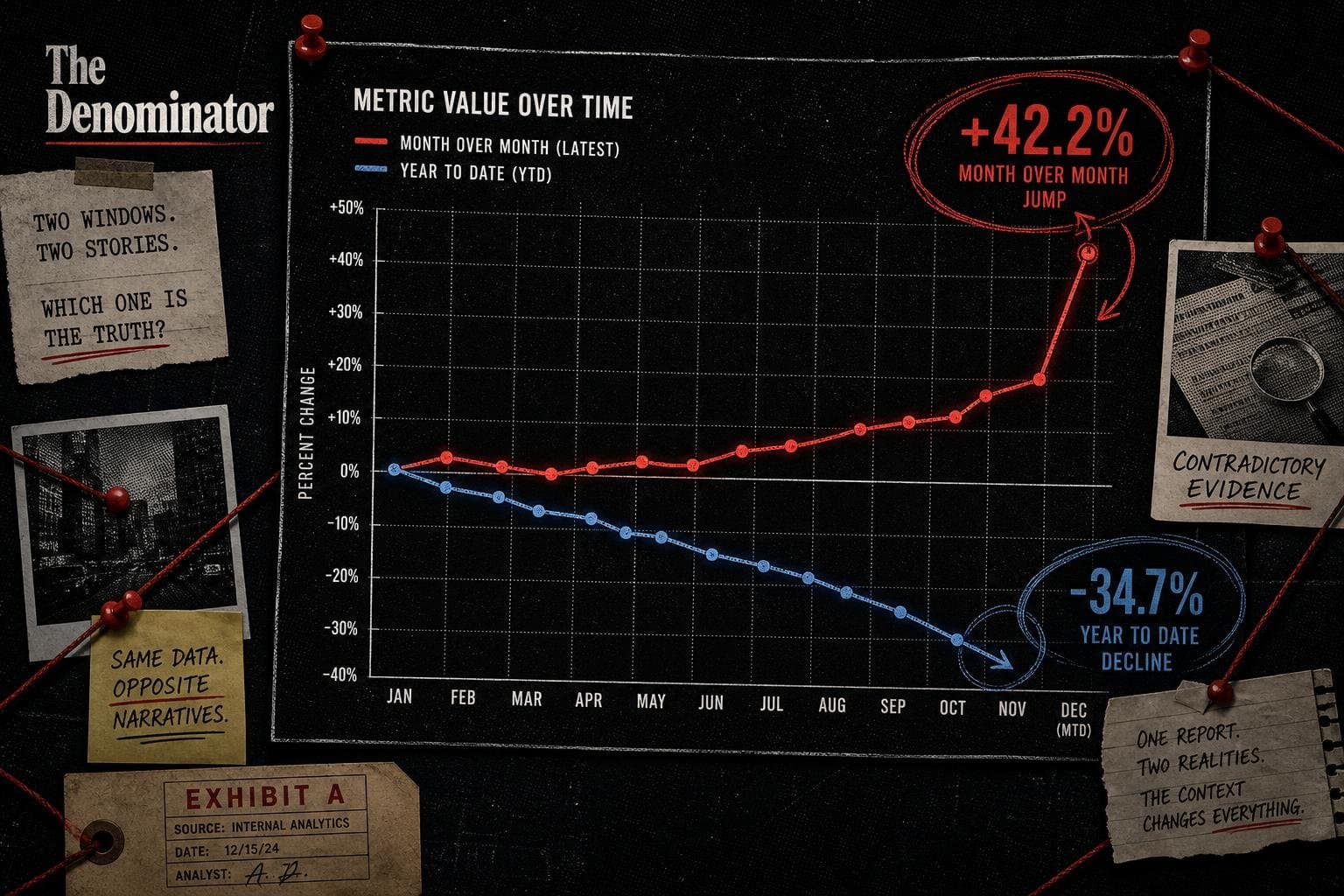

The headline from Tuesday's Census/BEA release is hard to ignore: the U.S. goods and services deficit hit $77.6 billion in May, up $23.0 billion from April's revised $54.6 billion — a 42.2% single-month spike. That number is already circulating as evidence of tariff failure, supply chain collapse, or whatever the preferred narrative happens to be.
Here's the problem with that framing: one month is not a trend.
The Month-to-Month Number Is Doing Work It Can't Support
The May jump was driven by a $23.6 billion surge in the goods deficit, which reached $106.5 billion. Imports rose $12.5 billion while exports fell $10.5 billion — a double squeeze. That's a real and significant single-month move.
But the same release contains a number that almost nobody is leading with: year-to-date through May 2026, the goods and services deficit is down $203.9 billion — a 40.6% decrease from the same period in 2025. Exports are up $164.7 billion (11.7%) year-over-year. Imports are down $39.2 billion (2.1%) year-over-year.
Those two pictures — a 42% monthly spike and a 40% annual improvement — are not contradictory. They're just measuring different things over different time windows. But presenting only the monthly number while the annual trend runs in the opposite direction is a denominator problem dressed up as a data story.
The three-month moving average, which smooths out exactly this kind of volatility, shows the deficit averaging $62.9 billion for the period ending in May — up $7.5 billion from the prior three-month average, but well below the year-ago average, which was $23.8 billion higher.
The honest read: May was a bad month in a year that has otherwise shown a substantially narrower deficit than 2025. Whether the May spike is a reversal of that trend or a one-month anomaly is a question this single data point cannot answer. The next release is scheduled for August 4.
Anyone citing the 42.2% figure without mentioning the 40.6% annual improvement isn't lying. They're just choosing their starting line very carefully.