



The headline from May's jobs report was tidy: 172,000 nonfarm payroll jobs added, unemployment rate unchanged at 4.3 percent. Commentators called it steady. Resilient. Fine.
But "unchanged" is doing a lot of work in that sentence, and it's hiding the number that actually moved.
The Denominator Nobody Mentioned
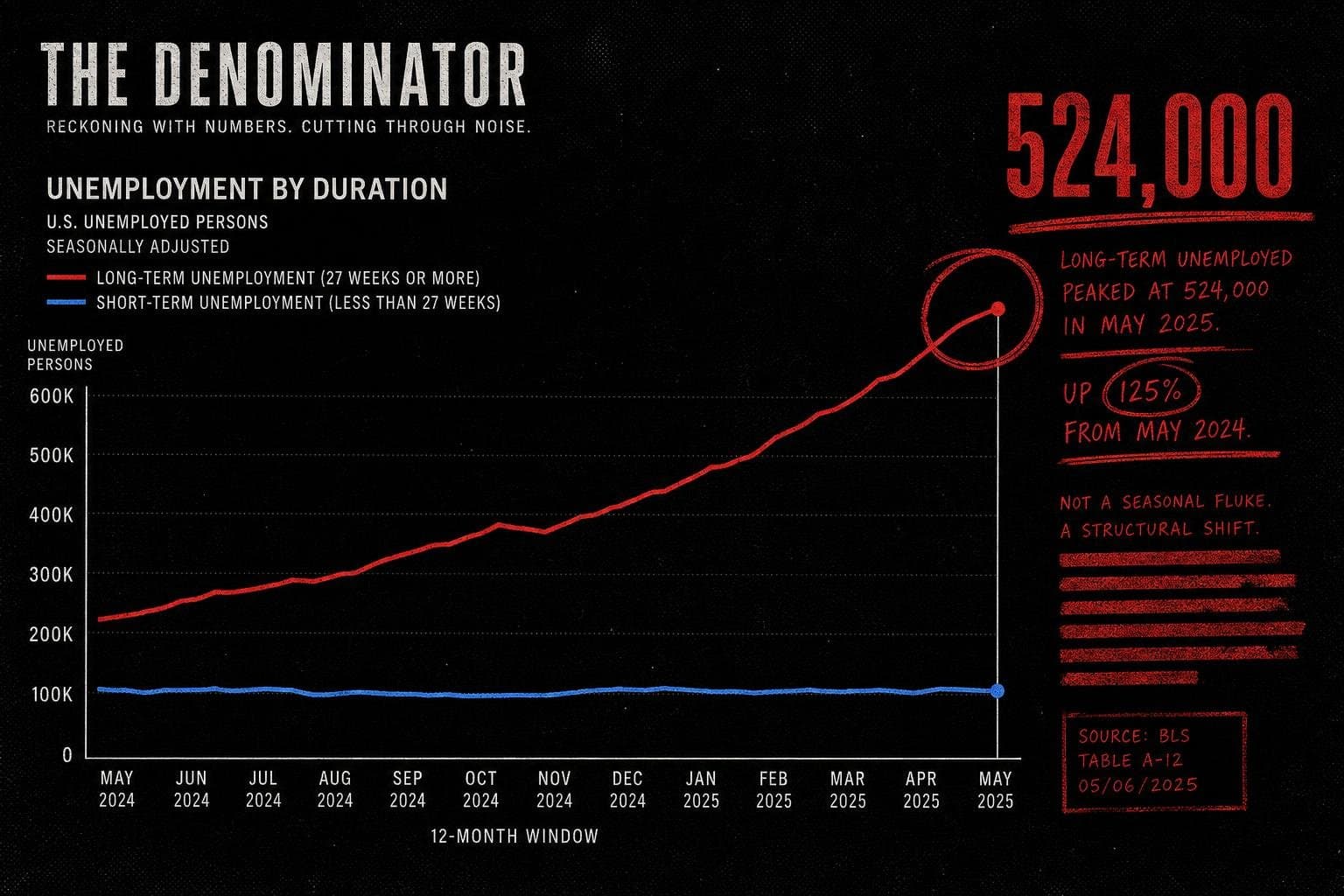
The unemployment rate held at 4.3 percent — but that's a snapshot, not a trend. Dig one row deeper in the same BLS release and you find this: the long-term unemployed (people jobless for 27 weeks or more) stood at 2.0 million in May, up 524,000 over the prior year. That's a 35 percent increase in long-term unemployment over twelve months, in a labor market that the headline number describes as stable.
Those 2.0 million people represent 27.5 percent of all unemployed workers — more than one in four. That's the denominator the stable-labor-market narrative skips.
Why does this matter? Because short-term and long-term unemployment tell completely different stories. Short-term unemployment — people jobless for under five weeks — actually fell in May, dropping by 286,000. That's the churn a healthy labor market produces: people between jobs, moving through quickly. Long-term unemployment is the opposite signal. It measures people who have been searching for work for over half a year and haven't found it. When that number rises by half a million in a year while the headline rate sits still, it means the labor market is bifurcating: easy to find work if you're already close to it, increasingly difficult if you've been out for a while.
The labor force participation rate, also from the same release, held at 61.8 percent and showed little change over the year. So this isn't a story of discouraged workers leaving the count and flattering the unemployment rate. The long-term unemployed are still in the pool, still being counted, still not finding work.
A single aggregate rate averaging across those two populations produces a number that is technically accurate and substantively misleading. The "compared to what?" question here isn't about the rate itself — it's about which unemployed people the rate is averaging over. When the composition shifts toward longer-duration joblessness while the rate holds flat, the rate is telling you less than it appears to.
Watch the long-term unemployment figure in the June release. If it keeps climbing while the headline rate stays in its 4.3–4.5 percent band, the "stable labor market" framing will need a denominator attached to it.