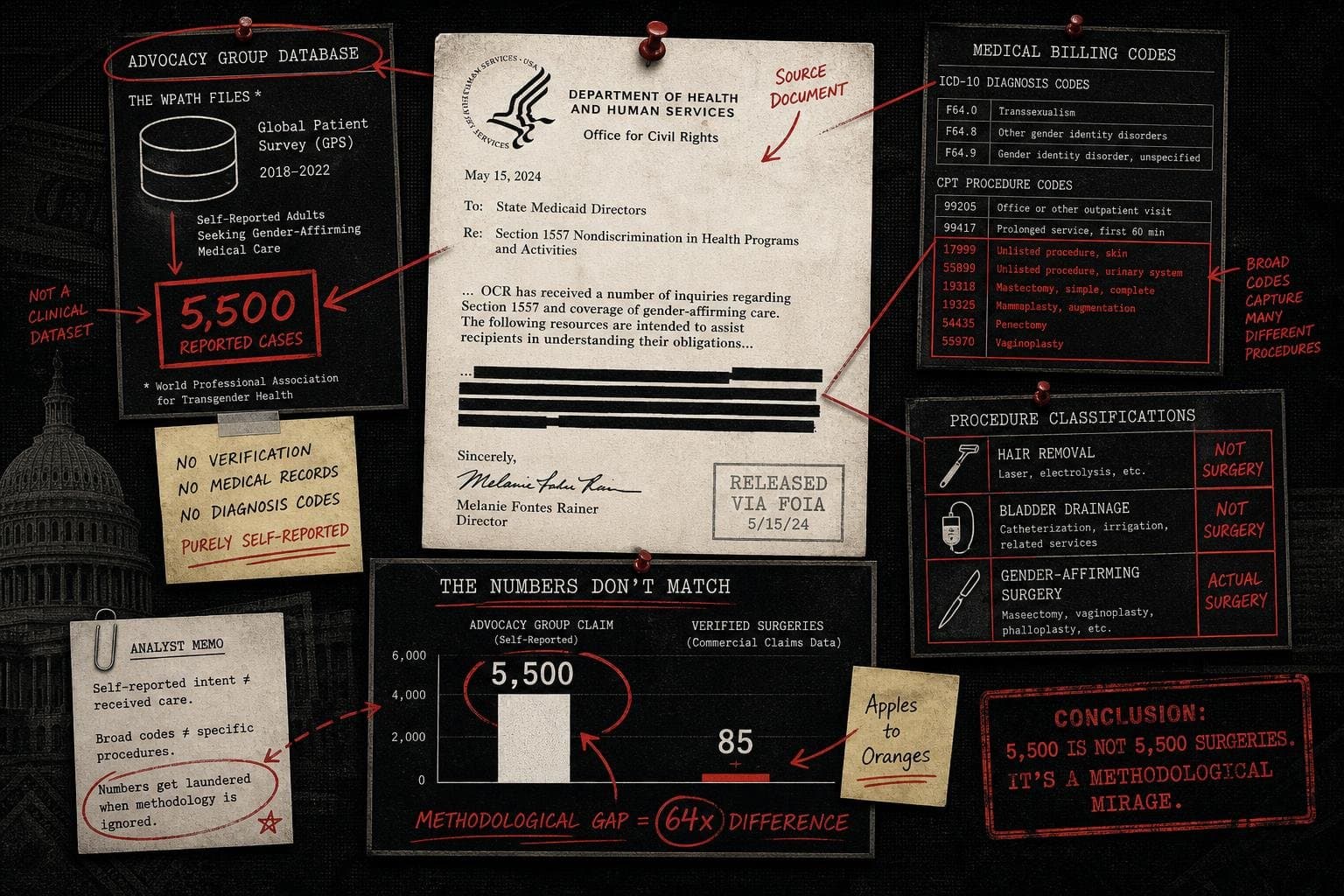

A government report cites a number. The number gets picked up by news outlets. The number becomes a policy rationale. And buried somewhere in the footnotes is the fact that the number was produced by an advocacy group that counted bladder drainage procedures as "sex change surgeries."
This is the story of the HHS trans surgery statistic — and it's a cleaner example of denominator manipulation than almost anything I've covered this year.
The Claim and Its Source
In August 2026, the Department of Health and Human Services released a report asserting that, according to Snopes's account of the document, "watchdog analyses tracking billed charges for minors from 2019 onward estimate almost $120 million in total hospital and clinic billings nationwide, encompassing over 5,500 surgical procedures."
The footnote leads to a database run by Do No Harm, an anti-LGBTQ+ advocacy group. That's the sourcing chain: a federal health agency citing an advocacy organization's proprietary database to make a claim about the frequency of pediatric surgery.
The first question to ask about any count is: what got counted?
According to Snopes's analysis, the Do No Harm database inflated its total by including procedures "entirely unrelated to 'sex change surgeries'" — among them hair removal, surgical removal of excess eyelid skin, and bladder drainage. The methodology: if a patient had a gender dysphoria diagnosis or a psychiatric condition related to crossdressing anywhere in their record, any procedure they received could be swept into the count. The diagnosis became the denominator. The procedure list became unlimited.
This is not a minor methodological quibble. It is the entire ballgame.
What the Peer-Reviewed Data Actually Shows
A 2024 peer-reviewed study from Harvard University researchers — cited by Snopes — found that in 2019, 85 trans minors received gender-affirming surgery in the United States. Eighty-five. Most were between ages 15 and 17. The Harvard study found zero gender-affirming surgeries performed on children under 12.
The HHS report's figure, covering 2019 to 2023, was 5,747.
The Harvard figure, for 2019 alone, was 85.
I'm not going to do the arithmetic that implies the HHS number requires, because the comparison isn't valid — the two studies are measuring different things. That's precisely the problem. The HHS report presented its count as though it were measuring the same phenomenon the Harvard study measured. It wasn't. It was measuring something much broader, defined in a way that maximized the output, and then labeling that output with a term — "sex change surgeries" — that implies a narrow, specific thing.
The Harvard study (observational, peer-reviewed, published in a medical journal) had a defined, reproducible methodology. The Do No Harm database is a proprietary advocacy tool whose methodology was not independently reviewed before being cited in a federal health document.
One of these is a source. The other is a claim dressed as a source.
Why This Pattern Keeps Working
The HHS number succeeded as a rhetorical object for the same reason most misleading statistics do: it was specific, it was large, and it came attached to an official-looking document. Specificity signals rigor. Large numbers signal crisis. Government letterhead signals authority.
None of those signals actually tell you whether the methodology was sound.
The tell, as usual, was in the denominator. When a count is dramatically larger than what independent peer-reviewed research finds, the right question is never "which number do I believe?" It's "what did each study count, and how?" The HHS report's number was larger not because it found more surgeries, but because it defined "surgery" to include procedures that have nothing to do with gender transition — and then applied that definition to anyone with a gender dysphoria code anywhere in their billing record.
That's not measurement. That's a filter designed to produce a predetermined output.
This dynamic — advocacy-group data migrating into official government documents and acquiring the authority of the letterhead — is not unique to this report. The CDC's own measles surveillance data depends on the integrity of the underlying reporting infrastructure; when that infrastructure gets politicized, the numbers that flow from it become harder to trust. The same logic applies in reverse: when an agency imports a number from outside its own measurement apparatus without scrutinizing the methodology, it is lending its credibility to someone else's filter.
The Census Bureau Problem Isn't Unrelated
This week also brought a PIIE analysis warning that political interference at the Census Bureau — including publication of a brief on the official Census platform that raised methodological alarms among independent experts — represents the worst period for U.S. statistical integrity since the firing of the BLS head last August.
The PIIE piece is careful to distinguish between collateral damage and deliberate intervention, and notes that the author still trusts the underlying expert staff at agencies like the Census Bureau. But the pattern it describes is worth naming: when the credibility of official statistical agencies erodes, the vacuum gets filled by advocacy-group databases and proprietary counts that don't publish their methodology.
The HHS surgery number is what that vacuum looks like in practice. An agency that would cite a Do No Harm database as though it were equivalent to peer-reviewed research is an agency that has stopped treating methodology as a constraint.
The Newsweek analysis of the measles outbreak made a point that applies here too: institutional trust and statistical credibility are not separate problems. When people stop believing the numbers that agencies produce, they become more susceptible to numbers that agencies launder. The solution to distrust in official statistics is not to import advocacy-group data onto government letterhead. It is to defend the methodology that made official statistics trustworthy in the first place.
Watch for whether the HHS report's figure gets quietly corrected, retracted, or simply left to circulate. In my experience, bad numbers issued by government agencies rarely get formal corrections. They just get cited by the next report.


