


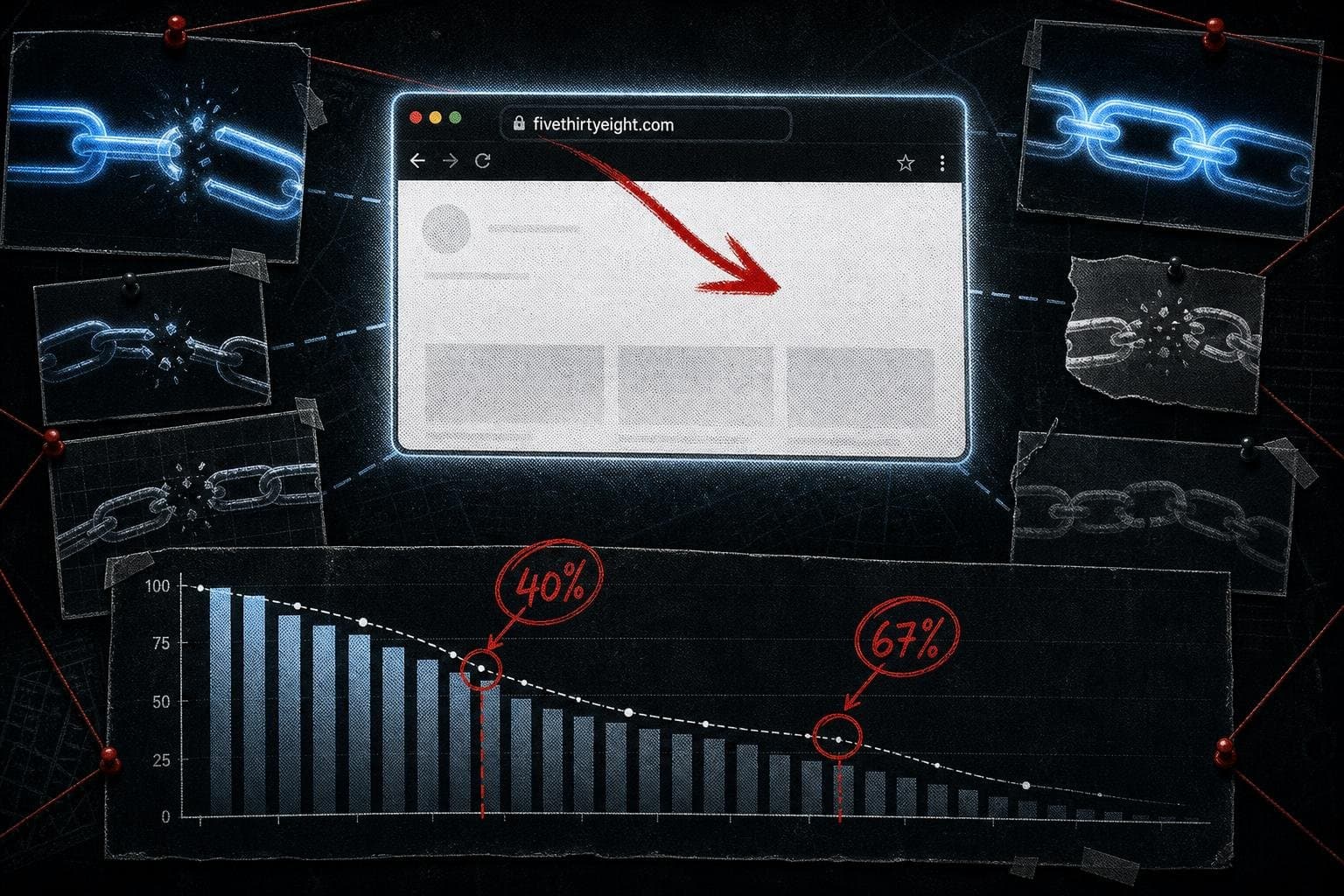

A few weeks ago, Nate Silver was working late, trying to look up a 2014 article he'd written about his soccer model. He got redirected to ABC News's homepage instead. Every text-based article from his nearly decade-long tenure at ESPN/Disney/ABC — gone. Not corrupted, not paywalled. Just gone.
ABC News declined to comment to the New York Times, which reported on the disappearance. No announcement. No archive handoff. The site that spent years teaching readers to ask "compared to what?" got deleted without a press release.
This is worth sitting with for a moment — not as a media industry story, but as a data infrastructure story.
The Archive Was the Product
FiveThirtyEight's value wasn't just in its live election models. It was in the accumulated methodology: years of articles explaining how to read a polling average, why sample size matters, what a confidence interval actually means, how to spot a cherry-picked trend line. That corpus was a public resource. Journalists cited it. Teachers assigned it. Readers bookmarked specific pieces and returned to them when a new misleading chart went viral.
When the archive redirects to a homepage, those citations break. The arguments those articles made — about denominator problems, about base rates, about the difference between correlation and causation — become harder to trace. You can't link to a methodology explanation that no longer loads.
Silver notes that the content is still accessible via the Internet Archive, and pre-Disney material survives through a New York Times partnership. But that's a workaround, not a solution. Most readers don't know to check the Wayback Machine. Most journalists linking to a FiveThirtyEight piece in 2024 didn't anticipate that the link would be dead by 2026.
Link Rot Is a Statistical Problem, Not Just a Sentimental One
Here's where this stops being a eulogy and starts being a methodology story.
Silver cites a Pew study from October 2023 that examined a random sample of internet links: nearly 40 percent of links that had been active ten years earlier were broken. A separate study by ahrefs found roughly a two-thirds attrition rate for web links after eleven years. Silver notes the Pew figure is probably an underestimate, since the study drew from the Common Crawl web archive, which skews toward more prominent sites — meaning the real link-rot rate for the average webpage is likely higher.
Think about what that means for statistical accountability journalism specifically. When a reporter writes "studies show X" and links to a source, that link is the entire accountability mechanism. It's the citation. It's how readers verify the claim. It's how other journalists check the work. If 40 percent of those links are dead within a decade, then 40 percent of the accountability infrastructure quietly disappears — not because anyone lied, but because no one maintained the plumbing.
This is a denominator problem wearing a server-redirect costume. The numerator — the claim — stays visible. The denominator — the source that constrains and contextualizes the claim — vanishes. What's left is an assertion floating free of its evidence.
What Gets Lost When the Receipts Disappear
The FiveThirtyEight deletion is a clean case study because the site was explicitly about showing its work. The methodology posts, the model documentation, the "here's why we weight this poll differently" explainers — that's not color, that's the product. Losing it isn't like losing a newspaper's feature archive. It's like losing the footnotes from a decade of published research.
The practical consequence is asymmetric. Bad statistics are sticky. A misleading chart gets screenshotted, shared, and embedded in slide decks for years. The debunking article — which requires the reader to click through, read carefully, and update their mental model — is the thing that depends on a live URL. Misinformation is robust to link rot. Corrections are not.
Silver is rebuilding pieces of this at Silver Bulletin — the election models, the sports models, the podcast. But he's explicit that it's not a full reconstruction of FiveThirtyEight. A smaller operation means more creative focus, less institutional breadth. The gap between what existed and what's being rebuilt is real.
The Reuters/Ipsos polling infrastructure still runs — their June 2026 poll, conducted June 3–8 with a nationally representative sample of 4,531 adults using the probability-based KnowledgePanel, shows the methodology documentation that makes a poll citable rather than just quotable. That kind of transparency is exactly what FiveThirtyEight spent years modeling and explaining. The explanation layer is what's gone.
The question worth watching: whether the Internet Archive's preservation of the FiveThirtyEight corpus holds, and whether Silver Bulletin's rebuilt models will eventually include the methodology documentation that made the originals useful as teaching tools — not just as forecasts, but as worked examples of how to think about uncertainty. A model without its documentation is a number without its denominator.
We've seen how that ends.