


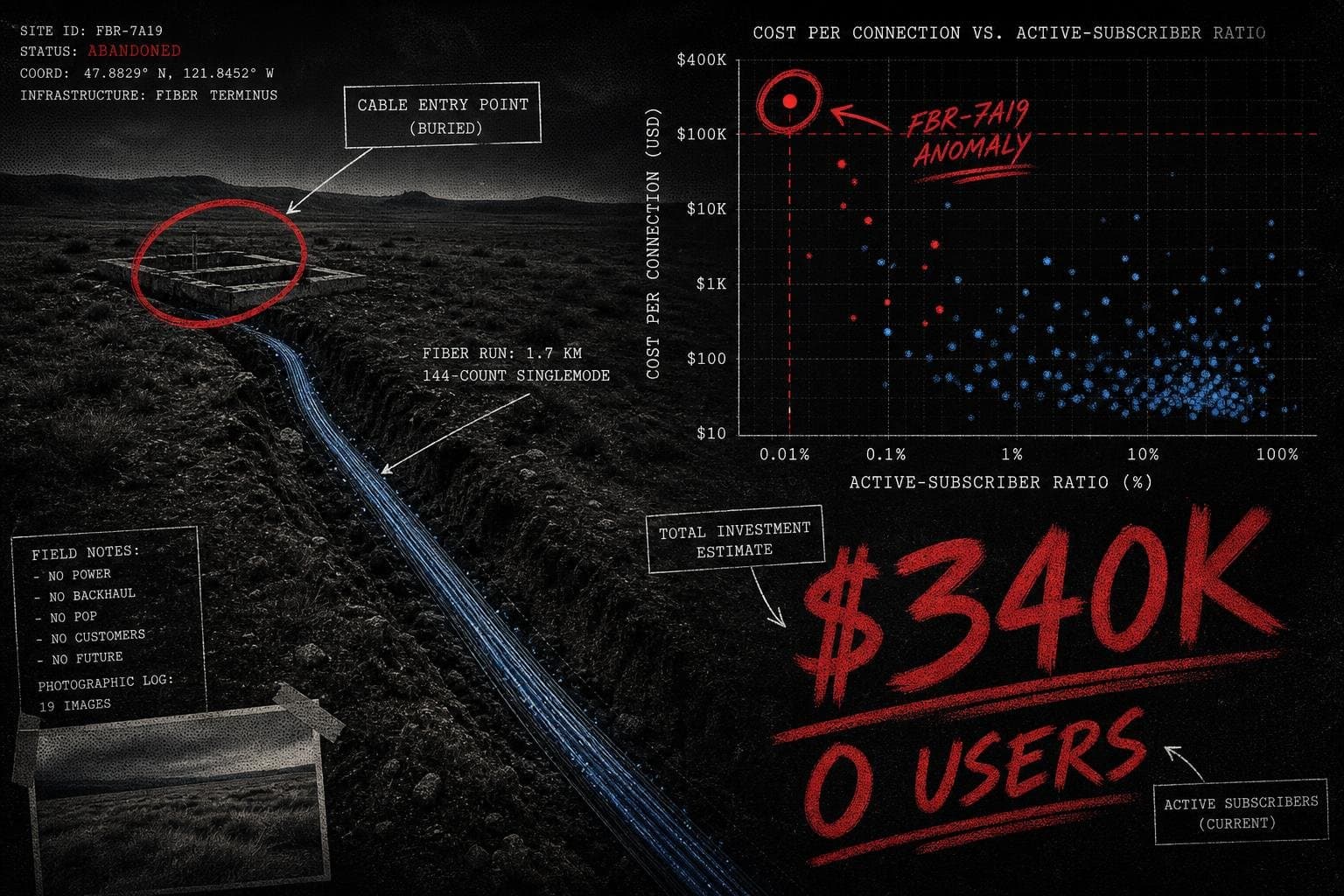

The fiber-optic cable runs into the ground outside an abandoned house on a former Navy base in the Bering Sea. No furniture inside. Wind through broken windows. Nobody home for years. And yet, according to a ProPublica and Anchorage Daily News investigation, U.S. phone customers are paying more than $340,000 annually to keep that building — and hundreds like it on Adak Island, Alaska — connected to the internet.
This is a denominator problem wearing a federal subsidy program.
The Numerator Looks Fine. The Denominator Is Empty.
The Federal Communications Commission's Universal Service Fund is, in principle, a reasonable idea: add a small fee to phone bills nationwide, pool the money, and use it to bring internet access to remote communities that the market won't serve on its own. The numerator — subsidized connections — sounds like a public good.
The denominator is the number of people actually using those connections. On Adak Island, that denominator is close to zero. The island hosts a tiny, dwindling population. Most of the buildings receiving subsidized service sit empty. Nobody disputes this. The FCC keeps the money flowing anyway.
This is the structure of a great many government subsidy failures, and it's worth naming precisely: the program was designed around a denominator that no longer exists. The original population that justified the expenditure moved away. The subsidy stayed. What you're left with is a cost-per-connected-household figure that, if anyone bothered to calculate it, would be extraordinary — but because the program reports connections provided rather than connections used, the absurdity stays hidden.
I'd argue this is the more common form of government waste: not fraud, not malice, just a metric that stopped being updated when the underlying reality changed. The FCC counts the orange pipe in the ground. It doesn't count whether anyone is on the other end.
"Slow Internet for Customers Who No Longer Use It"
The Adak case isn't an isolated quirk. ProPublica's broader reporting on the Universal Service Fund found that the multibillion-dollar program "pays for what often amounts to slow internet access for customers who actually no longer use it." Two problems compound each other: the service is obsolete (the technology being subsidized on Adak is described as outdated), and the customers have left.
That phrase — "slow internet for customers who no longer use it" — is doing a lot of work. It contains two separate failures. The first is a quality failure: the subsidized service doesn't meet modern standards even where people do live. The second is a utilization failure: the subsidy continues regardless of whether anyone is actually served. A program can fail on either dimension independently. Failing on both simultaneously is an achievement of a particular kind.
The FCC's accountability mechanism, per the reporting, is essentially nonexistent: the agency keeps the money flowing to telecom companies regardless of their owners' track records. That's not a denominator problem. That's the absence of a denominator.
The Metric That Would Fix This Is the One Nobody Reports
Here's the simple arithmetic that should appear in every Universal Service Fund oversight report and apparently doesn't: cost per active subscriber, not cost per subsidized connection.
These are different numbers. A subsidized connection is a wire in the ground. An active subscriber is a human being using the service. If you divide $340,000 by the number of people on Adak Island who are actually online, you get a number that would end the program immediately — or at least trigger a serious conversation about whether the money could be better spent connecting people who are actually there.
The Census Bureau's upcoming release of county-level internet adoption estimates — the Local Estimates of Internet Adoption (LEIA) program, scheduled for July 30 — is exactly the kind of data that could make this comparison possible. LEIA is designed to measure households that actually subscribed to high-speed internet service at the county level. That's closer to the right denominator: not wires installed, but households connected and using the service.
Whether anyone at the FCC will cross-reference LEIA data against Universal Service Fund expenditures is a different question. The incentive structure doesn't reward that kind of arithmetic. Telecom companies get paid per connection, not per active user. The FCC measures outputs, not outcomes. The BLS release calendar is a useful reminder of how much federal statistical infrastructure exists precisely to track whether programs are reaching real people — and how rarely that infrastructure gets pointed at subsidy accountability. And the $340,000 keeps flowing to an island where the wind blows through broken windows.
The forensic question here isn't complicated. It's the same question it always is: what's in the denominator? In this case, the denominator is a ghost town. The numerator is a fiber-optic cable running into empty soil.
Watch for the LEIA county-level data on July 30. It won't fix the FCC's accounting. But it will make the gap between "connected" and "actually using the internet" harder to ignore.