


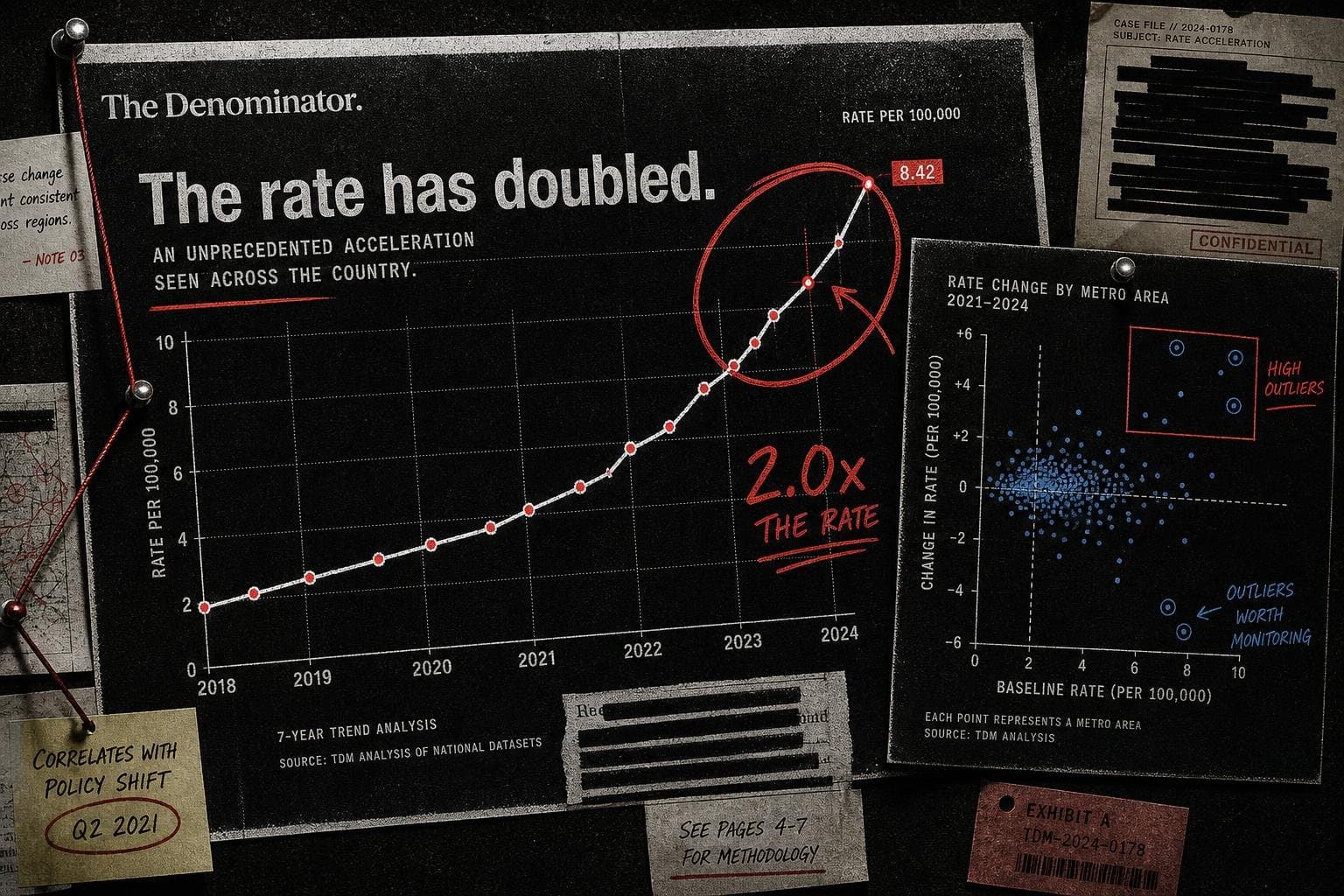

A death from an ectopic pregnancy is, by clinical consensus, a preventable death. The embryo implants outside the uterus — most often in a fallopian tube — and the treatment is well-established. Catch it early, intervene, the patient lives. So when the rate of these deaths nearly doubles over a six-year period, the denominator question isn't academic. It's a body count problem.
ProPublica's analysis of CDC WONDER data found that almost 200 women died after an ectopic pregnancy from 2020 to 2025 — compared with roughly 100 in the previous six years. That's a near-doubling of deaths in a condition that, as one OB-GYN quoted in the piece put it, "should really be a never event."
Here's what the headline number needs to carry with it.
1. The Rate Is Expressed Per Million Live Births — and That Matters
The ProPublica analysis presents deaths as a rate within three-year intervals to meet CDC data suppression thresholds (small absolute numbers in some periods require aggregation to be reportable). The metric: deaths per million live births.
Why does this framing matter? Because raw death counts can rise simply because more pregnancies are occurring. Expressing deaths as a rate per million live births controls for that — it's the right denominator. The fact that the rate is still rising, not just the count, is the finding worth sitting with.
The chart in the ProPublica piece shows the rate hitting approximately 12 deaths per million live births in the most recent interval. That's the number to track going forward.
2. The Geographic Split Is Where the Data Gets Specific
The analysis finds the increase is worse in states with abortion bans. This is a correlation finding — the piece does not claim the bans are the sole cause, and the methodology is observational, not a controlled study. But the mechanism is documented: abortion bans make exceptions for ectopic pregnancies, yet getting a definitive diagnosis can take days or weeks while the risk of rupture and death rises.
That's a delay-of-care pathway, not a direct prohibition. The distinction matters for anyone trying to understand what's actually driving the numbers.
3. The Federal Non-Response Is Its Own Data Point
ProPublica reports that there has been no public response to the increase in deaths from the Department of Health and Human Services, which has also cut maternal health staffers and grant funding. Whether or not you think federal intervention would help, the absence of any documented response to a rising preventable-death rate is itself a measurable fact — not an opinion.
4. What the Data Doesn't Tell Us
A few things this analysis cannot establish:
- Causation. The geographic correlation with abortion bans is suggestive but observational. Other factors — hospital consolidation, insurance gaps, rural access — could be contributing independently or in combination.
- Completeness. CDC WONDER death data depends on accurate cause-of-death coding on death certificates. Ectopic pregnancy deaths may be undercoded in some jurisdictions, which would make the true rate higher than reported.
- Trend direction post-2025. The analysis covers 2020–2025. We don't yet have data on whether the rate continued rising, stabilized, or changed after the period studied.
The Number to Watch
The CDC releases updated mortality data on a lag. The next update covering 2025–2026 deaths will be the first real test of whether the trend continued after the study period ended. If the rate per million live births holds at or above 12, that's a sustained failure of a preventable-death metric. If it drops, that's worth understanding too — and the methodology question (what changed, where, and for whom) will be just as important as the direction.
A death that "should never happen" doubling in frequency over six years is not a statistical artifact. It's a signal. The denominator here is doing exactly what denominators are supposed to do: making the problem harder to dismiss.