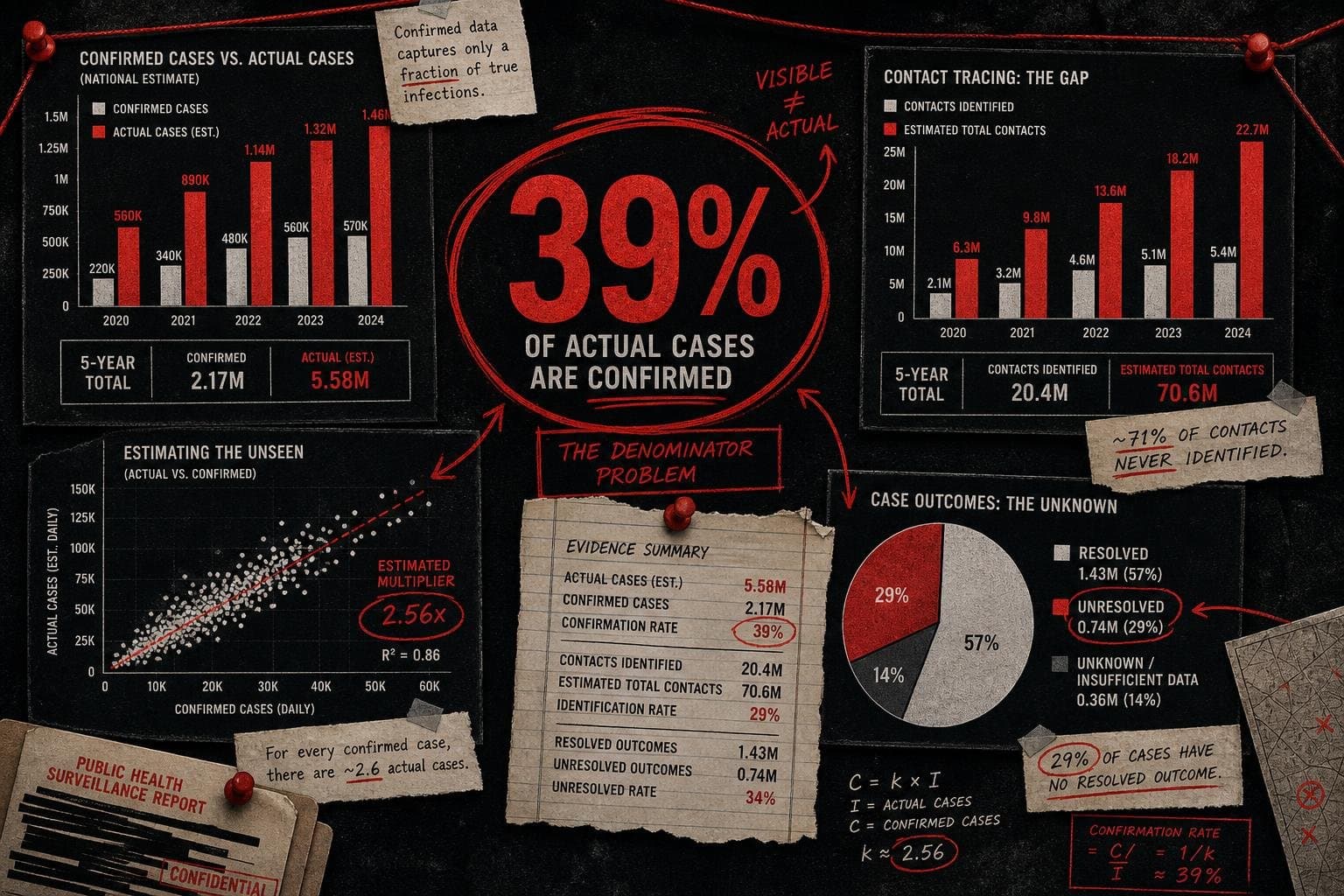

When an outbreak kills nearly four in ten confirmed cases, the number commands attention. It should. A 39% case fatality ratio for the ongoing Bundibugyo virus disease outbreak in the Democratic Republic of the Congo is genuinely alarming — and the WHO's Disease Outbreak News confirms it, explicitly labeling it a "crude case fatality ratio." That word "crude" is doing a lot of heavy lifting. Most people reading the headline number will skip it entirely.
This is a post about what the CFR is actually measuring, what it almost certainly isn't measuring, and why the gap between those two things matters more than the number itself.
The Denominator Is the Problem. It Always Is.
The WHO's figure, as of July 15, 2026, is 2,124 confirmed cases and 828 deaths in the DRC. Divide the second by the first: 39%. That's the crude CFR.
Here's the first problem: "confirmed cases" is not the same as "all cases." It is, by definition, the subset of cases that were tested, identified, and logged. In an active outbreak spreading across 46 health zones in five provinces — including remote areas of Ituri, North Kivu, South Kivu, Haut-Uele, and Tshopo — the gap between confirmed and actual can be enormous.
The WHO report itself acknowledges this directly: the surge in confirmed cases since July 3 (an additional 664 confirmed cases in roughly two weeks) is described as being "in part due to the scale-up of surveillance activities, testing, and diagnostic capacities." Read that carefully. A significant share of the recent case count increase reflects improved detection, not necessarily accelerating transmission. When you expand the denominator by finding more cases, the CFR should fall — assuming the newly found cases have a similar survival rate to those already counted. Whether that's happening here, the data doesn't yet tell us.
This is the classic outbreak CFR trap: early in an epidemic, or in areas with limited surveillance, you tend to find the sickest people first. They're the ones who show up at hospitals. The mild cases, the people who recover at home, the asymptomatic or subclinical infections — they're invisible to the denominator. So the CFR looks worse than the true infection fatality ratio (IFR), sometimes dramatically so. The CDC's Center for Forecasting and Outbreak Analytics tracks exactly this kind of time-varying transmission signal — the gap between what surveillance captures and what's actually circulating is a foundational problem in outbreak measurement, not an edge case.
The Contact Tracing Numbers Reveal the Surveillance Gap
There's a second number buried in the WHO report that most coverage will ignore, and it's more revealing than the CFR: contact tracing follow-up rates.
As of July 15, 12,693 contacts had been identified and were under follow-up. Of those, 10,195 had actually been followed up — a follow-up rate of 78.1% in Ituri, 50.0% in Tshopo, and 91.7% in North Kivu. Those numbers are not bad for an active outbreak in a conflict-affected region. But they also tell you that roughly 2,500 identified contacts were not successfully followed up as of that date — and that's just the contacts the system knows about.
Contact tracing coverage is a proxy for surveillance completeness. A 78% follow-up rate in the most affected province means roughly one in five known contacts is slipping through. Unknown contacts — people who were exposed but never identified — don't appear in this figure at all. Every missed contact is a potential case that won't enter the confirmed denominator until it's severe enough to reach a health facility.
The practical implication: the true case count is almost certainly higher than 2,124. How much higher is genuinely unknown. Epidemiologists studying previous Ebola outbreaks have found that confirmed cases can undercount true infections by factors ranging from modest (1.5x) to substantial (5x or more), depending on surveillance infrastructure. The DRC's Ituri province — accounting for 89.6% of all confirmed cases — is not a region with robust health infrastructure under normal circumstances, and this is not a normal circumstance.
If the true case count is even 50% higher than confirmed cases, the CFR drops from 39% to roughly 26%. If it's double, it drops to around 19%. These are not small differences. They represent the difference between "this pathogen kills two in five people it infects" and "this pathogen kills one in five people it infects." Both are catastrophic. But they're not the same catastrophe, and the policy responses they imply are not identical.
The Recovery Number Is the One Nobody Is Citing
Here's the number that should be appearing alongside every CFR headline: at least 410 patients have recovered across the DRC, Uganda, France, and Germany combined, per the WHO outbreak report.
That's 410 recoveries against 830 deaths. But notice what's missing from that accounting: the 2,145 confirmed cases minus 830 deaths minus 410 recoveries leaves roughly 905 cases whose outcomes are not yet resolved. They are neither counted among the dead nor among the recovered. They are still in the system.
This is the second classic CFR distortion: the "naive CFR" calculated during an active outbreak counts deaths against total cases, but many of those cases haven't reached their final outcome yet. The more technically correct measure — deaths divided by resolved cases (deaths plus recoveries) — gives a different picture. Using the WHO's figures: 830 deaths out of 1,240 resolved cases (830 + 410) yields a case fatality ratio among resolved cases of approximately 67%.
That number is almost certainly too high in the other direction. It's inflated because recoveries lag deaths — people who will eventually recover are still in hospital while people who died were counted quickly. The true CFR probably sits somewhere between the naive 39% and the resolved-cases 67%, and where exactly it sits depends on how the remaining ~905 active cases resolve.
The WHO knows this. That's why they labeled it "crude." But "crude CFR: 39%" is what will circulate. The methodological footnote will not. This pattern — a precise-sounding number that obscures the measurement uncertainty underneath it — is one the BLS has grappled with explicitly in its own data products when gaps in collection force imputation. The problem of a number that looks authoritative while resting on incomplete inputs is not unique to epidemiology. It's a feature of any real-time measurement system operating under stress.
What the Health Worker Numbers Actually Signal
One more figure deserves attention: 119 confirmed cases among health workers, with 61 recoveries and 36 deaths, per the WHO report. That's a CFR of approximately 37% among health workers with resolved cases — broadly consistent with the overall outbreak CFR, which is at least internally coherent.
But the more important signal is the absolute count. Health worker infections are a leading indicator of outbreak control failure. When healthcare workers are getting infected at scale, it means personal protective equipment is insufficient, contact tracing is breaking down, or both. It also creates a feedback loop: infected health workers reduce the system's capacity to treat other patients, which increases mortality among non-Ebola patients, which may push people away from health facilities, which reduces case detection, which distorts the denominator further.
The 119 health worker cases represent roughly 5.6% of all confirmed DRC cases (119 out of 2,124). For context, WHO has historically flagged health worker attack rates above 5% as a signal of serious infection prevention and control failures. The DRC figure is right at that threshold. Whether it's trending up or down from earlier in the outbreak, the report doesn't specify — and that trend direction would matter more than the point-in-time percentage.
The structural conditions enabling this kind of surveillance gap are well-documented. Reuters' ongoing Middle East and global conflict coverage is a reminder of how consistently active conflict zones degrade the civil infrastructure — roads, communications, health facilities — that outbreak response depends on. Eastern DRC's Ituri and North Kivu provinces have been conflict-affected for years. That context doesn't appear in the CFR. It should.
The Uganda and France Cases Are a Different Statistical Story
The outbreak has crossed borders: 20 confirmed cases in Uganda and 1 in France, with 2 deaths in Uganda and the French case recovered, per the WHO Disease Outbreak News. Two cases were diagnosed in DRC and subsequently treated in Germany, with one recovery noted.
The international cases are worth separating from the DRC figures for a specific reason: their CFR is almost certainly more reliable. A case that reaches a European hospital is, by definition, a confirmed case with full clinical follow-up. The denominator problem is minimal. The Uganda cases — 20 confirmed, 2 deaths, 18 recoveries — yield a CFR of 10% among resolved cases. That's a very different number from 39%.
This doesn't mean the virus is less lethal in Uganda. It almost certainly reflects the difference in healthcare capacity and the speed of case identification. The Ugandan cases were likely caught earlier, treated more aggressively, and had access to supportive care that's harder to deliver across 46 health zones in eastern DRC.
The comparison is instructive precisely because it isolates the denominator problem. Same pathogen, same outbreak, dramatically different CFRs — driven not by biology but by surveillance and healthcare infrastructure. That's the story the 39% headline obscures.
This dynamic — where the same underlying phenomenon produces radically different measured outcomes depending on the quality of the measurement apparatus — shows up across statistical domains. The Census Bureau's Small Area Health Insurance Estimates program, for instance, exists specifically because national-level health statistics mask enormous county-level variation. The aggregate number looks stable; the local reality is something else entirely. Outbreak CFRs have the same problem at a more acute scale.
What to Watch, and What the Data Can't Yet Tell You
The WHO report covers data through July 15 for DRC and July 17 for Uganda. The next Disease Outbreak News update will be the one to watch for two specific signals: whether the health worker case count is accelerating (a control failure indicator) and whether the recovery count is catching up to the death count (which would pull the resolved-case CFR down toward the naive CFR, suggesting the naive figure is becoming more reliable).
The 39% crude CFR is real data from a credible source. It is not fabricated, cherry-picked, or methodologically dishonest on its face — the WHO labeled it correctly. What's dishonest is treating it as a stable, interpretable measure of this pathogen's lethality when the denominator is actively expanding through improved surveillance, roughly 905 cases remain unresolved, contact tracing coverage is incomplete in the most affected province, and the comparison cases in Uganda and Europe suggest healthcare access is doing as much work as viral biology.
The number


