


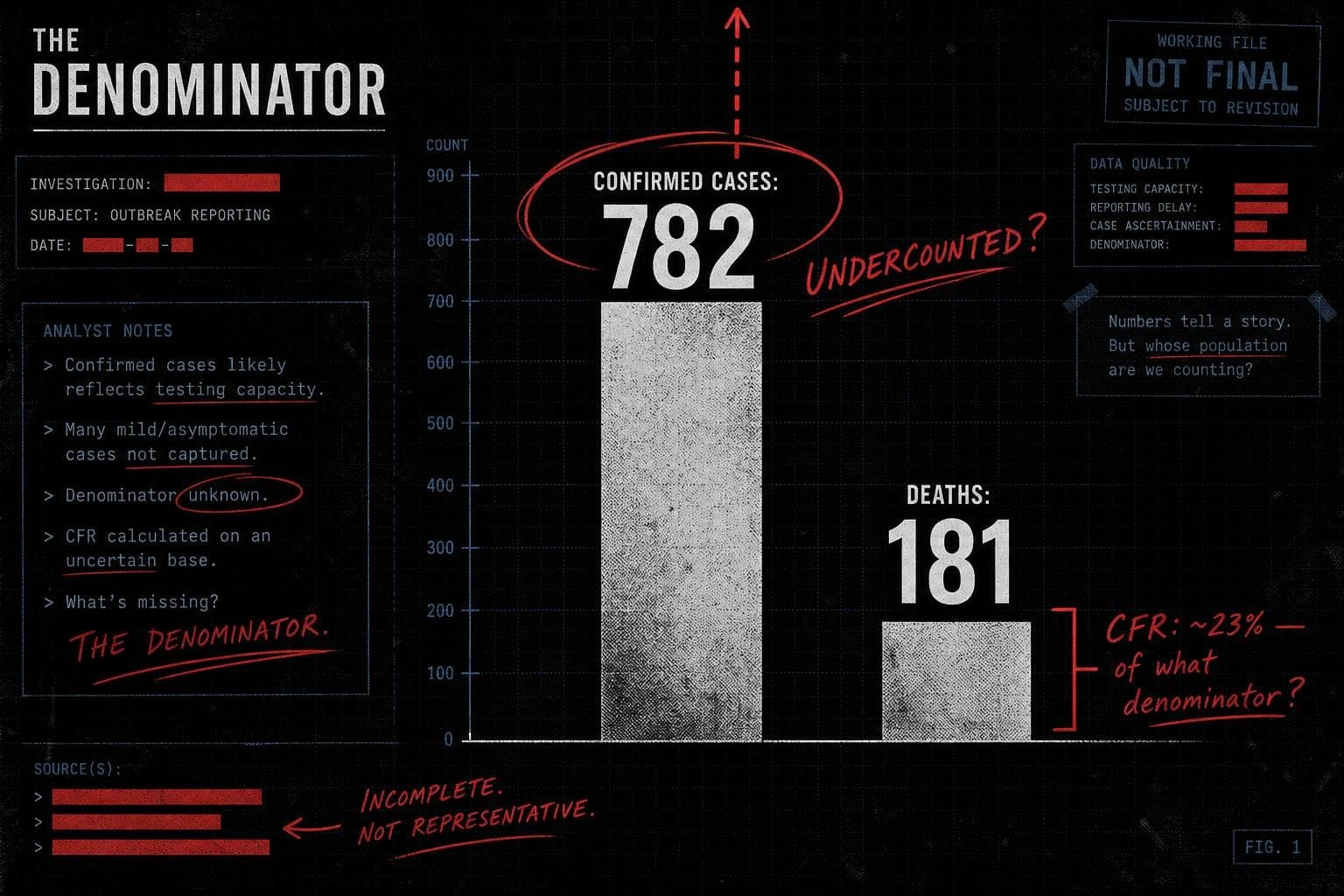

When a disease outbreak gets declared a public health emergency of international concern, the case count becomes the number everyone watches. It appears in headlines, drives resource allocation, and shapes how governments decide whether to act. So when that number is unreliable — not because anyone is lying, but because the measurement infrastructure is broken — the count itself becomes a kind of misinformation.
That's where the eastern Congo Ebola outbreak stands right now.
The Official Count Has a Known Undercounting Problem
Reuters reported on June 15 that one month into the confirmed outbreak, the three affected provinces in eastern DRC had recorded 782 confirmed cases and 181 deaths. That 181-death figure already makes this the third deadliest Ebola outbreak on record, by the government's own tally.
But here's the problem: Médecins Sans Frontières said publicly that the government's figures "likely understate the true toll." Kate White, MSF's emergency medical coordinator, put it plainly: "No one knows the true scale or exactly where the disease is spreading in DRC."
That's not a minor caveat. That's the headline.
When a major operational partner running treatment centers on the ground says the denominator is unknown, the case fatality ratio — 181 deaths out of 782 confirmed cases, or roughly 23% by the official count — becomes nearly uninterpretable. If confirmed cases are a fraction of actual cases, the true fatality rate could be substantially lower. If deaths are also undercounted, it could be higher. The official ratio isn't wrong exactly; it's just not measuring what people assume it's measuring. It's a ratio of confirmed-and-counted to confirmed-and-counted, not of infected to dead.
The Reuters report identified the specific mechanism: testing gaps and data harmonization failures across the three provinces. You can't count what you can't test. And in a conflict-affected region where security forces fired warning shots at a funeral — one of several violent incidents complicating the response — getting samples to labs is not a logistics problem with a clean solution.
A New Diagnostic Tool Arrives, But Timing Matters
On July 2, WHO added the first molecular diagnostic test for Bundibugyo virus to its Emergency Use Listing — a meaningful development for future outbreak response. The EUL mechanism is designed to accelerate access to quality-assured tools in exactly these settings.
The current outbreak involves a different strain, but the structural point stands: diagnostic capacity is the denominator problem in outbreak surveillance. Without reliable, rapid testing at scale, case counts are lower bounds at best and noise at worst. WHO's Director-General declared a public health emergency of international concern on May 17, 2026 — a designation that should, in theory, unlock resources and coordination. Whether that translates to testing infrastructure fast enough to matter is a separate question the current data can't answer.
What "Third Deadliest on Record" Actually Tells You
The "third deadliest on record" framing is worth stress-testing. It's based on the official confirmed death count of 181. That comparison to historical outbreaks carries an implicit assumption: that the historical counts were measured with roughly similar methodology. If earlier outbreaks were also undercounted — and there's substantial epidemiological literature suggesting they were — then the ranking is a comparison of undercounts, not a comparison of actual mortality.
This doesn't mean the outbreak is less serious. It might mean it's more serious. The honest answer is that the ranking tells you something about the confirmed, documented toll relative to other documented outbreaks. It doesn't tell you where this outbreak sits in the actual distribution of Ebola mortality events. That's a meaningful distinction when the number is being used to justify response levels and resource commitments.
The phrase "third deadliest on record" sounds precise. It has a rank, a superlative, a historical frame. It's the kind of number that travels well in headlines. But it's built on a foundation that MSF and Congolese officials themselves describe as incomplete — and the Reuters reporting makes clear that the data gaps are structural, not incidental.
The Number to Watch Isn't the Case Count
If you want to track this outbreak honestly, the case fatality ratio among confirmed, hospitalized cases with known outcomes is more stable than the raw count — it's less sensitive to testing gaps, because it only counts people who made it into the system. WHO's treatment center data, showing treatment centers overwhelmed, is a more reliable signal of outbreak severity than the headline case number.
The 782 figure will keep climbing as testing improves. Whether that represents new infections or newly-counted old ones is a question the current data infrastructure can't cleanly answer. Watch the hospitalization rate and the geographic spread of confirmed cases across the three provinces — those are the metrics that will tell you whether containment is working, not the cumulative count that everyone is citing.
A number that can only go up isn't a trend. It's a ledger.