


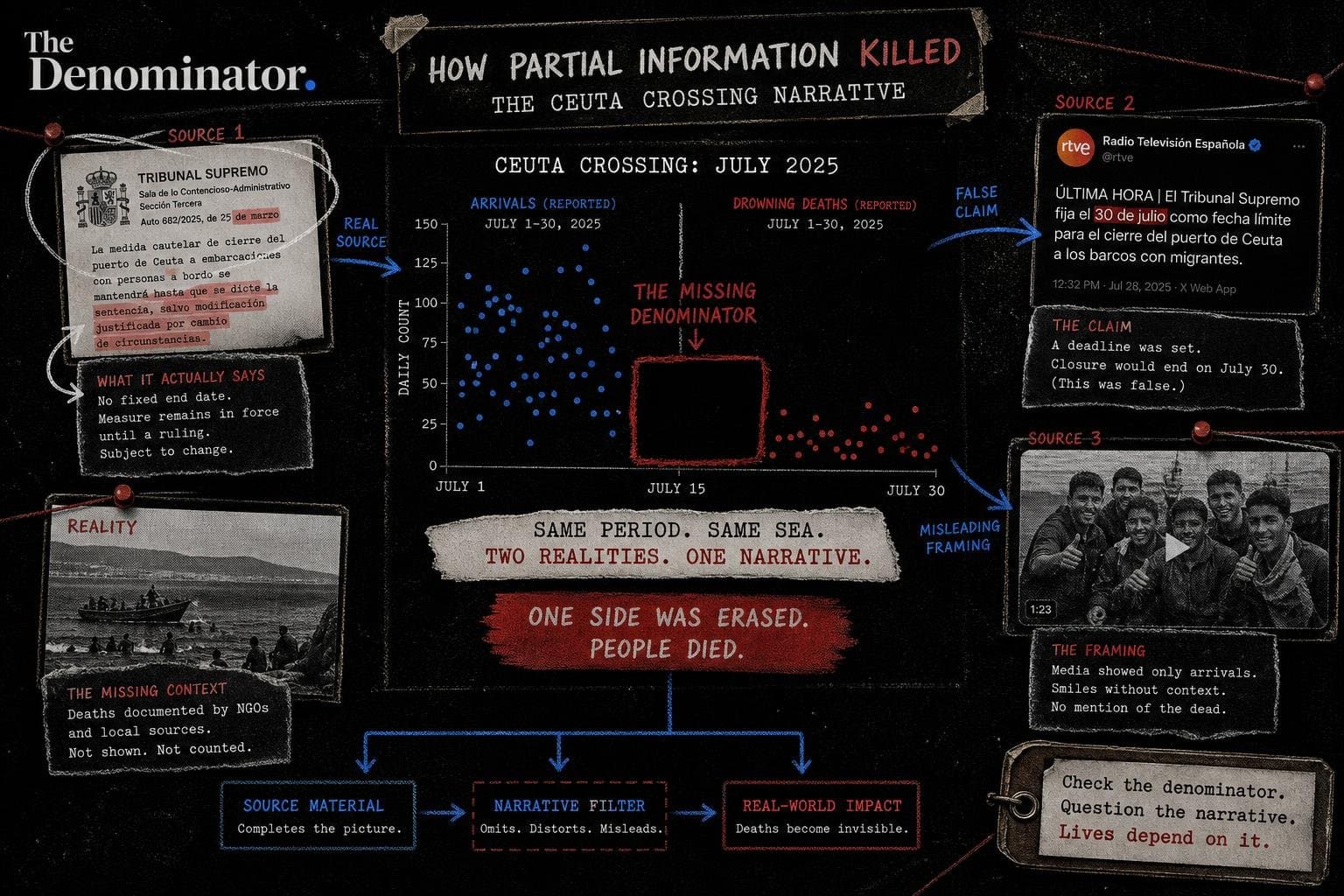

Tens of thousands of people swam toward a Spanish enclave based on a legal ruling that didn't say what they thought it said. More than 80 died. The story is being covered as a misinformation tragedy — and it is — but the statistical anatomy of how the false claim spread is more instructive than the headline.
The Ruling Said One Thing. The Viral Claim Said Another.
Start with the source document. Spain's Supreme Court published a ruling stating that migrants caught at sea could not be immediately pushed back at the border of Ceuta and Melilla. That's a narrow procedural constraint on the timing of returns, not a prohibition on returns altogether. Legal experts told Reuters that the ruling does not preclude summary return afterward.
What circulated instead was a categorical claim: get into Ceuta, stay in Ceuta. "Never believe those who tell you that if you get into Ceuta, they will send you back. You will not be sent back," said one widely shared video, filmed in Germany, later deleted and reposted by other accounts.
This is a classic base-rate error wearing a legal citation. The ruling established a constraint on one step in a multi-step process. The viral interpretation treated that constraint as if it nullified the entire process. The denominator — the full sequence of what happens after arrival — got dropped entirely.
The Fake Deadline Made It Worse
Layered on top of the legal misreading was a separate false claim about a regularization deadline. Reuters reported that several posts on Meta's platforms since July 7, including one with over 28,000 likes, falsely claimed that Spain's existing program to regularize hundreds of thousands of undocumented migrants would end on July 30.
The actual program: irregular migrants who had already been in Spain for at least five months before end-2025 could submit applications between April and June 30. The Spanish government received more than double the 500,000 registrations it had expected. The deadline had already passed. The program never extended.
Two false claims, stacked. One misread a legal ruling to eliminate a condition that still existed. The other invented a deadline for a program that had already closed. Neither claim was fabricated from nothing — both attached themselves to real events, real documents, real programs. That's the mechanism. Misinformation that references a genuine source is harder to debunk because the source does exist; the error lives in the interpretation, not the citation.
The Viral Video Problem Is a Sampling Problem
Here's the part that gets less attention: some of the footage that accelerated the crossings was posted by a Spanish news outlet intending to highlight the burden of migration pressures. The images of smiling arrivals — meant to document a crisis — functioned as recruitment material in a different context.
This is a sampling problem. The footage was real. The people in it were real. But the sample shown — arrivals who made it, who were visibly alive and present — was not representative of the full distribution of outcomes. The denominator included people who drowned. The viral clips did not.
By July 23, about 100 people had reached Ceuta, according to El Faro de Ceuta (via Reuters). Within days, that trickle became tens of thousands. More than 80 people died in the surge — drowned or crushed in a stampede. The footage of survivors was doing what survivorship bias always does: making a dangerous bet look like a reasonable one by hiding the losing outcomes.
What the Denominator Actually Contained
The full picture, assembled from what was actually knowable at the time:
- The Supreme Court ruling constrained immediate pushbacks, not returns generally
- The regularization program had already closed its application window by June 30
- The footage circulating showed arrivals, not drownings
- Morocco had previously prosecuted scores of suspected online instigators of a foiled mass crossing in 2024
None of this required classified information. The ruling was public. The regularization program's dates were public. The mortality risk of the crossing was documented. What the viral ecosystem provided was a highly curated selection of that information — the parts that supported the conclusion that the crossing was safe and legally protected.
The lesson here isn't that social media is dangerous, though it can be. The lesson is that a missing denominator kills people just as surely as a fabricated statistic. When you show arrivals without deaths, legal constraints without full legal context, and deadlines without checking whether they've passed, you haven't lied. You've just done the math wrong. And in this case, the math was done wrong by tens of thousands of people simultaneously, in real time, with fatal results.
The most dangerous phrase in data journalism is "studies show" without a link. The most dangerous phrase in viral media might be "if you get there, you're safe" — without the denominator.