


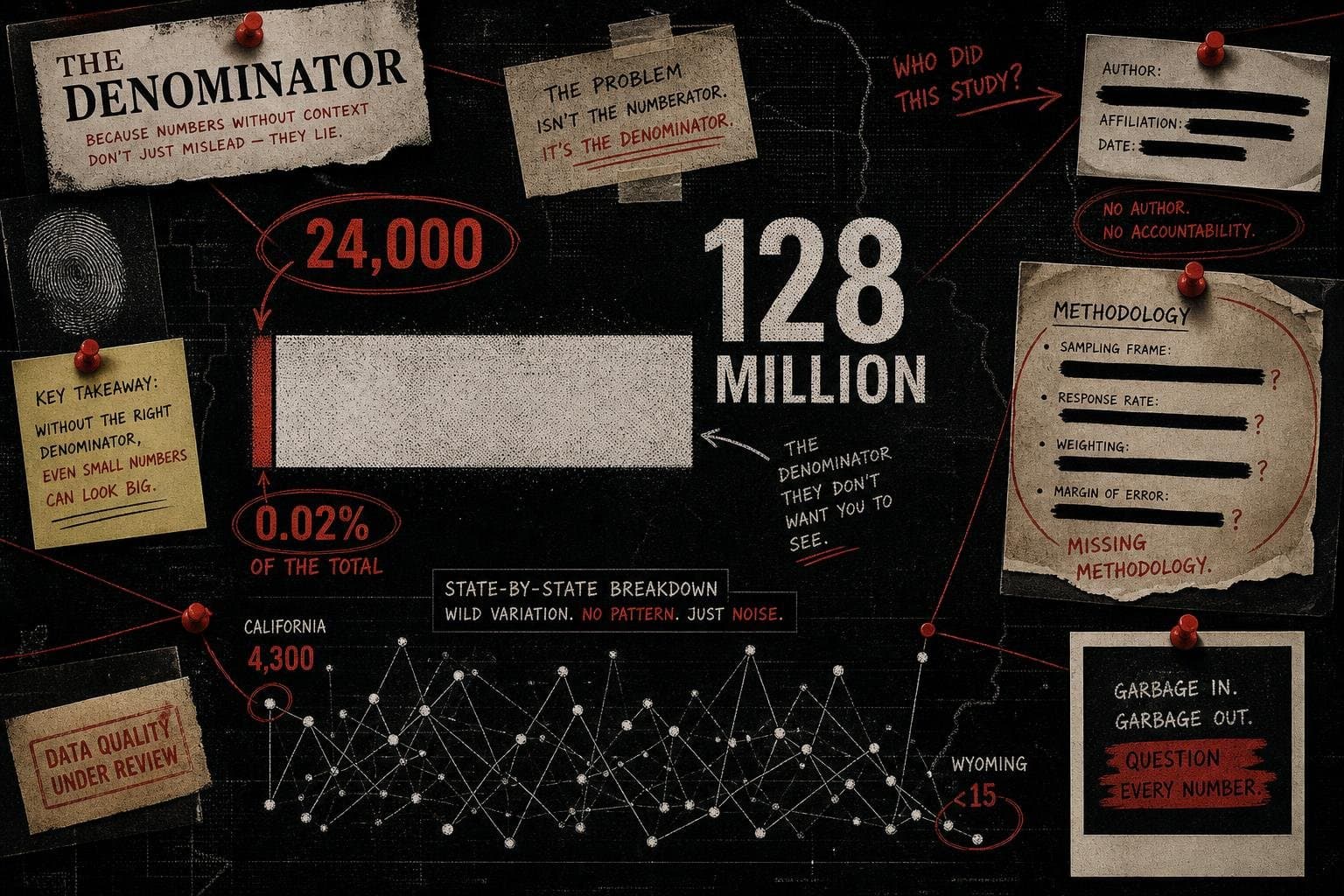

When I wrote about the Census Bureau's noncitizen voting report on September 18, the story was about a headline number — 24,000 — doing more political work than the underlying methodology could support. The new detail, reported by WIRED, isn't about the number. It's about who produced it, and how it got published without anyone's name attached.
That's the update worth sitting with this week.
A Report With No Byline Is Itself a Data Point
Federal statistical agencies exist because someone has to produce numbers nobody has a stake in. The Bureau of Labor Statistics, the Bureau of Economic Analysis, the Census Bureau — their credibility rests entirely on being boring, procedural, and anonymous in the right way: the methodology is public, the authors are accountable, the review process is documented.
The Census report titled "Noncitizen Voting in the 2020 Election: A Beginning Analysis" broke that pattern. Per WIRED's reporting, the report was published without its authors listed — something John Abowd, the Census Bureau's former associate director for research and methodology, called "extremely uncommon" for the agency, even for a blog-length research note. WIRED's investigation identified some of those unnamed authors as having ties to the Trump administration and the Republican Party, including a former affiliate of Elon Musk's Department of Government Efficiency and two researchers from the America First Policy Institute, a think tank founded by veterans of the first Trump administration.
That's not a methodology critique. It's a chain-of-custody problem. When you can't see who built the dataset, you can't evaluate their incentives, and incentives are exactly the thing a "beginning analysis" needs disclosed if it's going to claim it found evidence of noncitizens deciding a presidential election.
The Number Was Always Going to Collapse Under Its Own Denominator
Here's the arithmetic the report's authors apparently skipped, or at least didn't publish clearly: 24,000 flagged records out of more than 128 million voter records analyzed, per WIRED. Even before you interrogate the matching methodology, that's roughly 0.02% of the records reviewed — and the report itself, according to WIRED, showed wide state-level variation, from 4,300 flagged in California down to fewer than 15 in Wyoming. Numbers that swing that hard across states with very different voter-file infrastructures are usually telling you about data quality, not voter behavior.
Compare that to the actual audits states have already run. In Utah, Lieutenant Governor Deidre Henderson's office reviewed the state's roughly 2.1 million registered voters and found 27 "confirmed noncitizens" — and, per WIRED's reporting, none of them was ever confirmed to have actually voted. Pennsylvania and Idaho audits reportedly turned up similarly small figures. Those are the closest things we have to ground-truth checks, and they point toward a phenomenon so rare it barely registers, let alone one large enough to flip a national election.
None of this means the Census Bureau's number is fabricated. It means the number needs the same thing every number in this newsletter needs before it goes into a headline: a visible denominator, a visible methodology, and visible authorship. The report had none of the three when it launched, and Trump reportedly declared "I WON THE ELECTION" on Truth Social within hours of its release, per WIRED — which tells you the report did exactly the political job it was apparently built for, regardless of what the underlying data actually showed.
What to Watch
The Census Bureau did not respond to WIRED's request for comment, and the White House pointed the outlet to social media posts from Trump and Commerce Secretary Howard Lutnick rather than to a methodological defense. That silence is itself worth tracking. If the Bureau intends to stand behind the report, the test is simple: will it publish the authors' names, the matching methodology, and the review record that WIRED says was bypassed? If it doesn't, the report stays exactly what it looks like right now — a number with a denominator problem and an authorship problem, both discovered after the headline had already done its work.