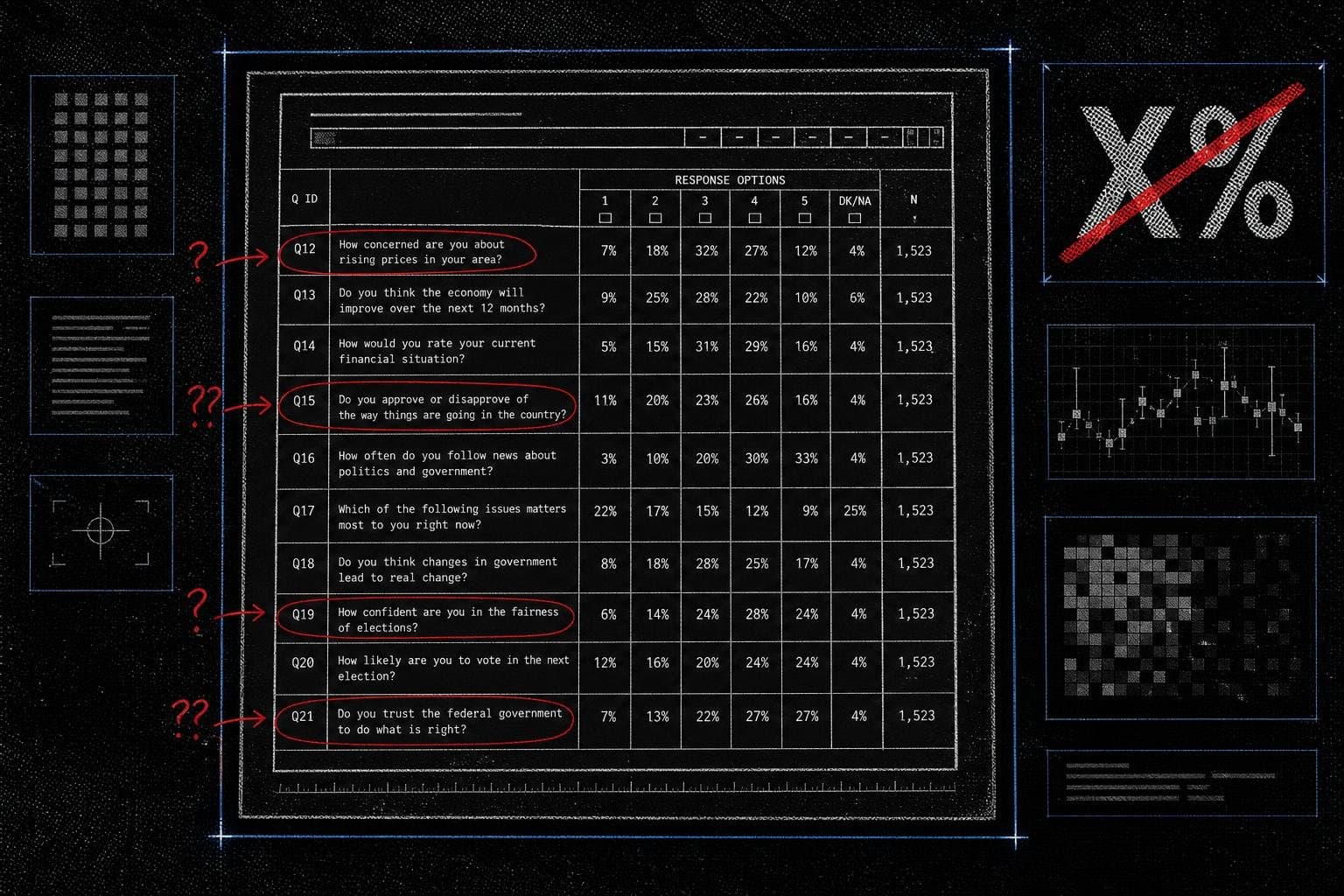

A number circulates in tech coverage with the confidence of settled fact: AI adoption among American businesses is either surging, stalling, or somewhere in between, depending on which outlet you read and which week they published. The underlying dataset is almost never named. When it is named, the methodology is almost never described. And when the methodology is described, the framing almost never matches what the data can actually support.
The Census Bureau quietly released something worth paying attention to. The Business Trends and Outlook Survey, updated June 4, 2026, added a supplemental module on AI adoption — new questions running from November 17, 2025 through February 8, 2026, covering how businesses are using AI, what tasks it supports, and how it is changing work. The sample: approximately 1.2 million businesses, split into six panels of roughly 200,000 each, with biweekly data collection. That is a serious survey. It covers all employer businesses in the U.S. economy except farms. It has geographic and sector breakdowns.
It is also being discussed, where it is discussed at all, in ways that strip out almost everything that makes it useful.
The Survey Is Designed to Measure Conditions, Not Trends — and That Distinction Matters
The BTOS is a continuous survey that captures business conditions in near-real time. That is its strength. It is not, however, a longitudinal panel tracking the same businesses over years. The AI supplemental questions ran for roughly twelve weeks — November 2025 through February 2026 — which means the data gives you a cross-sectional snapshot of AI adoption during that specific window, not a trend line.
This matters because the dominant frame in AI coverage is momentum: adoption is "accelerating," usage is "surging," businesses are "racing to implement." Those are trend claims. They require at minimum two comparable data points separated by time, with consistent methodology. A single twelve-week survey window cannot support a trend claim. It can tell you what share of businesses reported using AI for specific tasks during that period. It cannot tell you whether that share is higher or lower than six months earlier, because the comparable prior data does not exist in this instrument.
The BLS Employment Situation for May 2026 offers a useful contrast. That release is built on decades of consistent methodology — the same household survey and establishment survey, run continuously, with documented revisions and seasonal adjustments. When BLS says the unemployment rate held at 4.3 percent and has remained in a range of 4.3 to 4.5 percent since July 2025, that is a trend claim with a time window, a sample, and a methodology. The BTOS AI module cannot make that kind of claim yet. It is one data point. A good one, but one.
What the Data Actually Shows — and What It Doesn't
The BTOS release provides breakdowns by industry, geography (state level), and firm size. That is genuinely useful. It means you can ask whether AI adoption rates differ between large firms and small ones, or between states, or between sectors. Those comparisons are within the same survey window, using the same instrument, so they are methodologically sound.
What the data cannot cleanly support: claims about which specific AI tools businesses are using, how much productivity has changed as a result, whether AI is displacing workers at a measurable rate, or whether adoption is driven by genuine operational need versus executive signaling. The survey asks businesses to self-report AI use. Self-reported adoption data has a known problem: respondents define "using AI" differently. A firm that runs a spam filter is technically using machine learning. A firm that has deployed a large language model for contract review is doing something categorically different. If the survey instrument does not define AI precisely — and the BTOS tip sheet does not publish the exact question wording in the press release — then the adoption rate is a composite of very different things.
This is not a criticism of the Census Bureau. It is a criticism of how the number gets used downstream. "X percent of businesses use AI" is a headline that sounds like a fact and functions like a Rorschach test.
The Comparison Problem Hiding in Every Adoption Statistic
Here is the question that almost never gets asked about AI adoption data: compared to what, and measured how?
Consider the structure of the BTOS sample. The survey covers approximately 1.2 million businesses. Selected businesses are split into panels and asked to report every twelve weeks. Response rates for business surveys are not 100 percent — they never are. The Census Bureau estimates nine minutes per response, which suggests the questions are not deeply granular. When an adoption rate comes out of this instrument, the denominator is businesses that responded, not all businesses in the economy. The numerator is businesses that answered "yes" to a question about AI use, however that question was worded.
None of this makes the data bad. It makes the data specific. An adoption rate from the BTOS is the share of responding employer businesses (excluding farms) that reported using AI in some capacity during a twelve-week window in late 2025 and early 2026. That is a precise, defensible claim. "American businesses are adopting AI at [X] percent" is a different claim — broader, less qualified, and not quite what the instrument measures.
The BLS unemployment data illustrates what careful denominator work looks like. The May 2026 release distinguishes between the unemployment rate (7.3 million unemployed out of the labor force, at 4.3 percent), the labor force participation rate (61.8 percent), and the employment-population ratio (59.2 percent). Each number has a different denominator. The long-term unemployed — those jobless for 27 weeks or more — are reported separately: 2.0 million, accounting for 27.5 percent of all unemployed people, up by 524,000 over the year (July 2025 to May 2026). Every percentage comes with its base. Every trend comes with its time window. That is the standard. It is not a high bar. It is just the bar.
AI adoption statistics in the wild almost never meet it.
Why the ProPublica Ethics Problem Is Actually a Data Problem
There is a structural reason why AI statistics circulate without their denominators, and it has to do with incentives in how data gets amplified.
ProPublica's recent update to its code of ethics addresses prediction markets — the concern that journalists covering news events might have financial stakes in those events' outcomes. The underlying logic is about conflicts of interest corrupting the information chain. But there is a softer version of the same problem that does not require anyone to have placed a bet: the incentive to amplify a number that confirms a narrative you are already invested in.
AI coverage has a narrative. The narrative is that AI adoption is transforming the economy at speed. That narrative is not necessarily wrong — but it is a prior, and priors shape which numbers get amplified and which get quietly set aside. A Census Bureau survey showing modest or uneven adoption across firm sizes and sectors is less shareable than a headline claiming "most businesses now use AI." The BTOS data, carefully read, probably shows something more complicated: higher adoption among large firms, lower among small ones, variation by sector, and a measurement window that captures a specific twelve-week slice rather than a secular trend.
That complicated picture is the story. It is just harder to tweet.
The ProPublica ethics update is worth noting here not because prediction markets and AI statistics are the same problem, but because both illustrate how the information chain between primary data and public understanding can get corrupted without anyone lying. The Census Bureau published a careful, methodologically transparent survey. The press release is honest about what the data covers. The corruption happens later, when the number gets detached from its instrument and its window and its sample construction and starts doing rhetorical work it was never designed to do.
What Careful Readers Should Demand
The BTOS AI module is a genuinely valuable addition to the public data infrastructure. A survey of 1.2 million businesses, with state-level and sector-level breakdowns, run continuously by the federal statistical system, is the kind of primary source that should anchor AI adoption claims. The Census Bureau's data release makes the methodology transparent: sample size, collection window, panel structure, response burden.
What it cannot do, and what no single survey window can do, is support the trend claims that dominate AI coverage. For that, you need the same instrument run at multiple points in time with consistent question wording. The BTOS has been running since before the AI supplement was added — but the AI questions are new, which means the baseline is November 2025. The next comparable data point will be whenever the Census Bureau runs the same questions again.
Watch for that. When the next AI supplement drops, the comparison will be methodologically sound: same instrument, same question wording, different time window. That will be a trend claim worth making. Until then, any "AI adoption is up X percent" headline is comparing apples to whatever the previous survey happened to measure, with whatever methodology that survey used, in whatever time window it covered.
The BLS long-term unemployment figure — up 524,000 over the year from July 2025 to May 2026 — is a number that means something precise because the instrument that produced it has been consistent for decades. The BTOS AI adoption rate will mean something precise in the same way, eventually. Right now it means something more limited: here is what businesses reported during twelve weeks in late 2025 and early 2026, using this instrument, with this sample.
That is still worth knowing. It is just not worth overstating.
The most dangerous thing about a good dataset is that it lends credibility to claims it does not actually support. The Census Bureau did its job. The question is whether everyone downstream does theirs.


