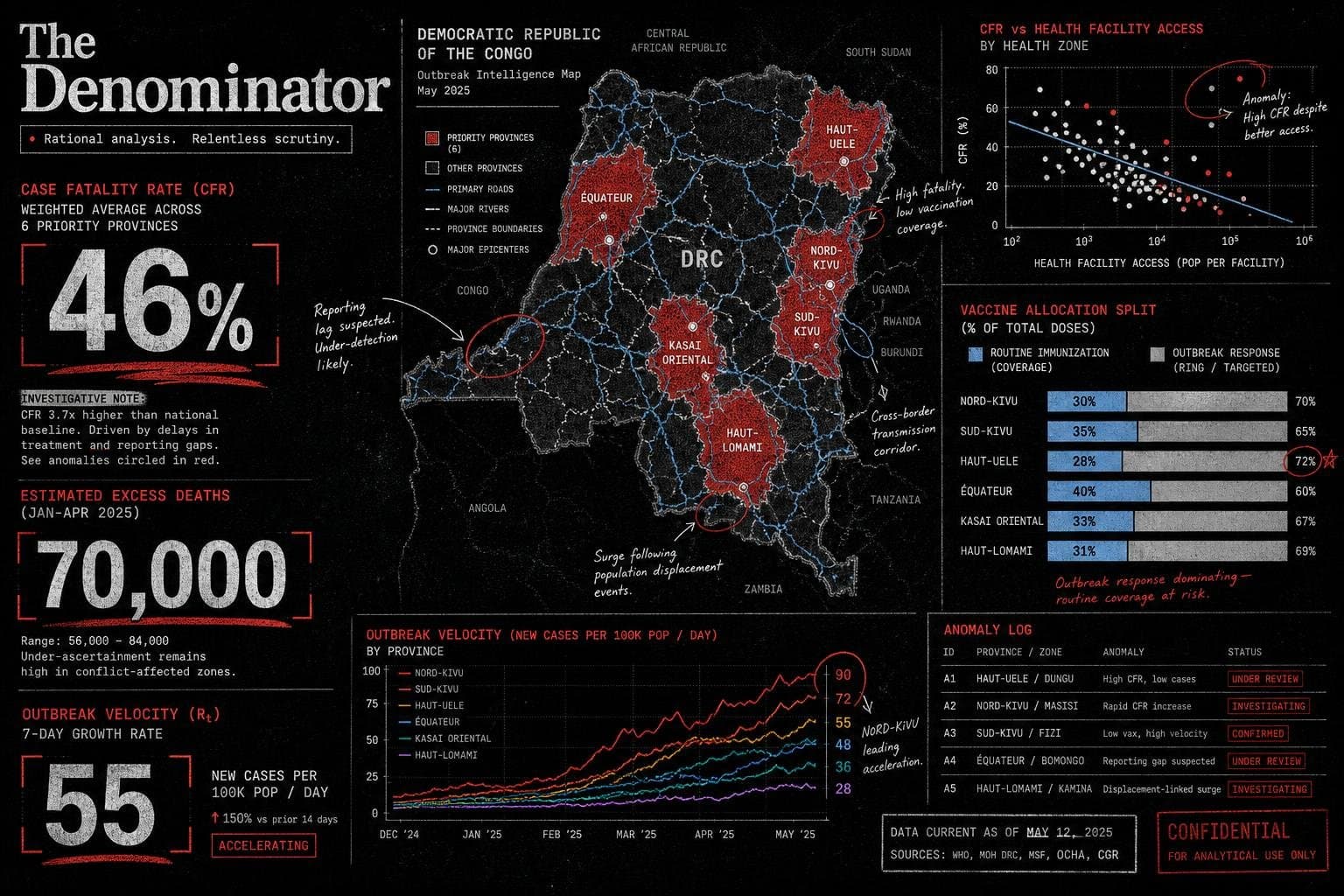

The WHO Director-General called the speed of the current Ebola outbreak in the Democratic Republic of the Congo "unprecedented." That word gets used a lot in public health emergencies, usually as a rhetorical intensifier. Here, it appears to be doing actual descriptive work — and the numbers behind it reveal something that most coverage has missed entirely.
The Headline Numbers Are Real. The Framing Around Them Is Incomplete.
Nearly 5,000 cases. More than 2,300 deaths. Six provinces. Fifty-five health zones. Those figures come directly from WHO Director-General Tedros Adhanom Ghebreyesus's opening remarks at the second IHR Emergency Committee meeting on August 18, 2026 — three months after he declared a Public Health Emergency of International Concern.
The case fatality rate implied by those numbers is roughly 46%, consistent with what I noted in the August 14 issue when the CFR had just crossed 45.9%. That figure hasn't moved much. What has moved is everything around it.
The DG described this outbreak as already the second-largest Ebola epidemic in recorded history, and noted that no previous outbreak had spread at this speed. That's a specific, falsifiable claim — and it's coming from the person chairing the global response, not a press release. It deserves to be taken seriously.
But here's the thing about a 46% CFR: it's only as reliable as the denominator. And the DG was unusually candid about the denominator problem embedded in this outbreak. Many of the dead, he said, are dying at home, in communities, outside treatment centers — and many of those deaths are not appearing in the contact-tracing lists. Every such death, in his framing, represents a transmission chain that hasn't been found yet.
That's not a minor methodological footnote. It means the confirmed case count is almost certainly an undercount, and the CFR — calculated as deaths divided by confirmed cases — could be moving in either direction as undercounting resolves. If there are many undetected mild or moderate cases, the true CFR is lower than 46%. If the deaths at home are being captured but the surviving cases aren't, the true CFR could be higher. The data, right now, cannot tell us which.
The Vaccine Allocation Reveals a Second Layer of Uncertainty
On August 20, WHO and Africa CDC announced that the International Coordinating Group on Vaccine Provision had approved an initial release of 70,000 doses of the Ervebo vaccine to the DRC.
The split matters: 20,000 doses for a Phase 3 clinical trial, and 50,000 doses for frontline and health workers under current SAGE recommendations.
That clinical trial isn't a formality. The WHO statement is explicit: "It is not known whether Ervebo may be protective against the Bundibugyo virus in humans." Ervebo is licensed and recommended for Ebola virus disease — specifically the Zaire ebolavirus strain. The current outbreak is caused by the Bundibugyo virus, a related but distinct pathogen. Early laboratory and animal data suggest some cross-protection may exist. But "may provide some protection" in animal models is a long way from "works in humans during an active outbreak."
This is a genuinely unusual situation. The global community is deploying a vaccine at scale — 50,000 doses to frontline workers — while simultaneously running a trial to determine whether that vaccine does anything against the pathogen in question. The WHO statement is careful to note that people receiving the vaccine must be informed of "the risks, potential benefits and limitations" and must provide informed consent. That's the right call. It's also a signal that the evidentiary basis for the 50,000-dose deployment is weaker than the deployment's scale might suggest.
None of this means the decision is wrong. In an outbreak spreading at unprecedented speed, with a 46%-ish CFR and no confirmed effective countermeasure, deploying a vaccine with plausible cross-protection while simultaneously testing it is a defensible risk calculus. But the coverage of this announcement has largely treated the vaccine allocation as straightforwardly good news — "vaccines arrive" — without noting that the vaccine's efficacy against this specific virus is currently unknown.
The Spread Pattern Is the Number That Deserves More Attention
The DG's remarks named the drivers of spread with unusual specificity: armed conflict, population displacement, and high-volume movement along roads, rivers, and gold-mining areas. Six provinces. Fifty-five health zones.
Compare that to the 2014-2016 West Africa outbreak, which was the largest Ebola epidemic in history by case count and which spread primarily through Guinea, Sierra Leone, and Liberia — three countries with porous borders and weak health infrastructure. That outbreak took months to reach its geographic extent. The current DRC outbreak, the DG says, is spreading faster than any previous one, and it's doing so within a single country's borders — which means the geographic spread is happening across internal administrative zones, not international crossings.
The DG noted that Uganda successfully interrupted transmission after an importation, and that France detected an imported case last month. The international dimension is real. But the primary driver of scale right now appears to be internal spread within DRC, accelerated by the specific mobility patterns of conflict-affected and resource-extraction regions.
This matters for how you read the case numbers. An outbreak concentrated in a few urban centers with functioning health systems looks very different from one distributed across 55 health zones, many of them in areas where contact tracing is structurally difficult. The 5,000-case figure is a single number sitting on top of a very heterogeneous geographic reality. Some of those health zones may have the outbreak largely contained. Others may have chains of transmission that haven't been detected at all. The aggregate count doesn't tell you which is which.
What the Employment Cost Index Has to Do With Any of This
Nothing, directly. But I want to use the contrast to make a methodological point.
The BLS Employment Cost Index for Q2 2026 shows civilian worker compensation up 3.4% over the 12 months ended June 2026, not seasonally adjusted. In constant dollars — adjusting for inflation — that same 12-month compensation growth is -0.1%. Wages and salaries for private industry workers: up 3.1% in nominal terms, down 0.4% in real terms over the same period.
That's a clean, well-constructed dataset. The BLS publishes the methodology, the sample construction, the seasonal adjustment approach. You can check the denominators. You can see exactly what's being measured and what isn't. The ECI covers civilian workers excluding farms, and it's designed to hold the composition of employment constant so you're measuring price changes in labor, not shifts in who's working.
The Bundibugyo outbreak data is nothing like that. It's a count produced under active emergency conditions, in a conflict-affected region, where the DG himself is telling you that the denominator is leaking — people dying outside the surveillance system, transmission chains undetected. The 46% CFR and the ~5,000 case count are real numbers in the sense that they represent real people. They are not reliable numbers in the sense that they accurately capture the full scope of what's happening.
This distinction — real versus reliable — is one that outbreak reporting almost never makes explicit. A number can come from a legitimate source, represent genuine events, and still be systematically incomplete in ways that matter for interpretation. The WHO is not hiding anything here; the DG is being more candid about data limitations than most public health officials in his position would be. But the headlines that will run on these numbers won't carry that candor with them.
The Forward View: Three Numbers to Watch
The DG's August 18 remarks were delivered to the second IHR Emergency Committee meeting — the body that advises on whether the PHEIC designation should be maintained, modified, or ended. The committee's recommendations haven't been published in the available sources, but the fact that a second meeting was convened three months into the PHEIC, with the DG describing the outbreak as still far from controlled, suggests the designation is not going anywhere soon.
Three numbers will tell you whether the situation is actually improving:
The health-zone count. Fifty-five health zones across six provinces is the current spread. If that number stops growing, it signals that geographic expansion is slowing. If it keeps climbing, the outbreak is still in its expansion phase regardless of what happens to the case count.
The community-death fraction. The DG flagged deaths outside treatment centers as the key surveillance gap. If the response can get that fraction down — more deaths occurring in monitored settings — the case count becomes more reliable, and the CFR estimate stabilizes. Right now, the community-death fraction is unknown, which means the CFR is floating on an uncertain base.
The Phase 3 trial interim results. The 20,000-dose Ervebo trial is the most important piece of evidence that doesn't yet exist. If interim data show cross-protection against Bundibugyo virus, the 50,000-dose frontline deployment looks prescient. If they don't, the response will need to pivot — and the window for that pivot is narrow in an outbreak moving at this speed.
The DG said it plainly: "We are still trying to catch up." That's not a rhetorical hedge. It's a description of where the response stands relative to the epidemic curve. The numbers will tell us when that changes. Watch the denominators.


