



When a disease outbreak produces a case count, that number is almost never the actual number. It's the number of people who got tested, reported, and logged. The gap between those two figures is the story.
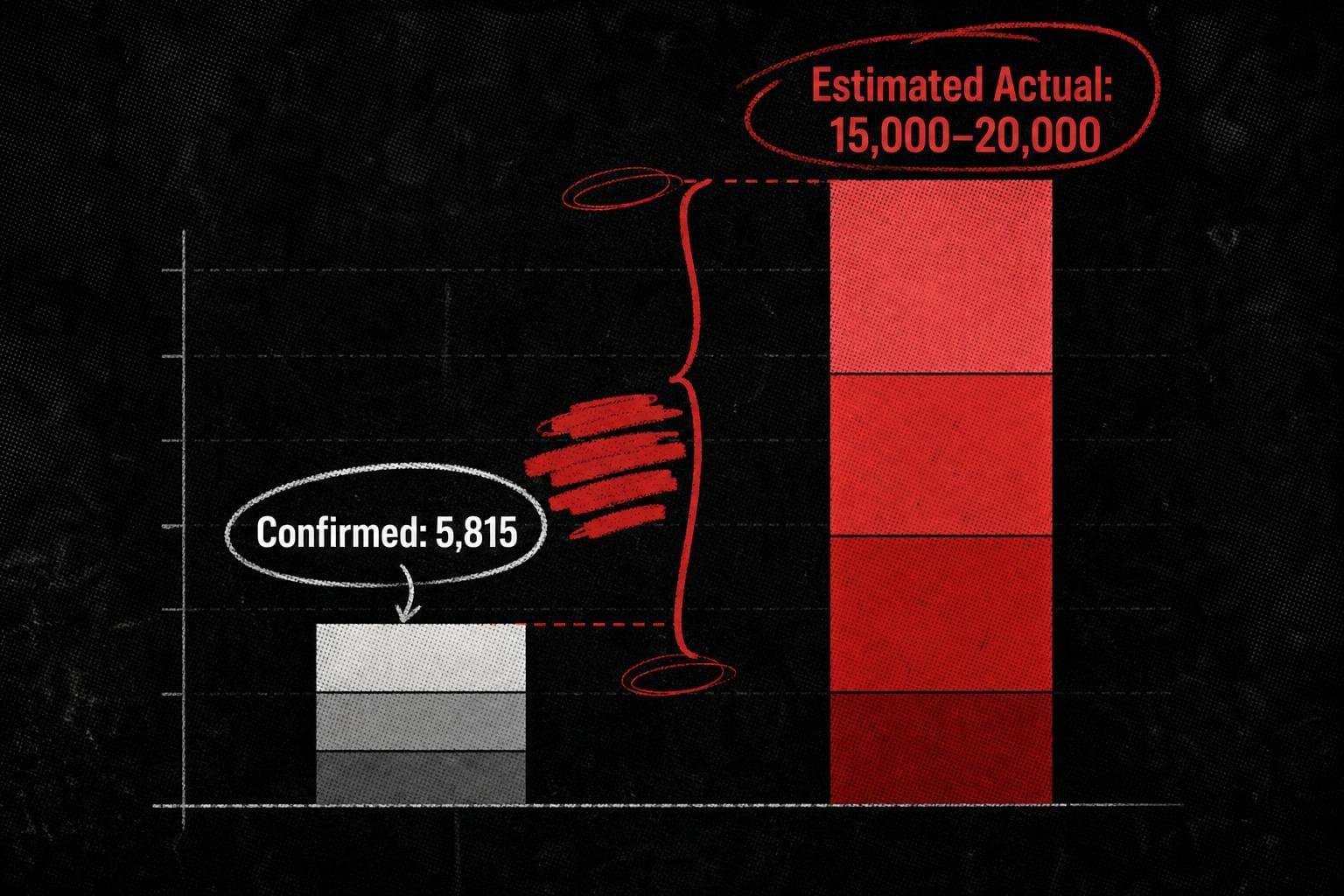
The WHO's latest Disease Outbreak News puts cumulative confirmed Bundibugyo virus disease cases in the Democratic Republic of the Congo at 5,815 as of August 26, with 2,788 deaths. That's a case fatality rate of roughly 48% — alarming on its own. But the more important number is buried in the IHR Emergency Committee's meeting report from August 18: available modeling suggests the true infection count may be three to four times higher than confirmed cases.
That's not a footnote. That's the denominator problem.
The Confirmed Count Is a Surveillance Artifact, Not a Disease Count
If the modeling range holds — and the Committee flagged it as a serious concern, not a speculative aside — the actual infection burden in the DRC could be somewhere between roughly 15,000 and 20,000 cases. The 5,815 figure reflects who got found, not who got sick. In a country where the highest-transmission zones substantially overlap with active armed conflict, population displacement, and constrained humanitarian access, the gap between "confirmed" and "actual" is structurally guaranteed to be large.
This matters for how you read every downstream statistic. The 48% case fatality rate is almost certainly inflated — severe cases are more likely to reach a testing facility than mild ones, so the confirmed pool skews toward people who are sicker. The real CFR is probably lower. The outbreak's geographic spread is also likely underestimated for the same reason: cases in areas with no surveillance infrastructure simply don't appear in the count.
The Committee's language is worth sitting with: without a rapid change in trajectory, this epidemic risks exceeding the scale of the 2013–2016 West Africa Ebola outbreak — the largest in recorded history. That comparison is being made against a confirmed count that the same committee believes may represent only a quarter of actual infections.
Watch the ratio between confirmed cases and recoveries as vaccination of health workers expands in Kisangani. The WHO has flagged that Ervebo — effective against Ebola virus disease — has unknown efficacy against Bundibugyo virus specifically, making the clinical trial running alongside deployment the actual data source to track. The confirmed count will keep climbing. The question is whether the surveillance gap narrows with it.