


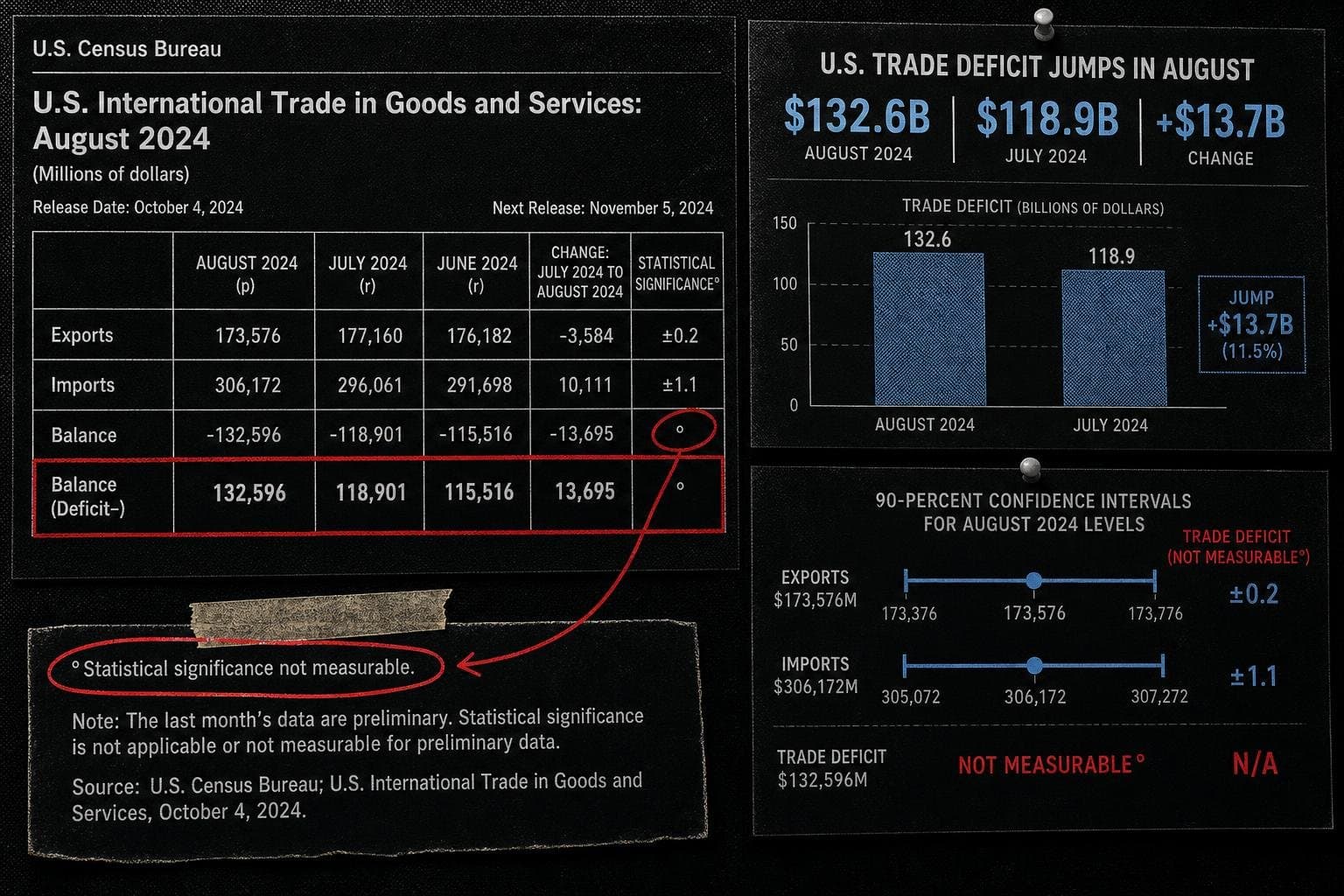

Here's a gift for anyone who wants to stop reading press releases: the Census Bureau just published a headline figure and then, in the same document, told you not to trust it.
The number: the U.S. goods trade deficit widened to $132.6 billion in August 2026, up from $118.9 billion in July — a jump of $13.7 billion, or roughly 11.5% month over month, according to the Census Bureau's Advance Economic Indicators Report. Exports rose modestly, to $203.4 billion. Imports did the heavy lifting, climbing to $336.1 billion.
The catch: that 11.5% figure carries a degree symbol in the source table, and the footnote reads: "Statistical significance is not applicable or not measurable." Compare that to the wholesale and retail inventory lines in the same release, which do get proper confidence intervals — wholesale inventories up 0.7% (±0.2 percentage points) month over month and 6.6% (±1.1 points) year over year; retail inventories up 0.3% (±0.2 points) and 4.8% (±0.7 points) year over year. Census built error bars for the inventory numbers and explicitly declined to for the trade figure. A newsroom running "trade gap jumps 11.5%" as a clean headline is reporting a number its own source agency won't vouch for statistically.
This is the same series I've flagged before over its May-to-year-to-date mismatch. The pattern holds: single-month trade swings make dramatic headlines and tell you almost nothing about trend. The next advance report, covering September, is due October 28, 2026 — that's the one to watch for whether August was noise or the start of something.
Three other numbers worth a second look this week
Kenya's first imported Bundibugyo case, and why "first" matters. Kenya confirmed its first case of Bundibugyo virus disease on October 6, 2026, in a patient who fell ill in the Democratic Republic of Congo, traveled through Uganda, and died within days of arriving in Nairobi, per the WHO African regional office. That makes Kenya the fourth country to confirm a case in this outbreak cycle, following DRC (ongoing), Uganda (outbreak declared over in August 2026), and a travel-linked case in France in June 2026. One imported case with 28 listed contacts and 23 traced passengers is not a Kenyan outbreak — it's a surveillance system doing exactly what it's supposed to do. The denominator here is contacts monitored, not cases confirmed, and it's worth watching whether that 28 grows.
The detention stat with a built-in correlation trap. ProPublica's tally of more than 500 documented cases of U.S. citizens detained during immigration enforcement includes a specific internal check worth isolating: of the more than 300 Americans tracked as detained for allegedly assaulting or obstructing agents, fewer than half were actually charged in federal court, and many of those charges were later dropped, per ProPublica's investigation. That's an observational tally, not a survey or audited dataset — it's built case by case from public records and reporting. The charge-rate denominator matters because "detained for assaulting an officer" and "charged with assaulting an officer" are different claims, and conflating them inflates the apparent justification rate for the stops.
Life expectancy "recovered" — to a number still below 2019. WHO's new Global Health Estimates put global life expectancy at 73.3 years in 2023, just short of the 73.4-year mark from 2019, while healthy life expectancy sits at 62.8 years, still 0.4 years below its pre-pandemic level, according to WHO. Meanwhile noncommunicable diseases rose from 58% of global deaths in 2000 to 74% in 2023. That's a 23-year window, not a single-year shift, and it reflects a structural transition in disease burden as populations age — not a sudden deterioration in health systems.
Watch the September trade report on October 28. Watch whether Kenya's contact list stays at 28. Both are small numbers now. Small numbers are where the good denominators live before anyone's had the chance to round them off.