



The headline from the August employment situation was easy to write: unemployment rate unchanged at 4.1%, 569,000 net new employed persons, participation rate ticking up 0.2 points to 61.6%. Fine. Stable. Moving on.
Don't move on yet.
The Number Buried in the Duration Table
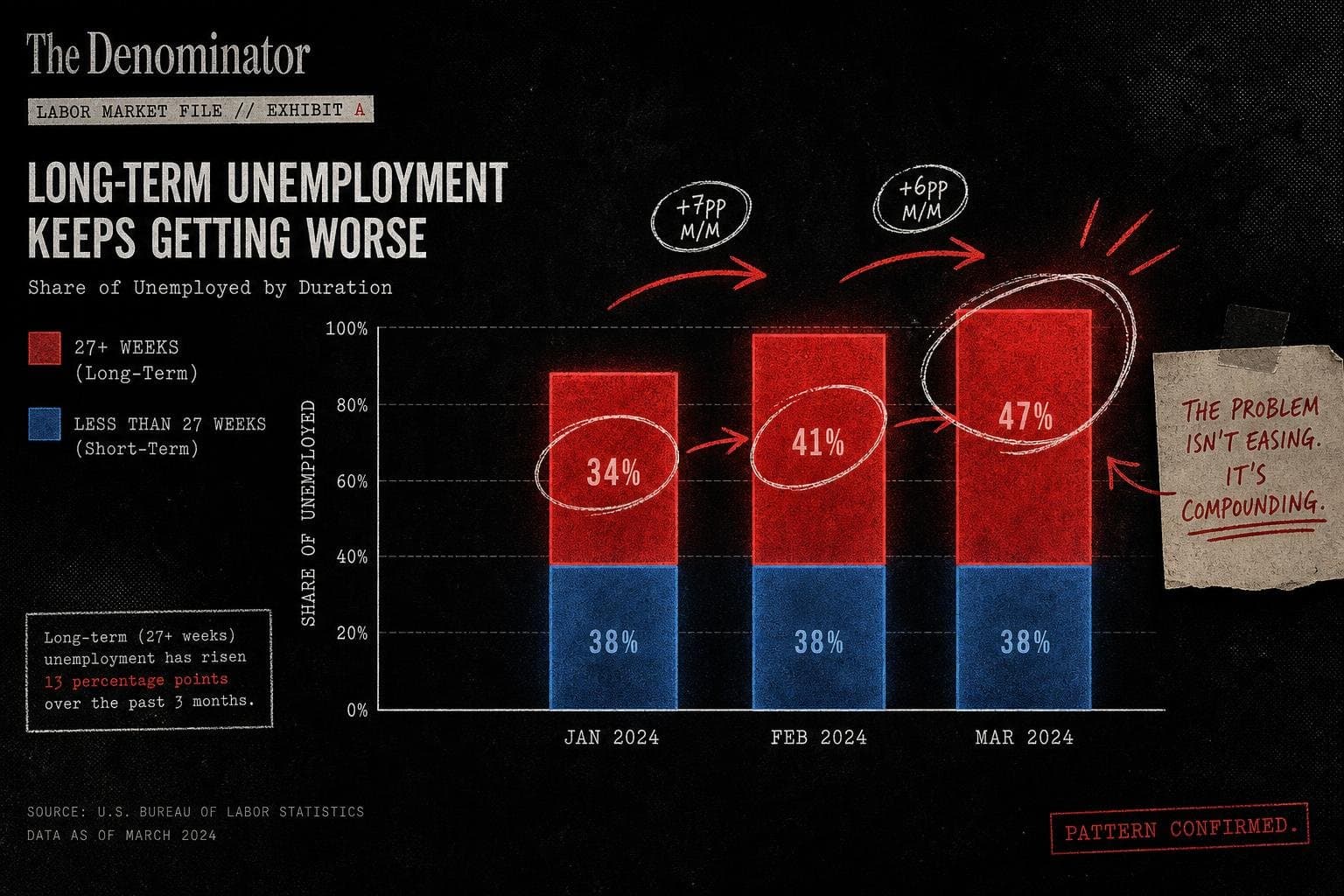
When I wrote about the August jobs report two weeks ago, I flagged that 1,930,000 people had been unemployed for 27 weeks or longer — the long-term threshold that economists treat as a structural warning sign rather than a cyclical blip. That number deserves a second look now that we have the full household table in front of us.
Here's the context the headline skips: total unemployment in August stood at 7,031,000. The long-term unemployed — those 27 weeks and over — accounted for 1,930,000 of that total. That's 27.4% of all unemployed persons sitting in the hardest-to-exit category, up from 1,771,000 in July (25.6% of that month's unemployed pool).
One month's move doesn't make a trend. But the direction matters: short-term unemployment (under 5 weeks) barely budged, rising from 1,960,000 to 2,000,000. The churn at the top of the funnel looks normal. The accumulation at the bottom does not.
The reason this asymmetry is worth watching: aggregate unemployment rates are weighted averages, and a stable headline rate can coexist with a worsening composition. If short-duration unemployment stays flat while long-duration unemployment grows, the rate holds — but the people inside it are increasingly those for whom re-employment is hardest. Job losers and people who completed temporary jobs actually fell month-over-month, from 3,309,000 to 3,245,000. Job leavers jumped from 793,000 to 914,000. That's a different kind of churn than a layoff wave.
None of this is catastrophic. A 4.1% unemployment rate with 27% of the unemployed in long-term status is not a crisis number. But "compared to what?" is always the right question, and the comparison that matters here is internal: the long-term share was lower in June (1,937,000 out of 7,094,000 total, or 27.3%) and lower still in July (25.6%). Three months of data is not a trend. It is, however, a denominator worth watching every month until it isn't.
The next jobs release will tell us whether August's long-term figure was noise or signal. That's the number to pull first.