



The headline from last week's Bureau of Labor Statistics employment release was reassuring enough: the unemployment rate held at 4.1% in August, unchanged from July. Payrolls came in, participation ticked up slightly. The kind of report that gets summarized as "steady" and then forgotten by the afternoon news cycle.
That's the wrong place to stop reading.
The Number That Moved in the Wrong Direction
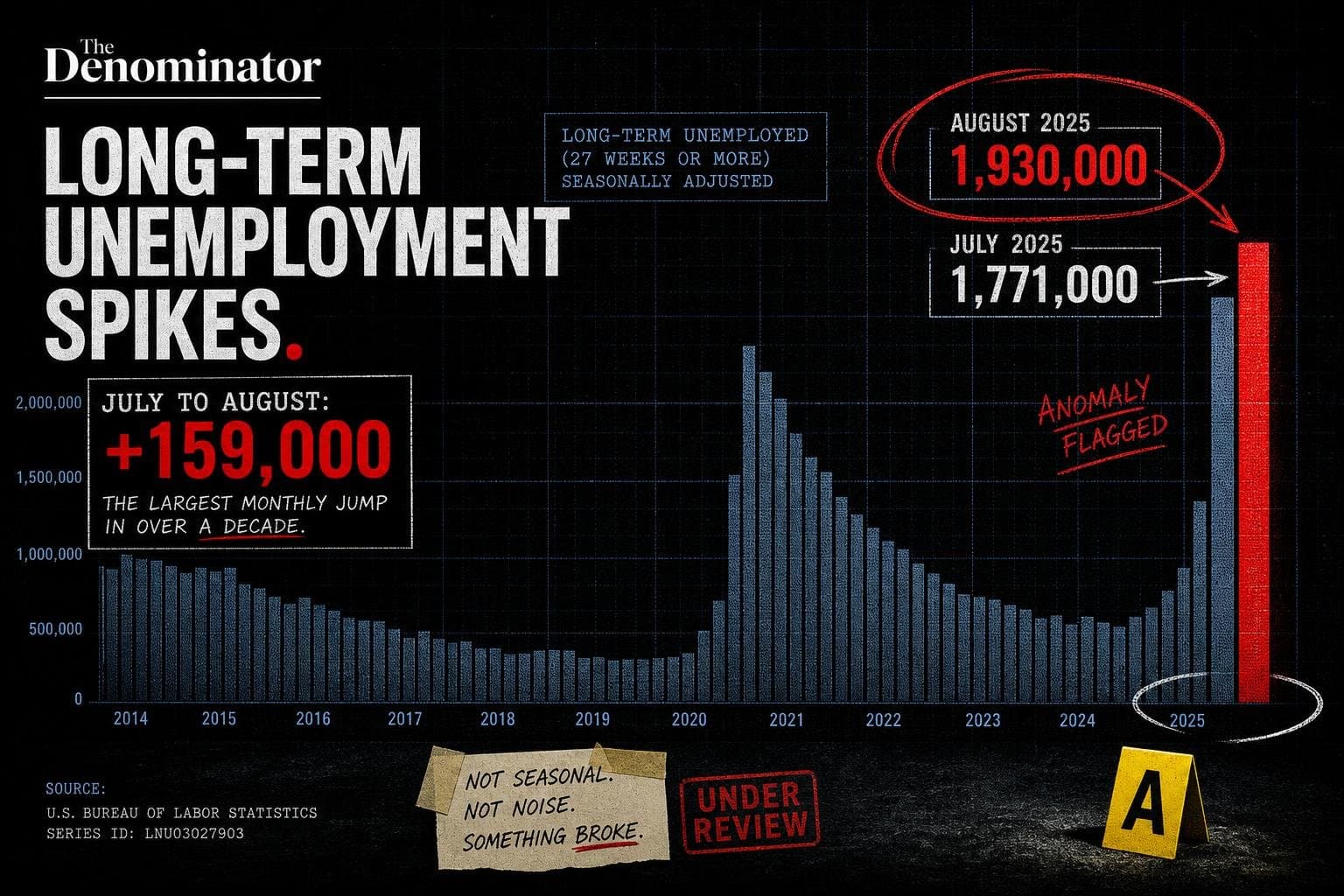
Buried in Table A of the August employment situation release is a figure that deserves more attention than it's getting: the count of people unemployed for 27 weeks or more — the standard BLS definition of long-term unemployment — jumped from 1,771,000 in July to 1,930,000 in August, an increase of 159,000 in a single month.
To put that in context: the total number of unemployed people in August was 7,031,000. That means long-term unemployed workers now account for roughly 27.5% of all unemployed people — more than one in four. That's not a rounding error. That's a structural signal hiding inside a stable headline rate.
I wrote about this exact figure after the July report — the 1,930,000 long-term unemployed was the number I flagged as deserving scrutiny then, and now it's confirmed in the August data. It didn't improve. It got worse.
What the Headline Rate Conceals
The 4.1% unemployment rate is a real number. It's not wrong. But it's a snapshot of a stock — people currently without work — and it treats a person unemployed for three weeks the same as someone unemployed for eight months. The denominator is the civilian labor force (169,777,000 in August), and the rate tells you the share of that labor force currently looking for work without finding it.
What it doesn't tell you is how long they've been looking.
The long-term unemployment count does. And when that number spikes by 159,000 in a month while the headline rate stays flat, it means the composition of unemployment is shifting — fewer short-term job losers cycling back into work, more people accumulating duration. That's a different economic story than "steady labor market."
There's a parallel signal in the job leavers category: people who voluntarily quit and are now unemployed rose from 793,000 in July to 914,000 in August — an increase of 121,000. Voluntary quits among the unemployed rising while long-term unemployment also rises is an unusual combination. It could mean workers are confident enough to quit but finding the landing harder than expected. It could mean something else. The data doesn't tell us which. What it does tell us is that the internals are moving in ways the headline rate obscures.
The Comparison That Actually Matters
The August 2026 long-term unemployment count of 1,930,000 compares to 1,924,000 in August 2025 — essentially flat year-over-year. That's the number that should anchor any trend claim. Anyone arguing that long-term unemployment is "surging" relative to a year ago doesn't have the data to support it. Anyone arguing the labor market is uniformly healthy because the headline rate is 4.1% is ignoring a subpopulation of nearly two million people who have been searching for work for more than six months.
Neither framing is honest. The honest framing is: long-term unemployment is elevated relative to the pre-pandemic baseline, has been stubbornly resistant to improvement even as headline unemployment fell, and just posted its largest single-month increase in the current data window — from 1,771,000 to 1,930,000 between July and August 2026.
That's a trend direction with a time window attached. That's what a claim about labor market conditions should look like.
What to Watch in September
The September employment situation release will tell us whether August's long-term unemployment spike was noise or signal. If the 27-weeks-and-over count retreats toward 1,771,000, it's probably statistical churn — the BLS household survey has meaningful month-to-month variance, and a single-month move doesn't establish a trend. If it holds above 1,900,000 or rises further, the story changes.
The participation rate is the other number worth tracking. August came in at 61.6%, up 0.2 points from July but still well below the 62.3% recorded in August 2025. The civilian noninstitutional population grew by 133,000 between July and August; the labor force grew by 683,000. That's a healthy ratio — more people entering the workforce than the population is adding. But participation has been running a full percentage point below year-ago levels for months now, and the people not in the labor force (105,638,000 in August) are not counted in the unemployment rate at all.
The 4.1% headline is the number that moves markets and shapes policy conversations. The 1,930,000 is the number that describes what's actually happening to the people the labor market is leaving behind. Both are in the same BLS release. One of them is getting reported.