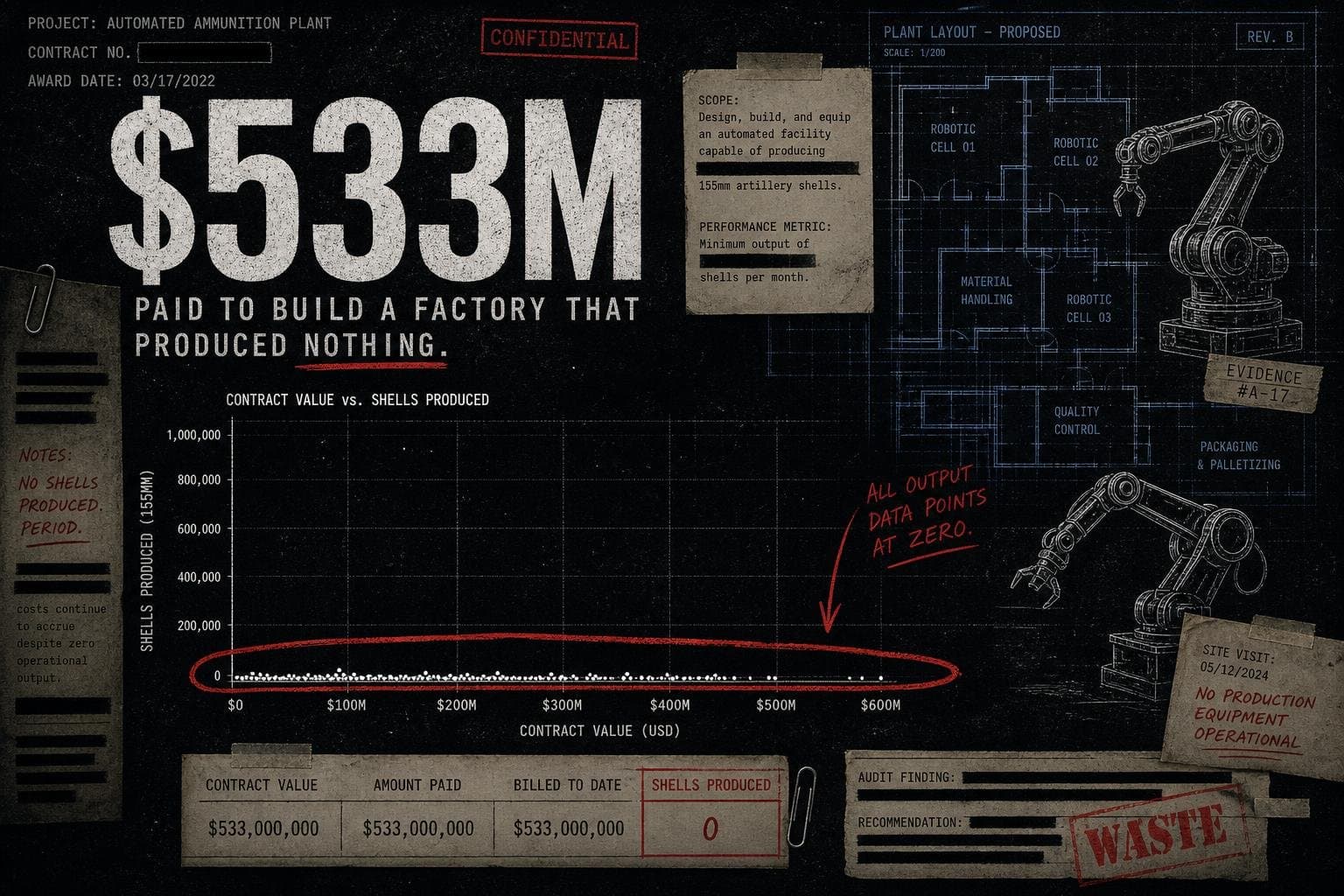

The number circulating in defense coverage is $533 million. That's the contract value the U.S. Army paid General Dynamics for an artillery factory in Texas that, according to ProPublica's investigation, produced not a single usable shell.
Stop there. Because "$533 million wasted" is doing a lot of rhetorical work, and the interesting question — as always — is: compared to what?
What the $533 Million Actually Bought (and Didn't)
Here's what ProPublica's reporting documents, based on interviews with 36 people across the Army, Pentagon, General Dynamics, and the White House, plus internal company documents, photos, and video:
- Robot arms caught fire. The factory's signature device repeatedly cracked the steel meant for artillery shells.
- Workers used sledgehammers on machines to try to make them function. The machines still failed.
- The result: Nearly every shell was botched. One former Army official described the project as an "absolute disaster."
- General Dynamics' position: The company claims it "met or exceeded requirements," per a Department of Defense inspector general report. It told ProPublica the reporting "fundamentally mischaracterizes the circumstances" but did not specify which claims were wrong.
- The Army's position: It exercises "rigorous oversight" and is "evaluating contract performance, seeking recoupment of funds."
That last phrase — "seeking recoupment" — is the denominator problem hiding in plain sight. Seeking recoupment is not recoupment. The Army has not said how much it expects to recover, over what timeline, or through what mechanism.
Three Statistical Traps in How This Story Gets Reported
1. The "wasted" framing skips the counterfactual.
$533 million for zero shells is a genuine failure. But the claim that it was "wasted" implies a clear alternative existed. The context — a rushed effort to arm Ukraine with artillery shells amid a production shortage — matters for evaluating the decision at the time. That doesn't excuse the execution failure, but it changes the denominator for "what should have happened."
2. The recoupment claim is unquantified.
"Seeking recoupment" is a press-release number waiting to happen. Watch for future headlines claiming the Army "recovered" some fraction of the $533 million — and check whether that figure accounts for legal costs, time value, and the opportunity cost of the production gap. A $50 million settlement on a $533 million loss is not "recoupment." For context on how defense procurement costs ripple through the broader economy, the BLS Productivity and Costs release for Q2 2026 is a useful baseline for what "unit labor costs" actually look like in domestic manufacturing — the gap between contracted expectations and realized output is rarely just a management story.
3. General Dynamics' "met or exceeded requirements" claim is sourced to a DoD IG report — but the factory produced zero usable shells.
These two facts cannot both be true in any operationally meaningful sense. Either the requirements were written in a way that didn't require functional shells (a contracting failure), or the IG report's framing is doing something unusual. ProPublica's reporting doesn't resolve this contradiction — which is itself the story. When a contractor claims compliance and the product doesn't work, the question is always: what did the contract actually specify?
What to Watch For
The Army's "recoupment" language will generate a follow-on number. When it does, apply the standard filters:
- Base rate: Recoupment as a percentage of the $533 million contract value — not as a raw dollar figure.
- Timeline: Over how many years? A $100 million recovery spread over a decade has a very different present value than one paid immediately.
- Comparison: What's the historical recoupment rate on failed defense contracts of similar scale? The DoD inspector general's office tracks this; those reports are public. For cross-country context on how governments account for revenue losses from failed public expenditures, the OECD's Global Revenue Statistics Database offers a useful comparative frame — even if U.S. defense contracting sits in its own accounting universe.
- Opportunity cost: How many shells weren't produced during the gap, and what did the Army pay to source them elsewhere?
The $533 million figure is real. The "disaster" framing is well-supported by [ProPubl


