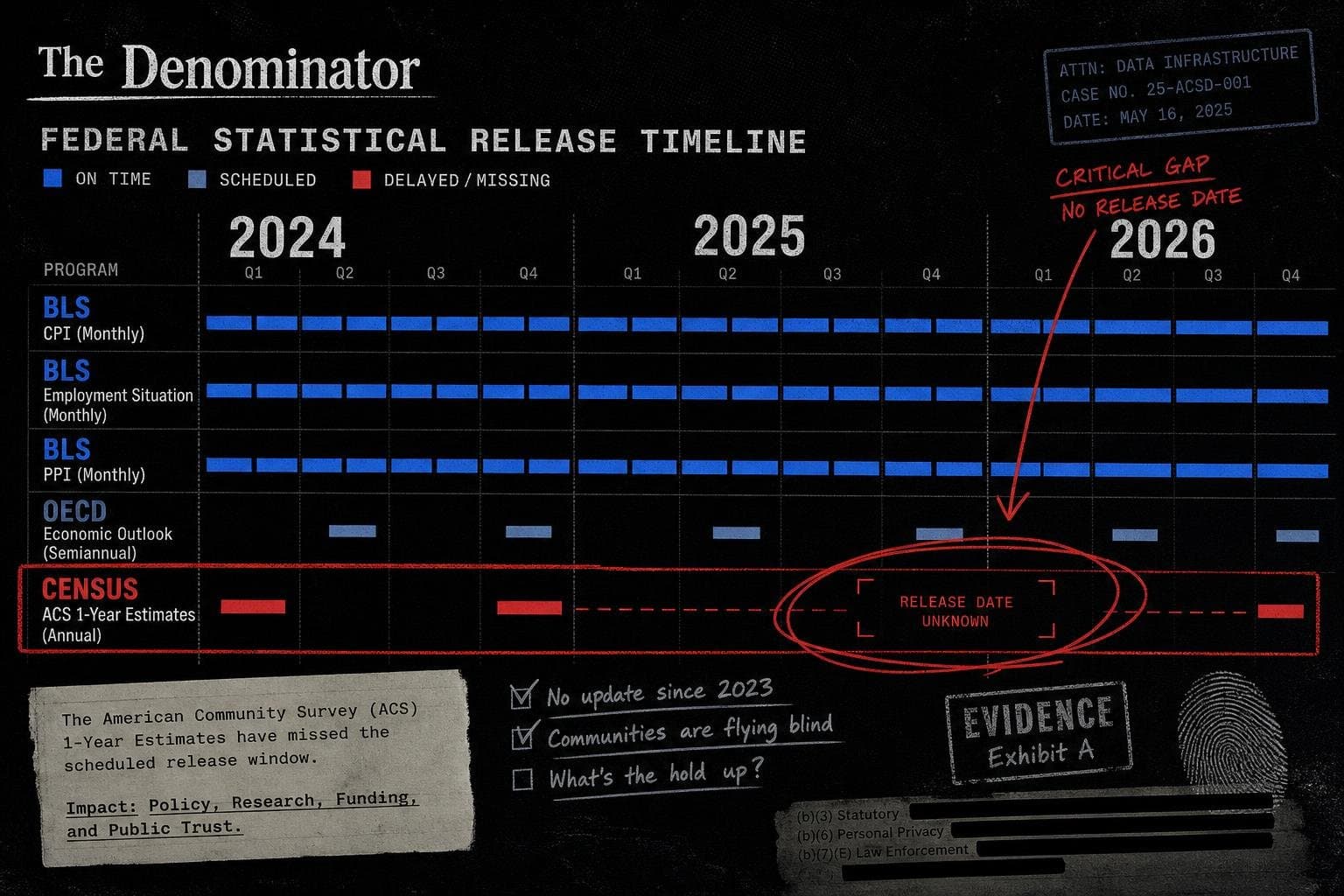

The Census Bureau just announced that the 2025 American Community Survey 1-year estimates — the most current, granular portrait of who Americans are and how they live — have no release date. Not "delayed until September." Not "pushed to Q4." No date at all.
The stated reason: the Bureau is "assessing the impact" of a new departmental administrative order on disclosure avoidance and "seeking DAO-compliant solutions." That's the kind of sentence that sounds like a technical footnote and functions like a policy earthquake.
What the ACS Actually Is — and Why the Delay Isn't Trivial
The American Community Survey is the federal government's continuous demographic survey, fielding questions to roughly 3.5 million households annually. It's the source that tells you median household income by county, educational attainment by zip code, commute times by metro area, disability rates by age cohort. It's the denominator for an enormous share of public policy math.
When someone cites a statistic about wage gaps, housing affordability, or immigrant workforce participation — there's a reasonable chance it traces back to ACS data. The 1-year estimates are the most timely version: they cover a single calendar year and are released the following fall, making them the freshest available snapshot of current conditions.
The 5-year estimates (which pool five years of data for smaller geographies) are more stable but older. The Census Bureau released the 2020–2024 ACS 5-year PUMS in March 2026 — that's the most recent available. The 1-year estimates would normally be the update that tells you what changed since 2024. Now that update has no scheduled arrival.
The Disclosure Avoidance Problem Is Real. The Opacity Around It Is Not Acceptable.
To be fair to the Bureau: disclosure avoidance is a legitimate statistical concern. The ACS collects sensitive individual-level data, and any public release has to be constructed so that no individual respondent can be identified. The Bureau has been navigating this tension for years, and the underlying methodological challenge is genuine.
But "we are assessing the impact" of a new order — with no timeline, no description of what the order requires, and no indication of what "DAO-compliant solutions" might look like — is not a methodology note. It's a press release written to say as little as possible.
Here's the question the Bureau hasn't answered: does the new departmental order require changes to how the data is released, or does it require changes to what data is collected or retained? Those are categorically different problems with categorically different timelines and implications. One is a formatting challenge. The other is a potential structural change to what the ACS can tell us. The announcement as posted doesn't distinguish between them.
The Downstream Cost Is Measured in Bad Denominators
This is where the abstract becomes concrete. The ACS 1-year estimates are used to allocate federal funding, set program eligibility thresholds, and construct the baseline denominators for dozens of policy analyses. State and local governments use them to plan housing, transportation, and social services. Researchers use them to track whether conditions are improving or worsening for specific populations.
When the 1-year estimates are delayed indefinitely, analysts don't stop working. They use older data. They use the 5-year estimates, which are more stable but less current. They use proxies. And then they publish findings — with denominators that are, at best, a year stale and, at worst, five years stale — without always flagging that the freshest data simply isn't available.
That's how you get a "studies show" problem at the infrastructure level. The issue isn't that individual researchers are being sloppy. It's that the primary data source has a gap, and the gap gets papered over by necessity. The Census Bureau's own economic indicators page flags confidence intervals and sampling variance on its monthly releases — the kind of methodological transparency that makes those numbers usable. The ACS delay announcement offers none of that rigor about its own disruption.
Meanwhile, other statistical agencies are running on schedule. The BLS released the July employment situation on time this month, as did the June JOLTS report — both monthly series with established, automated pipelines. The OECD's August consumer price update dropped on its regular schedule as well. Those are faster-moving series, yes, but the contrast is instructive: the agencies producing the most-cited monthly numbers are running on time. The agency producing the most-cited structural data about who Americans are is not.
Watch for the "DAO-Compliant Solution" Announcement
The thing to track here isn't the delay itself — delays happen. It's what the eventual "solution" looks like. If the Bureau releases the 2025 1-year estimates with modified disclosure avoidance methods, the key question is whether those modifications affect the estimates' comparability to prior years. A change in methodology that breaks the time series is, statistically, a much bigger problem than a delayed release.
The Bureau should publish, at minimum, a technical note explaining what the new DAO requires and how any methodological changes will affect trend comparability. Readers who use ACS data — and that includes most people who work with any social or economic statistics — should be demanding that note now, not after the data drops.
A delayed denominator is a known problem. An altered denominator that nobody flags is the kind of thing that corrupts a decade of trend analysis before anyone notices.


