


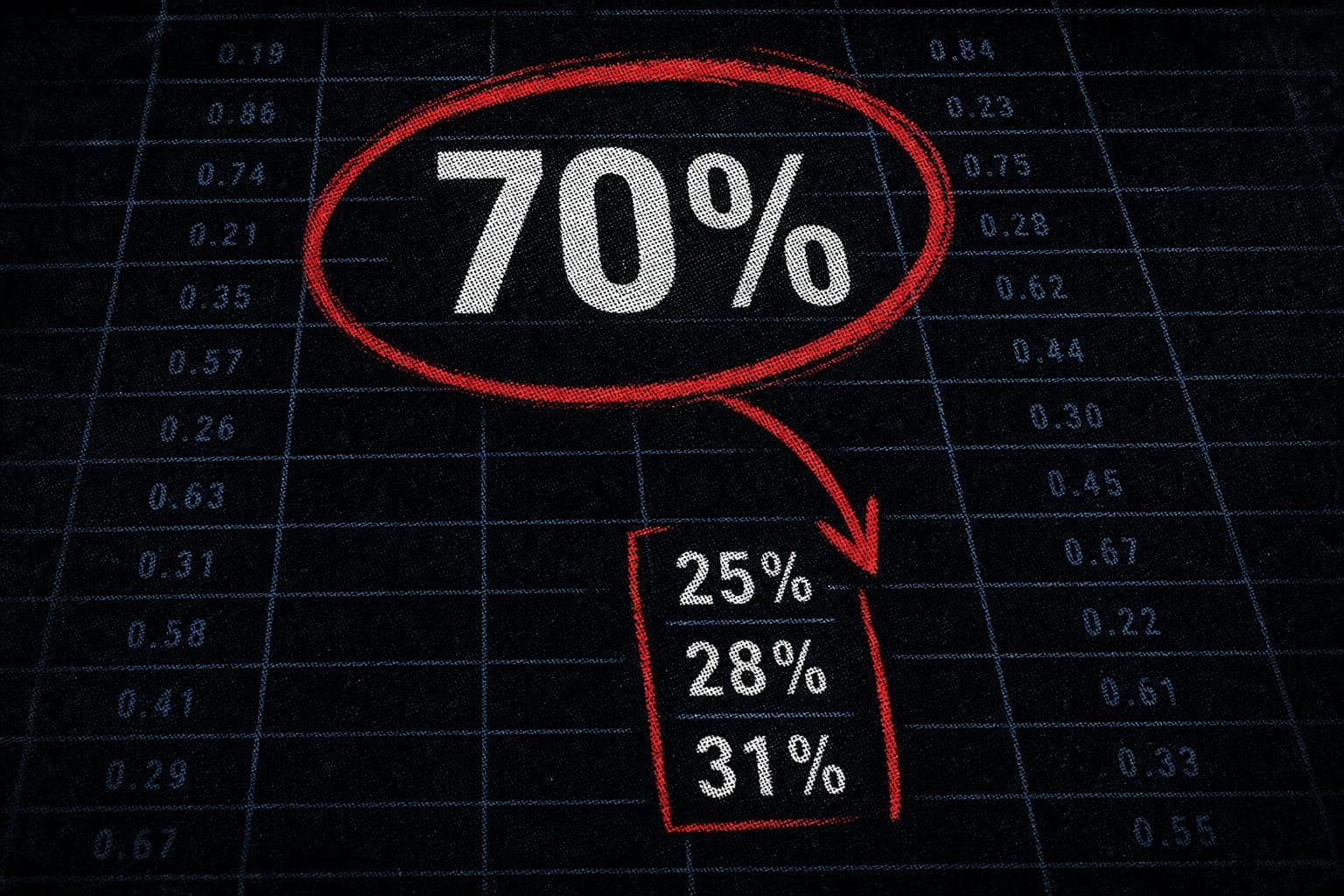

The Headline Number
"More than two-thirds of the public believe at least one false or unproven health claim." — Nature, reporting on the 2026 Edelman Trust Barometer, April 2026
The Audit
The number is everywhere. Seventy percent. Two-thirds. A majority of the public, credulous and misled. It's a clean, alarming figure — the kind that gets screenshot-shared with a caption like "this is why we can't have nice things."
Here's the problem: the methodology is doing most of the work, and nobody's talking about it.
The Edelman Trust Barometer survey polled more than 16,000 people across 16 countries and asked whether they believed six specific health claims — including that childhood vaccines carry more risk than benefit, that fluoride in water is harmful, and that raw milk is healthier than pasteurized. For each individual claim, 25–32% of respondents said they believed it. Another 17–39% said they didn't know.
That last part is load-bearing. The 70% figure is constructed by counting anyone who believed at least one of the six claims. This is a union probability, not an average. When you ask six questions and count anyone who answers "yes" to any of them, you will almost always get a large percentage — that's how union probabilities work. If each claim had exactly 25% agreement and the beliefs were statistically independent, you'd expect roughly 82% of respondents to endorse at least one. The 70% figure is actually lower than a naive probability model would predict, which suggests meaningful overlap among believers — but that's not the story being told.
The framing implies a majority of people are broadly credulous about health misinformation. The data shows something narrower: most people have at least one area of scientific skepticism, which is not the same thing.
What the data actually says:
- Per-claim belief rates: 25–32% (not 70%)
- "Don't know" rates per claim: 17–39% — a substantial uncertainty cohort that gets collapsed into the headline
- The survey has not been peer-reviewed, per Nature's own reporting
- Funding source: Edelman Trust Institute, a communications firm whose business model involves selling trust-repair services to corporations
None of this means the underlying concern is wrong. Vaccine skepticism is real, measurable, and consequential. FactCheck.org documented how a specific false claim — that no childhood vaccines have undergone placebo-controlled trials — has been repeated by prominent figures in ways that misrepresent the actual safety-testing process. That's a genuine problem worth tracking.
But "70% of people believe health misinformation" is a different claim than "25–32% of people endorse any given false health claim." The first sounds like a civilization in freefall. The second sounds like a persistent, serious, tractable public health communication challenge.
Verdict: Misleading. The 70% figure is technically derivable from the data but is constructed to maximize alarm. The per-claim rates are the honest numbers. The survey's non-peer-reviewed status and funder identity are material context that most coverage omitted entirely.
The irony is sharp enough to leave a mark: a report about people being misled by unverified claims is itself generating misleading headlines. The denominator problem doesn't take days off.
By the Numbers
98.2% — The share of maritime drug trafficking Trump claimed has "stopped." AP News traced this to a comparison of two specific months of CBP seizure data (July vs. November 2025) — not a measure of total drug flow, which is unobservable by definition. (I've covered this number twice before; it keeps circulating because the rebuttal is less shareable than the claim.)
14 out of 50+ — Election leaflets in England flagged by Full Fact as misleading or unsourced in their tactical-voting charts, including bar graphs where bar heights don't correspond to the numbers printed on them. The reframe: this isn't a fringe problem — examples came from all major parties.
"No evidence" — The finding of a 2020 American Statistical Association report on mail-in voting and fraud risk, cited by the New York Times in its fact-check of recent claims about mail ballots. The reframe: absence of evidence isn't absence of concern, but it does set the evidentiary bar for anyone claiming otherwise.